
Ukrainian drone operators have destroyed many Russian armored vehicles on the ground and even military helicopters in midair using $400 Shrike drones with explosive payloads. Now thousands of such drones are getting upgraded with an AI system capable of autonomously tracking and homing in on moving targets.
In mid-July, the Ukrainian military began receiving Shrike drones made by the Ukrainian company SkyFall equipped with AI-powered autonomy hardware and software developed by the US company Auterion. The companies plan to deliver 50,000 drones equipped with Auterion’s Skynode S strike kits in the coming months.
That allows human operators to manually fly the Shrike first-person view (FPV) drones into a battlefield area, designate a target up to half a mile away and then “flip the switch to turn it into fire-and-forget terminal guidance mode,” Lorenz Meier, co-founder and CEO of Auterion, told Ars.
The operator can abort a strike or choose a different target as long as they have a radio signal connection with the drone, Meier explained. But the drone can still automatically track and fly into targets without any human guidance, even if it loses its connection with the operator due to buildings or terrain blocking the signal or because of enemy jamming on the same radio frequencies.
To home in on targets, Auterion’s software relies solely on the visual information available from the Shrike drone’s main onboard camera. That means the Shrike drones can track and strike moving targets without any reliance on GPS—a crucial advantage on modern battlefields where GPS jamming has also become common.
That could further enhance the success rate of remotely piloted Shrike drones that have already struck many vehicle-size targets since Russia launched the full-scale invasion of Ukraine in 2022, including armored tanks, electronic warfare systems, artillery guns, and rocket launchers. Shrike drones have reportedly taken down two Russian Mi-28 helicopters, each worth as much as $19 million, according to the Kyiv Independent.
Cost-effective AI for battlefield drones
Until now, the Ukrainian military has mainly relied on human operators to manually guide drones toward their targets, with the exception of mid- or long-range strike drones such as the $5,000 AI-powered “Hornet” drones developed by the California-based company Perennial Autonomy founded by former Google CEO Eric Schmidt. Those drones often fly far beyond the frontlines to target Russian oil refineries and energy infrastructure, factories and warehouses, or even ships in the Sea of Azov and the Black Sea.
But Auterion focused on creating AI-powered capabilities for the cheaper, shorter-range FPV drones that have become the most common weapons responsible for killing or wounding soldiers on the frontlines in Ukraine. The company developed a tightly integrated flight control system and terminal guidance system optimized to run on a Western-made Arm system-on-a-chip costing just $18.
“What we are doing is replacing the existing flight controller—which has no computer, no AI—with avionics that has a microprocessor unit, has AI on board, and can track into the target fully autonomously,” Meier told Ars.
Each of SkyFall’s Shrike drones equipped with such capability costs about $2,000, compared to the $400 Ukrainian drones that rely only on manual piloting, Meier wrote in a blog post.
By comparison, he described Western militaries as still purchasing “precision munitions at six or seven figures per shot (30–60 times this price), drones procured in batches of dozens, priced like exquisite aircraft, delivered on timelines measured in years.”
The 50,000 Shrike drones equipped with Auterion’s strike kit were funded by a $100 million contract backed by an officially unnamed European country. Reuters reported that Germany is the country funding the order, and Meier also disclosed that Auterion’s team based in Munich, Germany, is fulfilling the order.
This is the largest delivery order to date for Auterion. But the company also previously committed to delivering 33,000 drone strike kits to Ukraine in July 2025, with backing from a $50 million Pentagon contract.
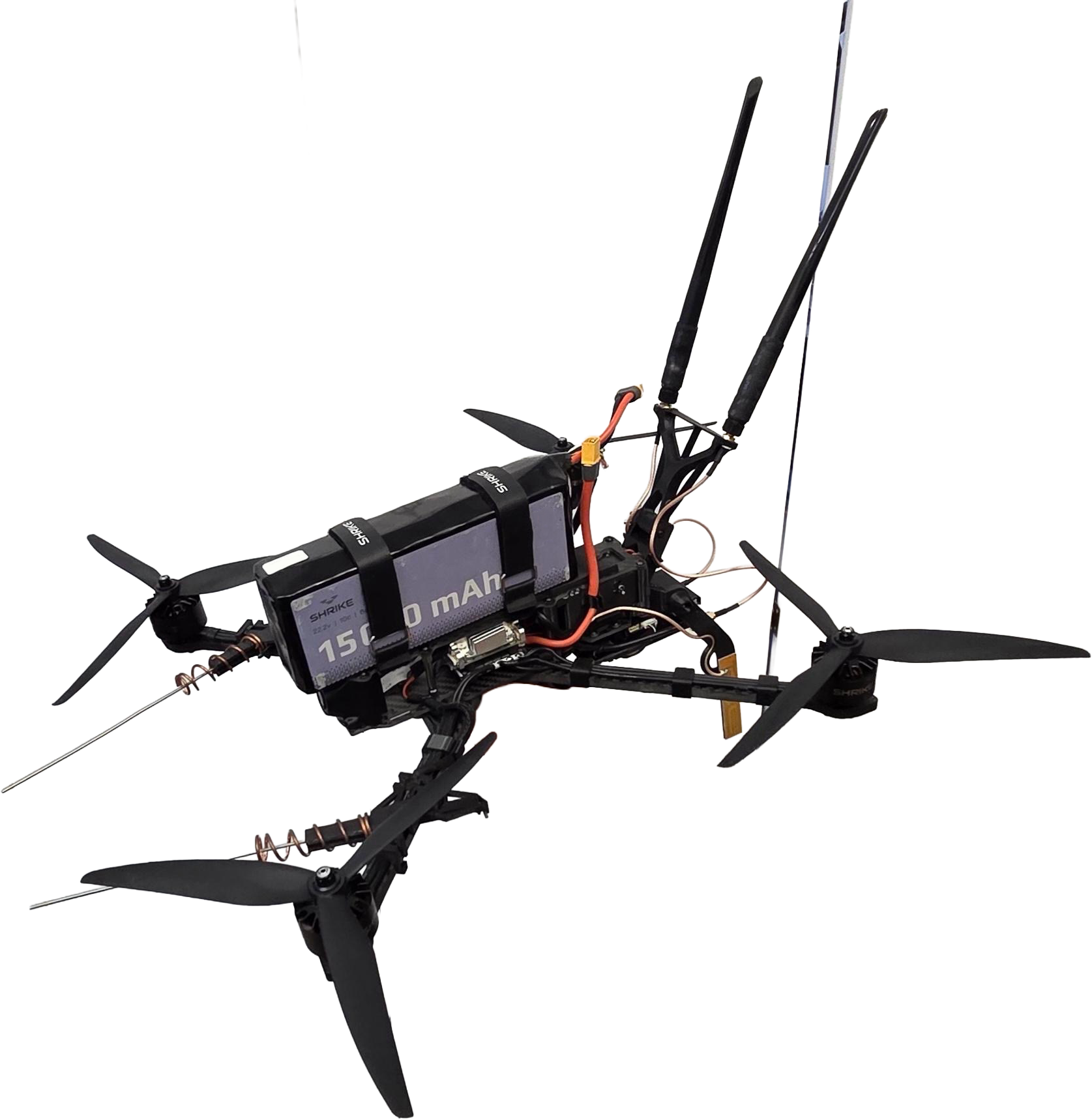
A Shrike FPV drone manufactured by the Ukrainian company SkyFall that can be equipped with Auterion’s AI-powered drone strike kit.
Credit: Auterion | SkyFall
Human control and drone swarms
The drone strike kits would also enable SkyFall’s Shrike drones to receive future software updates that could enable a single human operator to command an autonomous swarm of drones to attack targets.
Auterion did not provide a timeframe for when this might happen. But the company has already demonstrated such drone swarming capability during a live-fire combat exercise at a US military range at Camp Blanding in Florida. The demonstration involved a drone pilot commanding three autonomous strike drones to take out three separate targets.
Such swarm capability provided by Auterion’s Nemyx system means that drones can autonomously work together to prioritize higher-value targets and adjust on the fly as targets are destroyed, so multiple drones aren’t wasted on the same target, Meier explained. That can all happen without any human input after the operator first directs the drone swarm toward a given objective.
“It basically means that you can point one of our swarms at an objective, and you can either decide to point all the munitions at a single target point, or you can actually spread them out from the get-go, and they will reprioritize,” Meier told Ars. “If you kick the swarm into strike mode, the whole thing strikes. If you let it abort, the whole thing aborts.”
The autonomous drone capabilities provided by Auterion’s strike kits also simplify the piloting skill required of human operators—regardless of whether they are piloting a single drone or commanding a swarm. That could help Ukraine’s military deploy more drones using a limited number of drone operators, and could prove even more invaluable for the United States or other countries that don’t yet have large numbers of trained drone operators.
“We found that we can train people within—I’m not kidding—60 seconds to operate this drone and even to operate the swarm, because you just move up and down to steer them in the right direction towards the target,” Meier said. “And when you are close enough to acquire the target, you just select it on the screen.”
The prospect of deploying fully autonomous drones on the battlefield may seem to be creeping closer. But Meier emphasized that Auterion believes in keeping a human in the target selection process.
“I am not sure if our adversaries eventually will allow us that, because they might enter into a way of warfare where we have to send autonomous systems against autonomous systems and let them make split-second decisions,” Meier said. “But until we are at that point, we as a company, and I personally believe, it’s really good if a human operator makes a life-or-death decision.”
Ukraine’s battlefield innovation system
Having visited Ukraine eight times to talk with the country’s top political and military leaders while working alongside Ukrainian drone manufacturers, Meier praised Ukraine for developing a system that enables a rapid cycle of innovation and improvement informed by battlefield experience.
“The Ukrainian forces are relatively accepting of initial battlefield failure,” Meier told Ars. “A lot of the Ukrainian firms didn’t show up with a perfectly working product—they showed up with something that was better than nothing, and then iterated through a lot of failures towards a point where it works every single time.”
Ukraine has also created an effective system for evaluating how well new drones and other weapons perform on the battlefield in terms of hit rates and delivering results of military value, Meier said. That feeds back into the cycle of innovation and has enabled Ukrainian companies to take huge risks in developing drones, robots and other weapons, while learning from failures on how to harden their systems for modern battlefields.
By comparison, the US military’s strict schedule for selecting new drone technologies through the Pentagon’s Drone Dominance program means that companies cannot easily come back several weeks later with a greatly improved product if they fail to make the cut at each selection stage. But Meier described Auterion as being well positioned to bring some lessons learned from Ukrainian battlefields back to compete within the more regimented US system.
The US military will also need the equivalent of a common operating system for its command and control systems to work seamlessly with autonomous drones from many different manufacturers as it looks to eventually deploy thousands of drones, Meier said. He described Auterion’s long-term ambition as creating a software ecosystem that allows various software companies to develop applications for many types of drones from different companies—a vision that draws from his own experience in developing open source software and open hardware standards used in the drone industry.
“You need the autonomy to fold into your command system, which means you need the same operating system, and maybe you can afford to integrate two or three—like there are apps for iOS and Android and I think that’s OK,” Meier said. “But you can’t have 15.”


