
Smartphone LED and AI Detect Hidden Cameras
KAIST's SweepLED achieves 94% accuracy with 10,000 won LED device
By Choi Won-woo
Published 2026.08.30. 12:12Updated 2026.08.31. 11:21
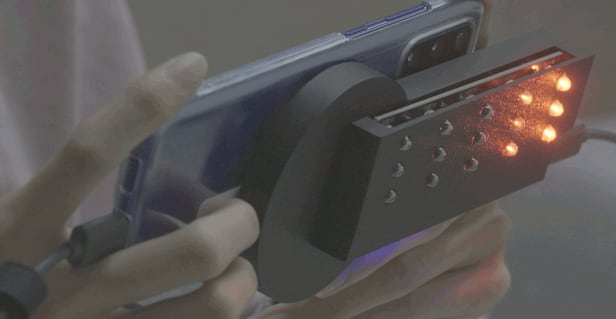
Prototype of the 'hidden camera detector' SweepLED, developed by KAIST researchers, in operation. /KAIST
A technology has been developed to detect illegal hidden cameras in places like hotels and restrooms by simply attaching a 10,000 Korean won light-emitting diode, LED device to a smartphone. Unlike conventional methods of visually identifying lenses, AI, artificial intelligence analyzes light reflection patterns to detect camera lenses within five seconds.
KAIST announced on the 30th that Professor Han Jun’s team from the School of Computing, in collaboration with researchers from the National University of Singapore, NUS, and Singapore Management University, SMU, developed the smartphone-based illegal camera detection technology ‘SweepLED.’ The research results were presented at the international mobile computing conference ‘ACM MobiSys 2026’ in June.
Existing portable hidden camera detectors often required users to manually identify bright spots reflected from camera lenses after illumination. This led to accuracy issues, as users frequently mistook reflections from metal, glass, or glossy plastic for camera lenses.
The research team overcame these limitations with a novel approach. While keeping the smartphone camera fixed, the LED light continuously changes direction, capturing reflection changes on object surfaces. Reflections from typical glossy objects move or disappear based on the light’s direction. In contrast, camera lenses exhibit unique reflection patterns when illuminated from different angles due to their internal structure of multiple lenses, apertures, and image sensors.
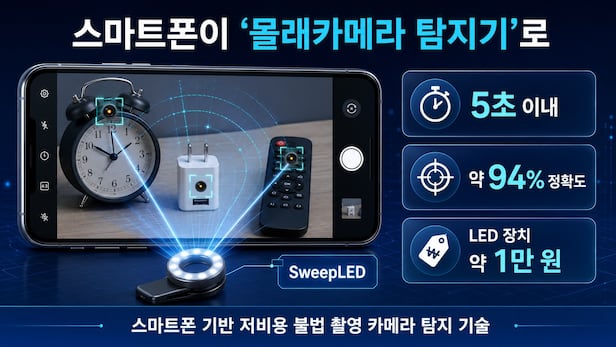
This method analyzes the position and shape of time-varying reflections using deep learning to determine if they originate from camera lenses. Instead of identifying a single bright spot, the AI analyzes the entire pattern of changes when light is shone from multiple directions.
In experiments on 30 objects commonly found in living spaces—such as chargers, alarm clocks, remote controls, and decorations—the technology achieved a 94% accuracy rate in detecting hidden cameras, with each inspection taking less than five seconds.
The cost has also been reduced. The core component of the LED device attached to the smartphone costs around 7 dollars (approximately 10,000 Korean won). The research team expects this technology can be developed into a low-cost hidden camera detector that general consumers can carry and use like a smartphone accessory.
Professor Han Jun from KAIST stated, “Illegal hidden cameras seriously threaten personal safety and privacy in everyday spaces,” and added, “By combining low-cost hardware with AI analysis, we have demonstrated the potential for a detection technology that even non-experts can use easily.”
· This article has been translated by Upstage Solar AI.
원문보기 (View Original Korean Article)


