
Smart Glasses Battle Heats Up as Apple, Meta Pursue Divergent Wearable Strategies
Apple is reportedly developing lightweight, screen-free smart glasses expected to launch no earlier than 2027, featuring cameras, microphones, speakers, and Siri integration without a display. The device positions as a practical alternative to Meta's Ray-Ban Stories, emphasizing ecosystem integration over immersive AR. Meta, meanwhile, has unveiled Meta VR Glasses, a roughly 100-gram device that pairs 5K micro-OLED displays with a separate compute puck, priced at $1,299.99 and due in spring 2027 as a laptop replacement for web browsing, email, and video conferencing. The contrasting strategies highlight a broader industry debate over whether wearable technology should prioritize subtle everyday accessories or fully self-contained computing platforms, with battery management and charging design remaining critical challenges for both approaches.
Key Elements
Apple Meta Platforms Ray-Ban Meta Rokid Siri Meta AI Apple Vision Pro XRE 1 Pro URXR1 Meta VR Glasses Meta Horizon OS Snapdragon Reality Elite Qualcomm IDC
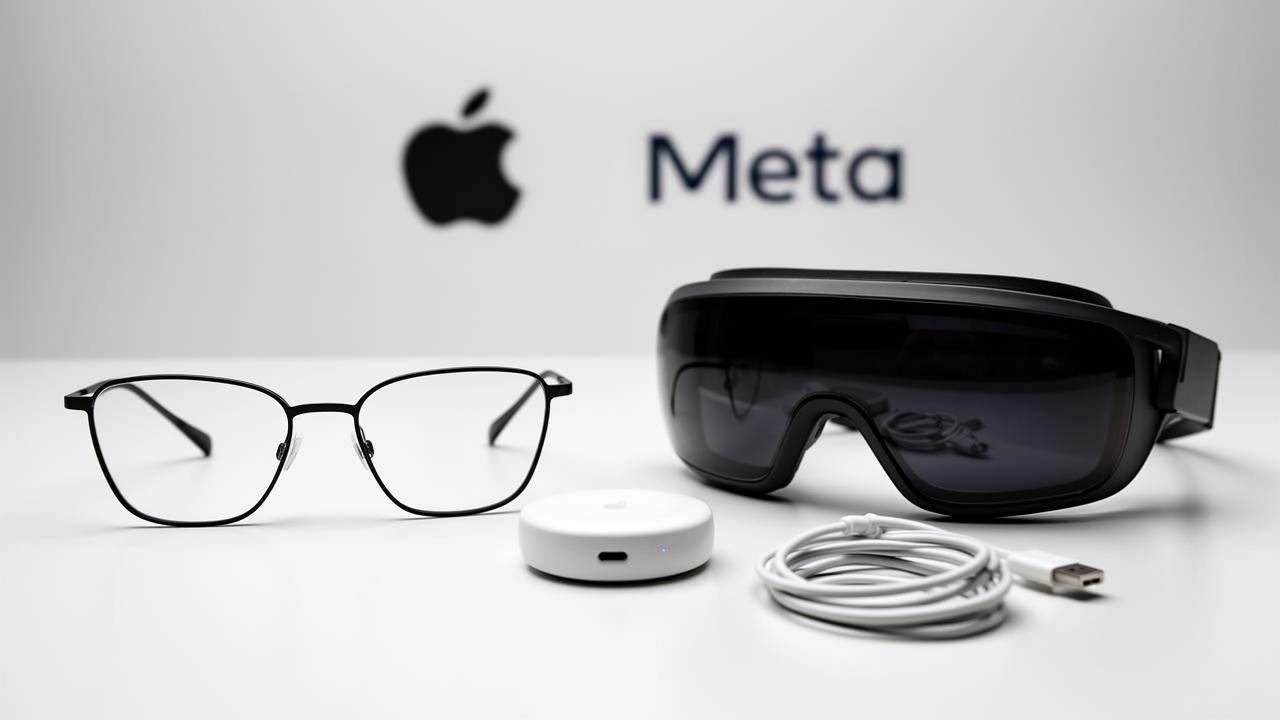
The race to define the next generation of wearable computing is intensifying, with Apple and Meta Platforms taking sharply different paths. While Apple is reportedly preparing a lightweight, screen-free entry into the smart glasses market no earlier than 2027, Meta has already unveiled a standalone VR headset priced at $1,299.99 and slated for spring 2027, aiming to replace the laptop for everyday tasks. The contrasting approaches reflect a broader industry debate over whether the future of face-worn technology lies in subtle, everyday accessories or in fully self-contained computing platforms.
The stakes are rising fast. Global shipments of XR headsets and glasses grew 35.3% year over year in the second quarter of 2026, according to IDC, and display-less audio glasses such as the Ray-Ban Meta accounted for 70.3% of those shipments, up from 61.9% a year earlier. Meta alone held 68.7% of the market, far ahead of RayNeo at 3.6%, Alibaba at 2.6%, XREAL at 2.5% and Xiaomi at 2.3%. The research firm expects total unit shipments to grow 26.3% in 2026 and accelerate to 40.5% in 2027.
According to a report from tech outlet geeky-gadgets, Apple's first-generation smart glasses will prioritize simplicity over immersive augmented reality. The device is expected to include built-in cameras, microphones, speakers, and Siri integration, but notably will not feature a display. This screen-free design positions the product as a direct conceptual rival to Meta's Ray-Ban Stories, though Apple is betting that deeper integration with its existing ecosystem of devices will give it an edge.
The report indicates Apple is taking a deliberately methodical approach to development, with industry insiders suggesting a release window between 2026 and 2027. The company appears intent on avoiding the pitfalls of rushing an underdeveloped product to market, instead using its expertise in hardware and software integration to deliver a cohesive user experience from day one. Unlike the high-end Apple Vision Pro, which targets immersive AR experiences, the glasses are envisioned as a more accessible, everyday alternative.
Apple's long-term roadmap may eventually include integrated displays and more advanced AR capabilities in future iterations. The company is also reportedly exploring complementary innovations across its wearable lineup, including AirPods with camera sensors and fitness devices with screen-free designs. Such moves would position the glasses as a central node in an interconnected network of personal technology.
Meta's Standalone Bet
Meta, meanwhile, is charting a more ambitious course. On Sept. 23, the company used its annual Connect developer conference to unveil Meta VR Glasses, a device weighing about 100 grams that splits its hardware in two. The frames carry the sensors and a 5K micro-OLED display offering 37 pixels per degree; a pocket-sized compute puck, linked by an optical tether, supplies the processor, battery and storage. That architecture sets the glasses apart from tethered competitors such as the URXR1 and XRE 1 Pro, which function primarily as external displays for other devices, and puts them closer to a laptop replacement than a phone accessory.
The glasses are designed to handle essential productivity tasks such as web browsing, email management, and video conferencing without a traditional laptop or desktop, with all processing done on the puck rather than mirrored from a phone or PC. Input comes through the eyes, hands and voice, and any table or desk can be turned into a virtual keyboard and touchpad. The glasses can also connect wirelessly or over USB-C to a Mac or Windows PC, and Meta AI is built into the operating system for contextual assistance and workflow streamlining.
Meta is targeting remote workers, students, and frequent travelers with the device, emphasizing portability and the ability to consolidate multiple gadgets into a single lightweight unit. The $1,299.99 price reflects its positioning as a premium standalone computing solution rather than a mere accessory. Inside is Qualcomm's new Snapdragon Reality Elite processor, paired with 12GB of memory, Wi-Fi 7, and a battery that Meta says delivers up to three hours of continuous high-resolution media playback with 45W fast charging. The device is the first VR product to earn IMAX Enhanced certification, and more than 75 games will be playable at launch using hand gestures alone. Meta plans a spring 2027 launch that will include Japan, where its local unit has announced the release but has not yet set pricing in yen.
Design Philosophies Collide
The divergent strategies highlight a fundamental tension in the smart glasses market. Apple's approach, as outlined in the report, favors comfort, simplicity, and gradual innovation — a device that looks and feels like ordinary eyewear while quietly adding useful functionality. Meta's VR glasses, by contrast, embrace the idea of a portable computing platform that can replace traditional hardware for specific tasks.
| Apple | Meta | |
|---|---|---|
| Product | Smart glasses, not yet announced | Meta VR Glasses, unveiled Sept. 23, 2026 |
| Core bet | A light accessory that extends the phone | A standalone platform that replaces the laptop |
| Display | None in the first generation | 5K micro-OLED, 37 ppd per eye |
| Compute | Not disclosed | Separate compute puck |
| Launch | 2027 at the earliest | Spring 2027 |
| Price | Not disclosed | $1,299.99 |
This philosophical divide extends to charging and power management as well. A separate analysis from Japanese tech publication ASCII highlights how current AI glasses handle the practical challenge of battery life. The Ray-Ban Meta, for instance, charges through contact points on the inner bridge of the frame that connect to a proprietary case. This design keeps the glasses aesthetically clean — no dangling cables — but means any mid-day top-up requires placing the glasses back in their case, interrupting use.
Competing devices like the Rokid smart AI glasses take a different approach, using magnetic connectors at the end of the temple arms that attach to a dedicated cable. This allows users to charge from a mobile battery pack while continuing to wear the glasses, a significant advantage during extended video recording or travel. The trade-off is the undignified sight of a cable hanging from the side of one's face.
The same analysis notes that AI glasses must power cameras, speakers, and wireless communication from a relatively small battery, making power management a critical design consideration. The choice between case-based charging and direct cable connections reflects deeper decisions about how these devices will be used in practice — as occasional accessories or as always-on companions.
Challenges Ahead
Both Apple and Meta face significant hurdles, and not only technical ones. Always-on cameras have already provoked a public backlash over recording without consent, forcing Meta to tighten safeguards on its existing glasses — steps that industry analysts say came only under pressure, leaving an opening for a rival that builds those protections in from the start. On the product side, Meta's VR glasses must overcome challenges in battery life, text input, and software interface design to fulfill their promise as genuine laptop replacements. Hand tracking must be reliable and intuitive, while virtual keyboards or advanced voice recognition will be essential for productivity tasks. The success of the $1,299.99 device depends on Meta's ability to address these issues through iterative improvement.
Apple, for its part, must convince consumers that a screen-free smart glasses product offers meaningful value beyond what a smartphone already provides. The company's strategy of gradual innovation — laying groundwork with a simple first-generation device before adding more advanced capabilities — carries the risk that early adopters may find the initial offering underwhelming. However, Apple's track record of ecosystem integration suggests the glasses could become a compelling entry point for users new to wearable technology.
The competitive landscape is further complicated by the presence of devices like the XRE 1 Pro, which serves as a lightweight external display for basic tasks, and the URXR1, which offers immersive spatial display but remains tethered to a smartphone or PC. Meta's standalone approach represents a clear differentiation strategy, positioning its glasses as a replacement for existing hardware rather than an enhancement of it.
Accessory tier: the phone keeps the compute — Ray-Ban Meta, rumored Apple glasses

Tethered display tier: a virtual screen mirrored from another device — URXR1 and similar viewers

Standalone tier: its own operating system and compute puck — Meta VR Glasses, spring 2027
As the wearable computing market matures, the question of which philosophy will prevail remains open. Apple's emphasis on comfort, simplicity, and seamless integration appeals to mainstream consumers who want technology to fade into the background. Meta's vision of a self-contained computing platform targets power users seeking to reduce their dependence on traditional laptops. Both approaches have merit, and the market may ultimately support multiple categories of face-worn devices serving different needs and use cases.
LikeFavoriteShare
Once added, BigGo Finance appears first in Google Search Top Stories, so you get the broadest, most up-to-the-minute, and most comprehensive global financial news first.
AI Agent
Compare Apple's methodical, display-free approach with Meta's fully self-contained $1,299 headset: which trade-off between everyday comfort and standalone computing power is more likely to win mainstream buyers?If Apple's screen-free glasses arrive as a practical rival to Meta's Ray-Ban Stories, which wearable categories — audio glasses, fitness bands, or tethered AR headsets like the URXR1 — face the most substitution risk?Which company's wearable strategy better protects its profit pool: Meta's $1,299 standalone headset tied to its XR app and developer ecosystem, or Apple's screen-free glasses meant to deepen iPhone and AirPods lock-in?Why does Apple's screen-free design for its first smart glasses, with cameras, microphones and Siri but no display, sidestep the battery and weight problems that sink display-equipped rivals?
Related Stocks
[ \
AAPL Apple Inc.
\
AAPL Apple Inc.
$333.54
0.97%](https://finance.biggo.com/quote/AAPL)
[ \
META Meta Platforms, Inc.
\
META Meta Platforms, Inc.
$727.5
0.22%](https://finance.biggo.com/quote/META)
[ \
SIRI SiriusXM Holdings Inc.
\
SIRI SiriusXM Holdings Inc.
$25.9442
1.19%](https://finance.biggo.com/quote/SIRI)
More Related News
Dario Amodei's $2 Trillion Bet: Inside the White House AI Theater and Anthropic's $500B Debt Bomb\ 20 hours ago AT&T Urges iPhone 18 Pro Max Update Citing 911 Risk, but Users Report Persistent Outages\ 22 hours ago Nilay Patel: Meta's Muse Is Being Built to Become a Corrupt Butler\ 24 hours ago Wall Street Banks Push Back on Nvidia's $500 Billion Chip-Collateral Financing Ambitions\ 2 days ago Instagram Adds AI Assistant to Edits App for Creator Analytics\ 3 days ago Halide 3.2 Unlocks Full Aperture Control on iPhone 18 Pro, Adds Two New Looks\ 3 days ago
Related Stocks
[\
\
AAPL Apple Inc.
$333.54
0.97%](https://finance.biggo.com/quote/AAPL)
[\
META Meta Platforms, Inc.
$727.5
0.22%](https://finance.biggo.com/quote/META) [\
SIRI SiriusXM Holdings Inc.
$25.9442
1.19%](https://finance.biggo.com/quote/SIRI)
AI Agent
Compare Apple's methodical, display-free approach with Meta's fully self-contained $1,299 headset: which trade-off between everyday comfort and standalone computing power is more likely to win mainstream buyers?If Apple's screen-free glasses arrive as a practical rival to Meta's Ray-Ban Stories, which wearable categories — audio glasses, fitness bands, or tethered AR headsets like the URXR1 — face the most substitution risk?Which company's wearable strategy better protects its profit pool: Meta's $1,299 standalone headset tied to its XR app and developer ecosystem, or Apple's screen-free glasses meant to deepen iPhone and AirPods lock-in?Why does Apple's screen-free design for its first smart glasses, with cameras, microphones and Siri but no display, sidestep the battery and weight problems that sink display-equipped rivals?


