
Interest rates expected to be held again by Bank of England
1 hour ago
Kevin PeacheyCost of living correspondent
 Getty Images
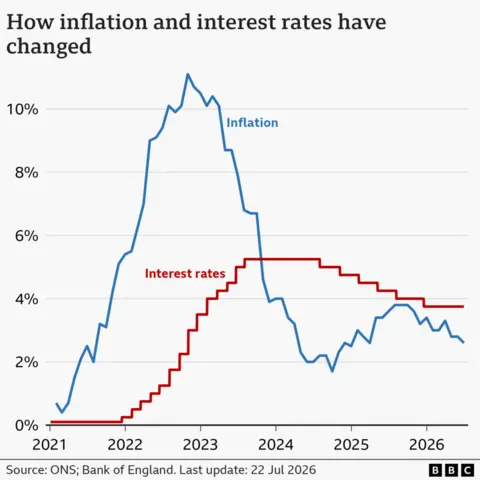
UK interest rates are expected to be held at 3.75% for a fifth time by Bank of England policymakers.
Uncertainty over the the global political and economic outlook, and the impact on prices, means the Bank is likely to continue its cautious approach to rates.
Its Monetary Policy Committee (MPC) meets eight times a year, with its decisions heavily influencing how much borrowers are charged for loans and mortgages, as well as the returns available to savers.
The benchmark Bank rate is at its lowest level since February 2023, but few analysts predict any short-term changes.
The committee of five women and four men will announce their latest interest rate decision at 12:00 BST, with a hold the widespread expectation.
The Bank rate is the MPC's primary tool for maintaining the rate of rising prices - inflation - at a target of 2%.
The latest official figures show inflation in the UK was 2.6% in the year to June, down slightly on the previous month but still above its 2.3% target.
The inflation rate is likely to go up in July, as millions of households in Scotland, England and Wales feel the impact of a 13% rise in domestic energy prices.
The increase was the result of the impact of the Iran war on wholesale energy prices.
Conflict in the Gulf, and uncertainty over the chances of a lasting truce, hang over the MPC's meeting and decision this month and in the months ahead.
Many analysts expect interest rates to be unchanged in the foreseeable future, with the possibility of the next change being a rise.
"A new government finding its feet, and the situation in the Middle East becoming increasingly uncertain, mean that a hold on [the] base rate decision would be a welcome dose of stability," said Katie Horne, from savings platform Flagstone.
"People have had more than enough uncertainty over the past year, and even a temporary pause eases the pressure a little."
Impact on borrowers and savers
A hold would mean monthly repayments for homeowners on a tracker mortgage rate would be unchanged.
However, more than eight in 10 mortgage customers have fixed-rate deals, and the major UK lenders have been increasing rates on new deals in recent days.
The interest rate on this kind of mortgage does not change until the deal expires, usually after two or five years, and a new one is chosen to replace it.
The average rate on a new two-year fixed deal is 5.62%, according to financial information service Moneyfacts - the highest for more than a month.
Rates are going up because of lenders' funding costs rising owing to renewed volatility in the Middle East. Individual companies don't want to be inundated with applications so the sector tends to move as a pack.
"A hold is still welcome, but market expectations will need to ease back before we can hope for a return to lenders cutting rates," said David Hollingworth, from mortgage broker L&C.
Recent projections by the Bank of England suggest just over five million homeowners should expect their monthly mortgage repayments to increase by the end of 2028.
Other loans are influenced by the MPC's decision, which also has a key impact on the returns available to savers. A higher Bank rate, or the likelihood of an increase, can improve the interest rates that savers are offered.
Some of the deals available to people willing to lock-in their savings for fixed period are at their highest for nearly two years.
The guaranteed interest paid on the top one-year bond is 4.91%, the highest for new customers since October 2024.
"This rare dose of good news for savers is somewhat of a silver lining after years of poor real returns," says Rachel Springall, of Moneyfacts.


