
China's EV Boom Is Quietly Undermining Oil's Biggest Chokepoint
By Leon Stille - Aug 04, 2026, 3:00 PM CDT
- China remains deeply exposed to the Strait of Hormuz, with an estimated 45–50% of its crude imports normally passing through the chokepoint.
- China’s electric vehicles displaced an estimated 34 million tonnes of oil in the first half of 2026, equivalent to roughly 1.35 million barrels per day.
- Strategic reserves can cushion a temporary disruption. Electrification permanently reduces the amount of imported oil China needs to defend, finance and transport.
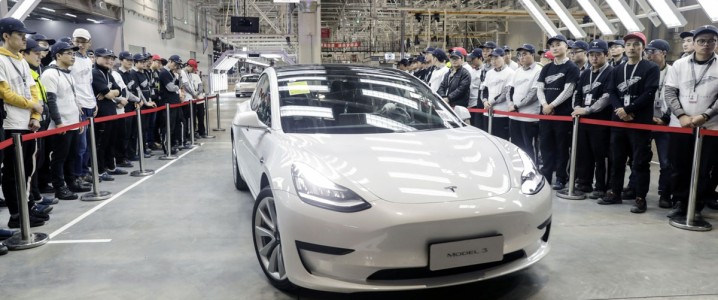
The conventional view of the Hormuz crisis is that China has been caught in an energy trap. It is the world’s largest crude importer, the Gulf remains one of its most important sources of supply, and an estimated 45–50% of Chinese crude imports normally transit the Strait of Hormuz. When traffic through the strait slows, Beijing cannot simply replace all those barrels overnight. That vulnerability is real. But it is also incomplete.
China entered this crisis with large strategic and commercial inventories, diversified suppliers and the ability to suppress refinery runs. More importantly, it entered with something previous oil-importing economies did not have during earlier supply shocks: a rapidly electrifying transport system already removing more than one million barrels per day of potential oil demand.
Strategic reserves buy time. Electrification changes the balance permanently.
The missing 1.35 million barrels per day
In the first half of 2026, China’s electric vehicle fleet displaced an estimated 34 million tonnes of oil. Using a standard conversion for crude-equivalent volumes, that is around 1.35 million barrels per day, more than 1% of total global oil consumption.
The comparison with Chinese imports is even more revealing. The oil displaced in six months is equivalent to roughly 6% of a full year of Chinese crude imports. If maintained for the full year, the rate would approach 12%.
This does not mean China can subtract exactly 1.35 million barrels from today’s import bill. Oil demand is influenced by refinery margins, petrochemical consumption, economic activity and product exports. The displacement figure is a counterfactual: the fuel that comparable internal-combustion vehicles would have consumed to provide the same mobility. But that is precisely why it matters. Those barrels are not sitting in a strategic tank waiting to be released. They no longer need to be bought. Related: Pentagon Scraps $300 Million Lithium Tender for Defense Stockpile
The scale is also no longer marginal. In 2025, nearly 15 million barrels per day of crude passed through Hormuz, with China and India together receiving 44% of the flow. China’s current EV-related displacement is already equivalent to close to one-tenth of all crude that normally moves through the strait. It cannot neutralize a closure. It can soften the blow.
China electrified the easy vehicles first—and then kept going
The progression explains why the impact is accelerating. Electric buses came first. They operate on predictable routes, have high utilization rates and normally return to a depot where they can charge. The higher upfront cost could therefore be spread over many kilometres, while cities gained cleaner local air and operators saved on fuel and maintenance.
Passenger cars followed. More than 13 million electric cars were sold in China in 2025, representing almost 55% of new-car sales. By the end of that year, China had an estimated 44 million electric cars on the road.
This was not achieved by asking consumers to pay a permanent green premium. Competition, manufacturing scale and cheaper lithium-iron-phosphate batteries changed the economics. According to the IEA, 70% of battery-electric cars sold in China in 2025 were already cheaper than the average conventional car.
Passenger cars now account for an estimated 54% of China’s EV-related oil displacement. Yet the next stage may be more important for oil markets because it targets diesel.
Electric semi-trailer oil displacement reportedly rose around 150% year-on-year in the first half of 2026. That follows a breakthrough year in which electric heavy-freight trucks reached 28% of Chinese heavy-truck sales, up from 13% in 2024. In December 2025, their share reached around half of sales.
Long-haul trucking was supposed to be one of the last sectors to electrify. Batteries are heavy, charging takes time and every lost tonne of payload costs money. Those objections remain valid for many routes.
China did not wait for one battery truck to perform every transport task. It targeted the routes where electrification already works: ports, mines, industrial clusters and fixed regional corridors. High utilization improves the economics, depot charging lowers infrastructure complexity, and battery swapping turns charging time into an operational rather than technological problem.
This is a characteristic feature of China’s transition. It scales the workable niche first and expands outward as costs fall.
An oil-security strategy disguised as industrial policy
China’s EV push is usually discussed as climate policy or as an industrial challenge to Western carmakers. It is both. But the Hormuz crisis exposes its third function: national energy security.
An internal-combustion vehicle locks in years of recurring dependence on oil. An electric vehicle shifts that demand to a power system supplied overwhelmingly from domestic generation.
That does not automatically make every kilometre clean. Coal remains a major part of China’s electricity mix, and electrification should not be confused with complete decarbonization. China also continues to consume oil in aviation, shipping, petrochemicals and heavy industry. EVs cannot resolve those vulnerabilities.
Yet from an import-security perspective, the distinction is decisive. Coal, nuclear, hydro, wind and solar power can all generate electricity without a tanker passing through Hormuz. Even a coal-powered EV substitutes domestically available energy for imported petroleum, while the emissions benefit improves as the grid becomes cleaner.
And that grid is changing at extraordinary speed. China added nearly 500 GW of renewable capacity in 2025, including about 370 GW of solar and 117 GW of wind. This does not eliminate the need for coal or grid investment, but it means new electricity demand from transport is increasingly supported by domestic renewable generation rather than imported oil or LNG.
The gas effect is more nuanced. EVs mainly displace gasoline and diesel, not natural gas. But electric trucks are now also competing with China’s large LNG-truck fleet. Where battery trucks replace LNG models, electrification reduces exposure to gas markets as well. More broadly, every transport activity shifted directly to electricity avoids building a second imported-fuel dependency around gas.
Inventories cushion crises; demand destruction weakens chokepoints
China is still suffering from the disruption. The IEA reported that Chinese seaborne crude imports fell by 3.6 million barrels per day between February and April. Refineries reduced runs, while inventories helped bridge the gap. Those are emergency responses, not evidence that China has escaped the oil market.
Nor should 1.35 million barrels per day be exaggerated. China remains a huge oil consumer and importer. Petrochemicals may absorb part of the demand lost from road transport, and a prolonged Hormuz closure would still damage Chinese industry through higher freight, feedstock and global commodity costs.
But energy security is not binary. A country does not need to become oil-independent before reduced demand becomes strategically useful.
Every barrel displaced lengthens the life of inventories, reduces the number of replacement cargoes required from Russia or elsewhere, lowers exposure to freight and insurance costs, and weakens the inflationary transmission from crude prices to household mobility. The effect compounds because EVs sold this year continue displacing fuel for years.
The IEA expects EVs to remove more than 4 million barrels per day of Chinese oil demand by 2035 under both its current- and stated-policy scenarios. At that scale, electrification would offset more than a quarter of the crude volumes that passed through Hormuz in 2025.
That is not a forecast of Chinese oil independence. It is a forecast of declining leverage for oil chokepoints.
The lesson from Hormuz is therefore not that China moved too quickly into electric vehicles. It is that other importing economies have underestimated what transport electrification does for resilience.
Pipelines can bypass some vulnerable sea lanes. Strategic stocks can cover a temporary loss. Supplier diversification can redistribute risk. But only demand reduction removes the barrel altogether.
China’s strongest response to the Hormuz crisis was not assembled after the first tanker was attacked. It has been rolling quietly onto its roads for years.
By Leon Stille for Oilprice.com


