
The Congo Pushes for Global Rules to Manage Mineral Exploitation
- Damilola Banjo
- • July 5, 2026
8m read
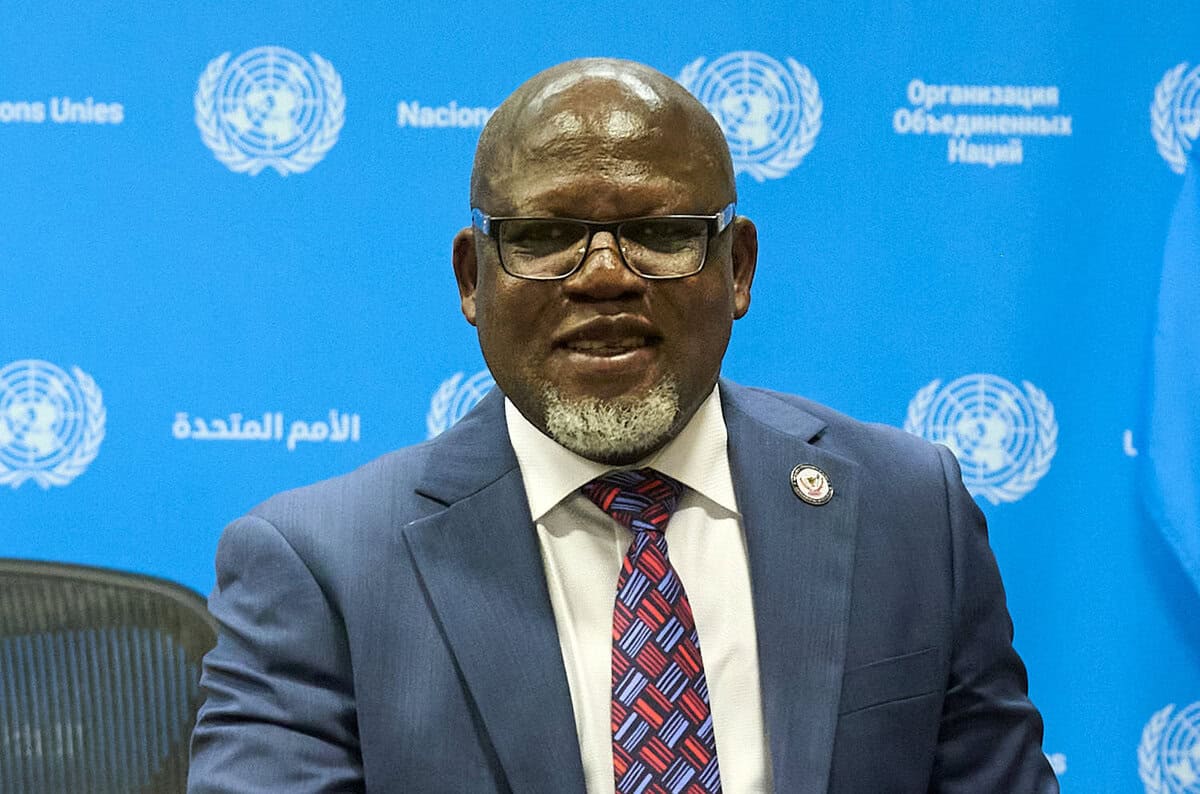 Zénon Mukongo Ngay, ambassador of the Democratic Republic of the Congo to the UN, July 1, 2026. As rotating president of the Security Council this month, his country will hold debates on advancing an international text to “legislate natural resource governance.” JOHN PENNEY/PASSBLUE
For one month, the Democratic Republic of the Congo holds the rotating presidency of the United Nations Security Council, and the country plans to use July to lay the groundwork for a Council resolution that could protect countries from exploitation of their own resources by armed groups.
Eastern Congo’s soil holds what is described as the 3TG minerals — tin, tantalum, tungsten and gold — used in electronics. The resources feed the global battery and electric-vehicle supply chain, but they also perpetuate a decades-long conflict that has killed millions of people and displaced others in the vast central African country.
The numbers are staggering: According to the International Rescue Committee, from 1998 to 2007 alone, an estimated 5.4 million people died due to conflict in the Congo. At least 7,000 people have been killed since January 2025, says Prime Minister Judith Suminwa Tuluka. The UN documented 632 civilian deaths in the eastern provinces of North Kivu and Ituri from March 19 to June 26, 2026.
Additionally, the UN Refugee Agency and the Office for the Coordination of Humanitarian Affairs say that 8.2 million people have been internally displaced and 1.2 million Congolese are refugees in neighboring countries.
“Legally speaking, international law is mute on how to manage natural resources,” Zénon Mukongo Ngay, the DRC’s envoy, told reporters at the UN on July 1, when his country assumed the rotating presidency of the Security Council. “There is no legal basis, no international texts which legislate natural resource governance.”
Internal and external armed militias have wrestled with the Congolese government for control over its territory and mineral resources for more than 30 years. The decades-long conflict erupted amid a long spillover of ethnic war in neighboring Rwanda, but has since morphed into a struggle for domination over Kinshasa’s mineral-rich regions. The M23 rebel group, reportedly backed by Rwanda, is a spinoff from disgruntled Congolese soldiers from the Tutsi-majority National Congress for the Defense of the People ( CNDP).
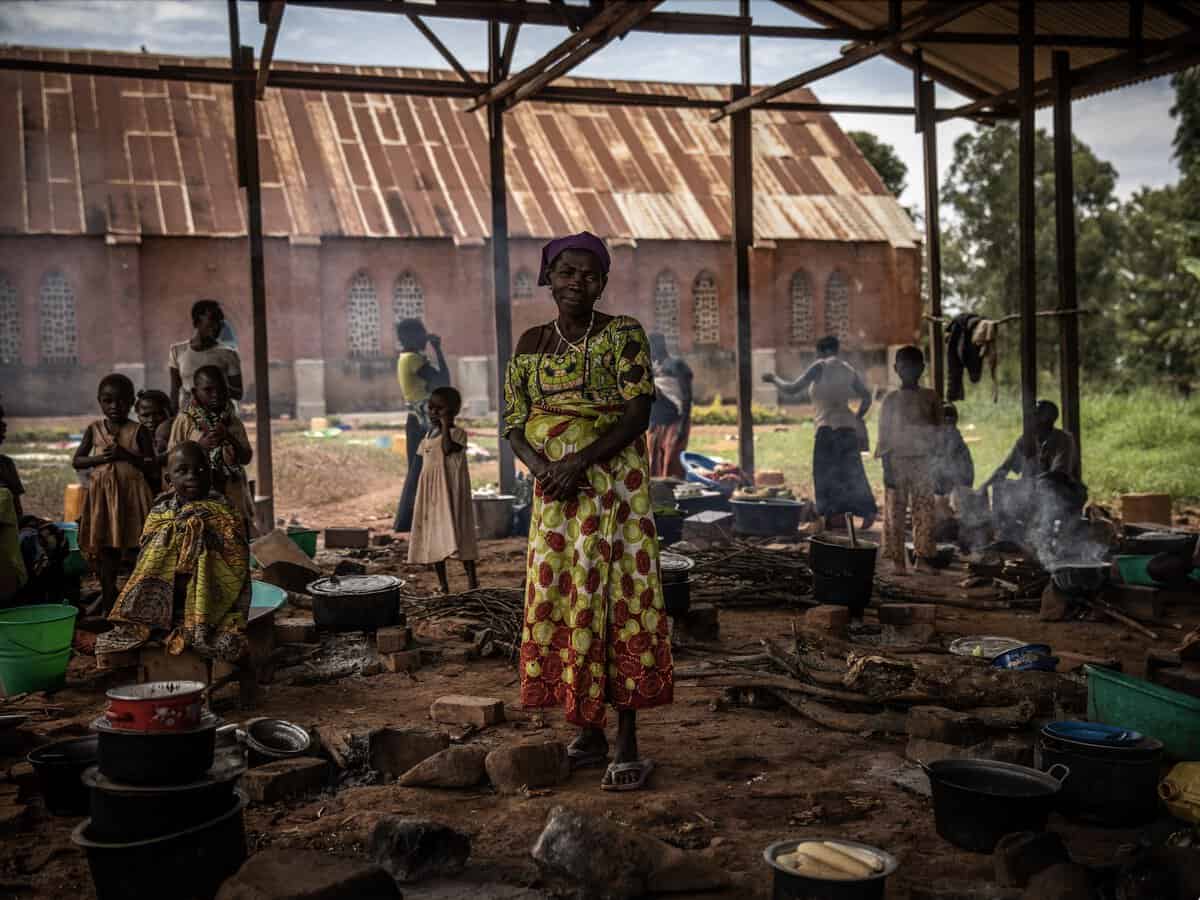 A displacement camp in Ituri Province, eastern Congo. Fighting in the region over minerals has forced people to seek refuge in makeshift settings, such as above, as atrocities carried out by Rwandan-backed militias and others continue. HUGH KINSELLA CUNNINGHAM
Since early 2025, the M23 has controlled large parts of North and South Kivu provinces, including the strategic provincial capitals of Goma and Bukavu. Rwanda, for its part, repeatedly says that its forces are responding to threats from the Democratic Forces for the Liberation of Rwanda, or FDLR, a militia formed by perpetrators of the 1994 Rwandan genocide that has operated in eastern Congo for three decades.
The US Treasury Department slapped sanctions in June on individuals accused of moving gold from M23-controlled territory of the Congo into Rwanda and described mineral smuggling as a direct funding stream for the group’s continued occupation of Congolese territory.
Ngay said in the press briefing that most of his country’s natural resources benefit the armed groups, who exploit the minerals to cause a “bloodbath.” To remedy that, Kinshasa said an international framework could protect countries from such illicit exploitation.
He elaborated on how the Security Council might react to such a proposal, saying, “You bring the discussion, and then you listen to each and every one and form a conviction of what you can do and what you cannot do.”
US deals with the Congo and Rwanda
Congo has scheduled two events during its Council presidency devoted to managing natural resources. One is an informal expert-level meeting on July 13, exploring what Ngay called a “normative vacuum” in international law; the other is a high-level open debate on July 22-23 on natural-resource governance as “the foundation of peace, security and prosperity.”
Frederic Mousseau, the policy director at the Oakland Institute, a California-based policy group that has spent the last year tracing Congo’s mineral trade in forensic detail, said there were mechanisms and UN resolutions that have had no effect on the situation in the country.
“Unless Security Council members walk the talk with concrete action, it is hard to see what a new resolution would do,” Mousseau said in an interview with PassBlue.
In December 2025, the US and DRC signed a Strategic Partnership Agreement, building on the Washington Accords for Peace and Prosperity that the Trump administration brokered between Congo and Rwanda earlier that year. Yet, there is no sign of peace in the Congo’s east as killings, rapes and pillaging continue — most recently, hindering the humanitarian response to the Ebola outbreak there.
Critics have also said the minerals agreement gives American companies preferential access to Congolese assets through a new mechanism called the Strategic Asset Reserve, an evolving list of mining sites and unlicensed exploration areas to which US investors have a right of first offer before Congolese investors themselves.
Ngay told PassBlue in an exclusive interview on July 2 that such criticism was a matter of interpretation. [Full interview below]
Mousseau said that while applying sanctions against officers in the Rwandan army, the US government itself is invested in mining and processing of minerals in Rwanda. In May 2025, Rwanda’s Trinity Metals signed a letter of intent with the US Department of State to establish a new supply chain of tin from Rwanda to the US.
In October 2025, Rwanda exported tungsten to the US for the first time through a partnership involving Trinity Metals, Pennsylvania-based Global Tungsten and Powders and the international commodities trading firm Traxys. Under this deal, four to seven containers of tungsten concentrate will be shipped every quarter to the US for two years.
“DRC has its own challenges of governance and corruption in the mining sector,” Mousseau said. “What the country needs is a Congolese-led path for peace, justice and prosperity for the DRC instead of Trump’s hyperbole of peace and security, which obviously does not deliver on its promises.”
Each month, PassBlue profiles UN ambassadors as their countries assume the rotating presidency of the Security Council. We spoke with Ambassador Ngay extensively on the country’s signature events, the A3 dynamics (the three African elected members in the Council, currently the Congo, Liberia and Somalia) and the UN secretary-general selection process, plus a bit about sports and “big bellies.”
The interview has been edited for clarity and condensed for brevity.
PassBlue: Let’s start with the signature event you’ve chosen for your presidency. What’s the ambition behind building a framework based on international law that regulates mineral resources?
Ngay: We know that conflicts are sometimes fueled by mineral resources, or natural resources in general, because when you look at a country like mine, there are a lot of armed groups operating in eastern Congo, and these armed groups are supporting their activities through the illegal exploitation of mineral resources. It becomes like gas in their car. The gas is the mineral resources, and they can push forward and keep using them for a lot of bad activities like crimes, organized crime; all these bad things come from where the mineral resources are. We think mineral resources should build countries, their prosperity, their economy, and make sure people live a good life. But on the contrary, what we see is that where mineral resources are [located], where people are supposed to live off that wealth, the wealth becomes something that is killing them, and this is our concern.
So we say the reason we are facing this situation is because there is no regulation at the international level. When you look at the international arena itself, there is no framework you can build upon and say, this deals with the exploitation of natural resources. What we have are things like some allusions to mineral resources; the issue of blood diamonds and the Kimberley Process, for example, but you don’t have an international framework or regulation that talks about the management of natural resources. The principle should be that natural resources belong to the country they are in, but what we see on the ground is that illegal exploitation is very prosperous in those countries, just because there are outsiders who are exploiting. At the end of the day, people have no money, they don’t have jobs and life becomes difficult.
PassBlue: You mentioned some existing guidelines, particularly the Kimberley Process, that fill this gap. How does codifying this issue as international law differ from current mechanisms in the African Union and other regional groups?
Ngay: On two levels. The first is the disparity of those mechanisms. There are a lot of them, and each one fits one thing, one region, one sort of natural resource and that’s it. We are not talking about that. Those are small regulations, and they do not fit the subject itself. What we are talking about is a framework that deals with international law in general, that will be a reference for all countries to know that when the management of natural resources is not well done, where there are armed groups, where there are outsiders profiting from the wealth of a country, you can refer to that framework. Also, when you look at what we have now, it’s not regulation per se, the word is “guidelines.” Guidelines are not binding. You can follow them or not; you don’t even have to follow them.
PassBlue: There’s a lot to unpack with a possible new binding international regulation. Have you tested the appetite of Security Council members for it? To put it plainly, several permanent members have their own hands in resources that aren’t theirs. How do you sell them on a framework that would constrain that?
Ngay: I understand very well. But what we are saying is we are testing the water. It’s just to bring the discussion into the Security Council. Why not? We try that. It’s a good way to assess the members, the international community. You bring the discussion, and then you listen to each and every one and form a conviction of what you can do and what you cannot do.
PassBlue: I also want to ask about the Strategic Asset Reserve that Congo gave the US as part of a bilateral agreement. Some NGOs and human rights groups in DRC say it shuts out local miners and it appears hypocritical for DRC to champion regulation of mineral exploitation while signing a bilateral deal like this.
Ngay: Everyone can have his own interpretation. I think that is not the reality on the ground. In every country, when you raise an idea, you will always have people who come and show you the bad consequences of the idea. It happens everywhere, so I don’t think that is the direction we should take.
PassBlue: Given that Congo itself is dealing with an active, deadly conflict that is on the Council’s regular agenda, how do you separate advocating for global peace and security from advocating for your own government’s position? Countries taking up the presidency often try to zoom out from their own region to focus on issues with broader global impact. How do you strike that balance?
Ngay: The balance is there. When we want to advocate for our own interests, we do it in our national capacity, and we say so. But bringing up an issue like the management of natural resources is not just about the DRC. There are natural resources all around the world, and the management of those resources, when you look at conflict, is one of its root causes not only in Africa but elsewhere.You will see that where there is war, there are natural resources. Take the Gulf countries, for instance — there is oil.
PassBlue: What is your relationship with the other two current African members in the Council, Somalia and Liberia? We felt the impact when Sierra Leone, Algeria and Guyana (the “A3) coordinated in the Council last year, especially on the Gaza war. It was remarkable to watch. What’s your relationship with Liberia and Somalia?
Ngay: You don’t feel the impact now?
PassBlue: I’m just asking. . . .
Ngay: We have good relations. The A3 is even stronger than before. I’m the coordinator of the A3 at the moment, so I can tell you we are very close. We just finished a meeting in this room with one of the secretary-general’s special envoys, and that was an A3 meeting. So we are assuming the coordination. We are advocating for Africa’s interests, but at the same time, each of us is promoting the interests of our own country. But African interests are there.
PassBlue: We’re not seeing much of the “plus” dynamic with this cohort — when a Latin American/Caribbean Council member joins the A3, such as Guyana. Why not?
Ngay: That doesn’t depend on us. There has been no “plus” since Guyana left the Council [in 2025], but we are expecting a new plus coming next year, when Trinidad and Tobago will joing the Council.
PassBlue: I’m looking forward to that.
Ngay: Oh, yes.
PassBlue: I can’t do this interview without asking about the UN secretary-general race as closed-door dialogues with the candidates have begun in the Council. What qualities and priorities is DRC looking for in the next UN leader, especially since part of the selection process falls during your presidency?
Ngay: No, I cannot express DRC’s position here as president of the Council. I have to express the Security Council’s position.
PassBlue: I’m just asking what qualities you’re looking for, what the priorities are for DRC.
Ngay: Right now, the organization is facing a lot of challenges. We’re talking about UN80 [reform], reform of the Security Council, about budget cuts. When you look at translation services of the UN, I was surprised yesterday [in July 1 briefing with Ngay] to see there was translation in that room. . . . The reason I wanted to do it in French as well is because I want my audience to be aware of what is going on. But multilingualism has to be sustained in the Security Council and the UN system. So all of these are the challenges we are facing, we have to take that into consideration. [Editor’s note: Translation from one of the UN’s six official languages, including French, is routinely provided in UN press briefings when the speaker is not using English]
PassBlue: What about your expectations for the year and a half you have left as a member of the Council. What are you hoping to achieve?
Ngay: I’m expecting to see at least two or three conflicts definitively resolved in the world, and that is something we don’t see every single day. It’s difficult. There are conflicts that have been going on for a long time. We keep talking, talking, talking, but at the end of the day, there are no solutions. I think the Security Council should be a solution-oriented organization, giving solutions to conflicts, not just dealing with conflict through talking. We need to see results on the ground.
PassBlue: What do you want people to know about you outside the UN? What do you enjoy?
Ngay: I like sports, but I don’t have time for that. I used to do a lot of sports when I was young, but with these responsibilities now, time has become very short. Now we have big bellies . . . but I like sports.
Ambassador: Zénon Mukongo Ngay
Since: 2023
Languages: Lingala, Swahili, Kikongo, French and English
Education: Law degree, with distinction, from the University of Lubumbashi
His story, briefly: Zénon Mukongo Ngay is the Congo’s ambassador and permanent representative to the UN in New York City, a post he has held since his appointment by President Félix Tshisekedi in July 2023. Since September 2023, he has also served as chair of the informal Group of Francophone Ambassadors, which coordinates the positions of French-speaking member states at the UN headquarters.
A career diplomat, Ngay has spent more than two decades in multilateral diplomacy. From 2015 to 2019, he served as his country’s permanent representative to the UN in Geneva and Vienna. Before that, he worked at the country’s permanent mission to the UN in New York City, where, from 1998 to 2015, he was a minister-counselor and senior legal adviser.
After earning a law degree, Ngay began his career at the Lubumbashi Bar. He later pursued advanced studies in international law, human rights, transitional justice and information technology through programs at Columbia University, the UN Codification Division, the International Labor Organization’s training center in Turin and institutions in Morocco.
Country Profile
President of Congo: Félix Tshisekedi
Minister of Foreign Affairs: Thérèse Kayikwamba Wagner
Type of Government: Republic, semipresidential system
Year Congo Joined the UN: 1960
Years in the Security Council: 1982-1983, 1990-1991, 2026-2027
Population: 116 million
Per capita CO2 emission figures per person (in tons): 0.06 per person; world average, 4.7


