
On March 7, 2026, the day before congressional elections in Colombia, Abelardo de la Espriella was in an unusual place for a presidential candidate in the middle of a campaign: Miami.
"Miami, here is your tiger that roars and bites," shouted the now winner of the elections according to the preliminary count from the stage of MCI Church — a Colombian Christian church with a presence in 15 countries — before a crowd that cheered him and waved small tricolor flags.
Being in the United States allowed him to evade the electoral ban that prevents candidates from holding campaign events in the week before elections.
That same night, he posted on social media a photo with two important American politicians: Republican Representative Maria Elvira Salazar and Deputy Secretary of State Christopher Landau.
"Wonderful evening in Miami with two great friends of Colombia," the candidate wrote.
His connection with Salazar is longstanding, but Landau's presence already suggested subtle support from Trump's circle for De la Espriella.
A few months later, with an effusive congratulatory message from the U.S. president after his first-round victory, the support was reaffirmed.
But De la Espriella's relationship with the U.S. is not new and goes far beyond politics.
Although precise dates are not publicly known, he himself has confirmed that he lived in the U.S. for many years and his four children — ages 4 to 15 — were born there.
Additionally, there are posts on his social media that show his life in the U.S. at least from 2014 to 2024.
In 2023, he became a naturalized U.S. citizen.
It was also in that country where he developed a large part of his business network and even his emerging career as a singer.
And, without a doubt, in American politics he found one of his main references: Donald Trump.
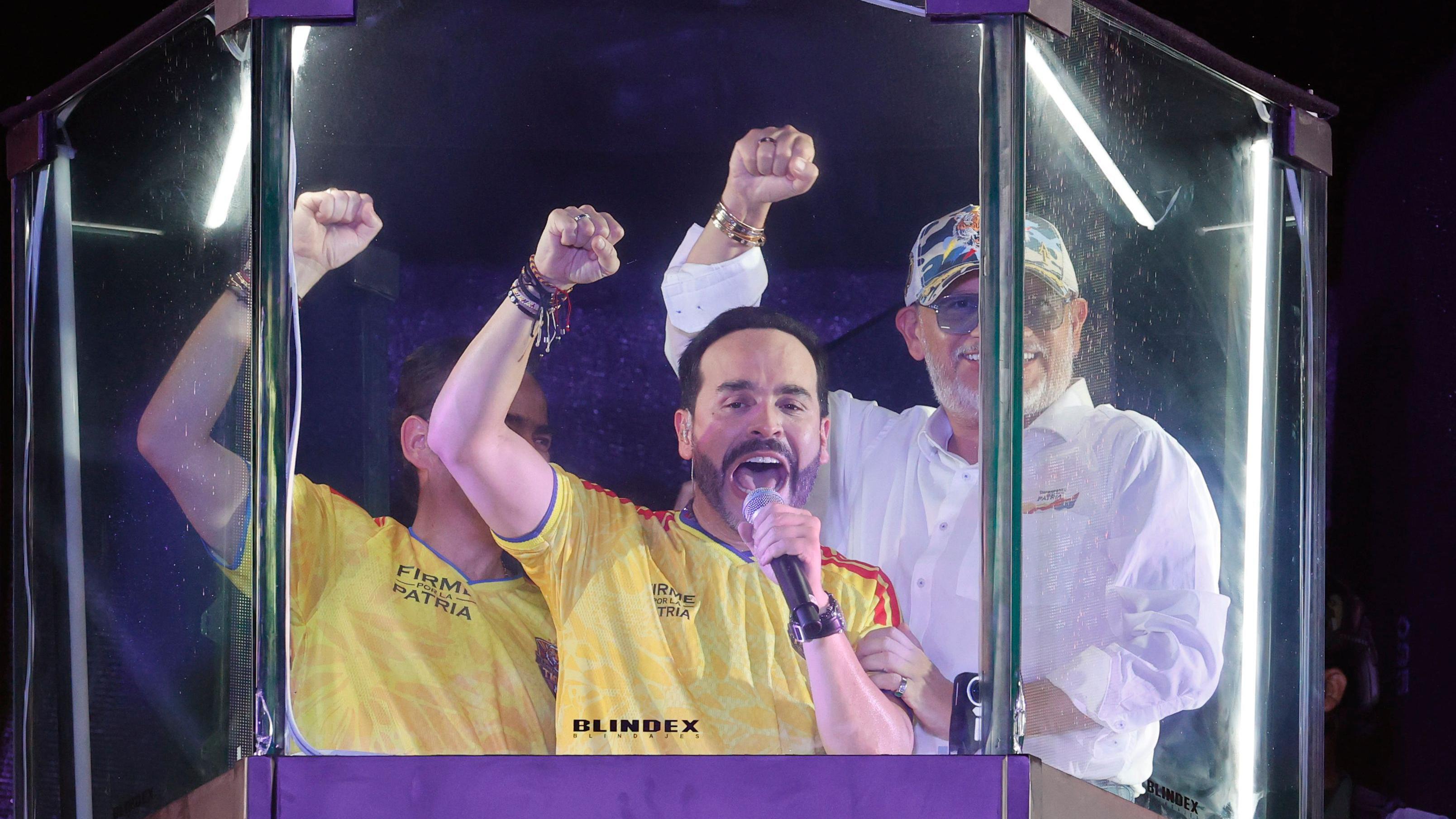 De la Espriella obtained 4 out of 5 votes from Colombians in the U.S., according to the preliminary count.
Business, the first pillar of De la Espriella in the U.S.
Writer and political strategist Ángel Beccassino recounted in his biography of Abelardo de la Espriella that during his university years, the now election winner frequently traveled to Miami and New York to sell emeralds.
"On each little trip I made US$2,000 or US$3,000, after paying expenses at the highest level. I was 19 years old and in New York I stayed at the Waldorf Astoria drinking champagne and eating lobster salad, the same one Liz Taylor ordered," De la Espriella told Beccassino.
And, although as a lawyer he focused his work in Colombia, with clients ranging from politicians accused of ties to paramilitaries to entertainment figures, his ties with the U.S. remained.
According to an investigation by the media outlet La Silla Vacía, De la Espriella owns, together with his wife, a house worth US$5.1 million in Miami and, between 2013 and 2023, created or appeared in the documents of 14 companies in the state of Florida.
These companies range from a subsidiary of his law firm De la Espriella Lawyers Enterprise Inc to a restaurant that closed in 2025 after two years of operation.
According to documents released by the media outlet Cuestión Pública, he had an apartment in the exclusive Brickell area of Miami between 2014 and 2020.
Social media posts show his life in the U.S. at least from 2014 to 2024.
On social media, there is record that in April 2023 he celebrated, for example, the inauguration of his restaurant in the city of Coral Gables, alongside Gilberto Santa Rosa and his partner, Silvestre Dangond.
 This image of De la Espriella with Colombian singer Silvestre Dangond was published on January 15, 2023 from Coral Gables, Florida.
A few months later, he himself gave a concert in the city of Doral, surrounded by cabaret dancers, to launch his album "Navegante", in which he performs songs like New York, New York by Frank Sinatra and La vie en rose by Édith Piaf.
In photos, he is also seen celebrating Thanksgiving with his family, receiving visits at his Miami home from former President Uribe, and supporting the Miami Heat, the city's basketball team.
At the same time, he maintained strong ties with Colombia, where his law firm has three offices and he owns alcoholic beverage, clothing, and real estate companies.
In September 2024, however, De la Espriella announced that he had moved with his family to Florence, Italy, a country of which he is also a citizen.
They lived there before returning to Colombia for the presidential campaign.
In an interview with Revista Semana, De la Espriella's wife, Ana Lucía Pineda, stated that if they lost the elections, they could continue their prosperous life in another country.
And she added: "If we want, we go to Colombia; if not, we don't," a statement that went viral and was heavily criticized.
Advertisement for the concert De la Espriella gave in Doral in 2023.
From U.S. citizen to president of Colombia
On February 17, 2023, De la Espriella posted a photo on his Instagram account in which he appeared with a U.S. flag in one hand and the U.S. citizenship certificate in the other.
"Here my 4 children were born, I have been very happy in these lands alongside them and my beloved @analu_pineda," he wrote, describing the U.S. as "the land of liberties and opportunities" and "a great nation."
"I also enjoy the tranquility that is so elusive for me in Colombia, due to the multiple security problems I suffer there," he said.
That De la Espriella is an American and retains citizenship became a topic of discussion during the final stretch of the campaign.
President Petro himself — who, like De la Espriella, holds Italian citizenship — pointed out that "if he wants firmness with the Colombian homeland, then Abelardo should renounce the U.S. citizenship that requires him to be loyal above Colombia to the U.S."
Having dual citizenship does not conflict with the requirements set by Colombia's Constitution to be president, which De la Espriella fully meets.
However, some legal experts have argued that U.S. citizenship specifically could be incompatible with the office of President of the Republic.
"U.S. nationality raises legal, ethical, and political obstacles for someone who wants to be president of Colombia," said a statement from a group of 20 law professors and former magistrates of Colombia's high courts.
Their argument stems from the oath of allegiance taken when becoming a U.S. citizen, which requires renouncing "absolutely and entirely all allegiance and fidelity to any foreign prince, potentate, state, or sovereignty," and implies assuming a series of obligations toward the U.S.
"The naturalized person must support the U.S. against any actor considered by that country as an enemy, including possibly Colombia," the signing lawyers explain.
They conclude that there is therefore an "evident incompatibility" that would prevent an American by adoption like De la Espriella from being president of Colombia.
His campaign responded by saying that concept "is not true" and described the signatories of the statement as part of "President Petro's circle of lies."
De la Espriella himself said in an interview: "I have a commitment to Colombia and I will be the president of Colombians."
And he added: "The interests of the Colombian people will always come first for me."
In any case, it is possible that De la Espriella's election or inauguration will be a source of litigation due to his U.S. citizenship and a competent authority will have to make a definitive ruling.
Political and ideological closeness with Trump
Beyond his U.S. citizenship and his businesses in Florida, De la Espriella maintains, in his words, "very good relations" with the U.S. government and the Republican Party.
According to what he has said in interviews, he is a registered voter of that party and voted for Trump in 2024.
Perhaps his closest relationship is the one he holds with Republican Representative Maria Elvira Salazar, to whom he donated thousands of dollars for her campaigns in 2018 and 2023, according to the Federal Election Commission website.
Days before the first round in Colombia, Salazar announced her endorsement, defining him as her "personal friend" and "friend of the United States."
Likewise, De la Espriella has been close to Secretary of State Marco Rubio.
He attended his inauguration in January 2025 and has said on several occasions that he is a "friend of Colombia" and will be "the first Hispanic-origin president of the United States."
De la Espriella also donated to Trump's presidential campaigns in 2016 and 2020 and to the Republican National Committee in 2017, 2018, 2019, and 2020.
So it was no surprise that, a few days after his first-round success, the U.S. president sent him an enthusiastic message of support: "Due to his enormous achievements in life and his political support for me, it is an honor to give Abelardo my full and complete endorsement."
Trump stated that the election results would be "very important for the future of Colombia and its relationship with the United States."
And he described De la Espriella as "a smart, strong, and firm leader" while calling his rival, Iván Cepeda, a "radical Marxist."
De la Espriella responded with a lengthy message, accompanied by an AI-generated image of an eagle and a tiger, in which he referred to Trump as "a leader with mettle, who does not bow to ideological fads or enemies of freedom."
And he expressed that his government and Trump's would fully coincide in their values and security policies.
That coincidence is also reflected in his government program, which proposes promoting a "Plan Colombia 2.0" financed by the United States and Israel.
Plan Colombia was a major U.S. military assistance project to combat the FARC and drug trafficking in the early 2000s.
It relied on forced eradication to reduce coca crops, a strategy that Petro's government stopped using and the new president proposes to resume.
De la Espriella also agrees with some of the narratives promoted by the Trump administration to, for example, justify its bombings in international waters against boats supposedly loaded with drugs from Colombia and Venezuela.
In an interview with Red + Noticias, he spoke of "a corridor through which illegal migrants, members of criminal organizations, drugs, weapons, and all sorts of things that end up affecting U.S. national security arrive in the United States."
Multiple analysts have noted that the coincidences between Trump and De la Espriella are not only in substance but also in form and tone.
Both entered politics presenting themselves as wealthy, media-savvy 'outsiders' willing to take radical measures to change course.
De la Espriella has highlighted his marked ideological coincidences with Trump.
Alleged irregularities
Closeness with Trump, however, distances De la Espriella from Democrats and from having a bipartisan relationship with the U.S. during his government.
In fact, a few days before the second round, 11 Democratic lawmakers sent a letter to Secretary of State Marco Rubio, Treasury Secretary Scott Bessent, and Acting Attorney General Todd Blanche, asking for an investigation into De la Espriella for alleged ties to paramilitaries and to Álex Saab, alleged frontman for Nicolás Maduro.
Saab, who was a client of De la Espriella for years, was extradited on May 16, 2026, to the U.S. to face serious money laundering charges.
The Democrats' letter also rejected Trump's interference in the Colombian elections.
"Instead of campaigning for him, our government should be examining his ties to a designated terrorist organization, a money laundering defendant, and possible financial irregularities involving companies and real estate transactions in Florida," the lawmakers stated.
This is not the first suspicion of possible irregularities committed in the U.S. raised against Abelardo de la Espriella.
Colombian journalist Daniel Coronell recently exposed documents that would prove that De la Espriella received hundreds of thousands of dollars from two companies that Álex Saab used for corrupt purposes.
Regarding his relationship with Saab, De la Espriella has said that he simply did his job as a lawyer and that in 2016 he recommended him to cooperate with U.S. justice.
None of the accusations against him have been proven judicially, either in the U.S. or in Colombia.
Aside from the records, the closeness between De la Espriella and the United States resulted during the campaign in a frenzy among the Colombian community abroad.
During the election weeks, De la Espriella supporters were promoting voting for him outside polling stations with banners, T-shirts, and tiger costumes, alluding to the candidate's nickname.
Colombian law strictly prohibits political advertising near polling stations, but abroad it becomes unenforceable.
De la Espriella won 72% of the first-round votes at Colombian consulates in the U.S. In the second round, that percentage rose to 80%.
President Petro himself noted that the foreign vote explains, to a large extent, De la Espriella's advantage: "We are approaching the Peruvian situation, where it is the vote abroad, especially in the U.S., that puts the president in office," he said.
And he stated that all polling stations abroad were challenged.
If De la Espriella's victory is confirmed in the official count, Colombia will see a president arrive at the Casa de Nariño who spent a large part of his life, his businesses, and his relationships in the U.S.
What remains to be seen is how this will affect the course of his government starting August 7.


