Plastics remanufacturing is the industry everyone wishes they’d gotten into earlier, with McKinsey seeing as much as $75 billion in economic opportunity by 2035 for technologies capable of putting the world’s plastic waste back to work. And Denovia has just taken its biggest step toward capturing a piece of that market, signing a strategic framework with a major international polyester producer that could eventually take its technology into billions of pounds of annual processing capacity.
The agreement starts with a planned commercial facility capable of processing tens of millions of pounds of material every year. Following technical and commercial validation, that will expand into multiple facilities handling billions of pounds of waste annually. At the one billion pound mark alone, Denovia would be handling roughly 454,000 tonnes of plastic, enough to fill around 18,000 semi trucks. Lined up bumper to bumper, that convoy would stretch nearly 240 miles, almost the entire length of the Grand Canyon.
That is a significant jump in scale for Denovia, which has developed a molecular recycling technology capable of breaking difficult polyester waste back down into the chemical building blocks needed to manufacture new material.
The real prize is in the waste conventional recycling finds difficult to handle. The partnership is targeting post industrial polyester, discarded textiles, contaminated and mixed polyester streams, automotive materials and other difficult PET based waste.
The scale of that problem is enormous. More than 400 million tonnes of plastic are produced globally every year, while only a fraction makes its way back into usable material. And getting rid of the rest comes with an enormous price tag. The global cost of collecting and disposing of plastic is projected to reach $140 billion a year by 2040, while discarded textiles alone have been estimated to cost the U.S. roughly $700 million a year in landfill fees.
For manufacturers generating millions of pounds of polyester waste, disposal is a recurring cost before another dollar is spent replacing that material with new supply. Denovia is targeting both sides of that equation, taking material companies already pay to get rid of and breaking it back down into valuable chemical building blocks that can be sold or returned to manufacturing.
That turns an expensive waste stream into both a savings opportunity and a source of revenue, clearing Denovia’s p ath to monetizing billions of pounds of material that currently represents a cost to the companies producing it.
The World Has Too Much Plastic and Not Enough Recycled Plastic
The world is drowning in plastic waste, but manufacturers are facing the opposite problem: They can’t get enough high quality recycled plastic to meet growing demand.
That sounds almost impossible when more than 400 million tonnes of plastic are produced every year and mountains of discarded material are already sitting in landfills, waste facilities and the environment.
But having an abundance of plastic waste does not mean having an abundance of usable recycled material. Most of that waste cannot simply be fed back into manufacturing, particularly when it is contaminated, mixed with other materials or has already deteriorated through previous recycling.
That leaves manufacturers chasing a much smaller pool of recycled material that is clean enough and high quality enough to replace virgin petrochemical inputs. And that pool could become dramatically undersupplied.
McKinsey estimates that demand for high quality recycled plastics could outstrip supply by as much as 50% to 60% by 2035.
That is where Denovia's up to 99.5% purity result becomes particularly relevant. Its technology is designed to take precisely the difficult material piling up at one end of the plastics economy and break it back down into chemical building blocks clean enough to return to manufacturing at the other.
The world does not need more plastic. It needs a way to recover the enormous amount it already has at a quality manufacturers can actually use.
Denovia's Shortcut to Global Industrial Scale
The new industrial agreement gives Denovia access to something that would take years and enormous amounts of capital to build independently: the recycling and manufacturing infrastructure of a major international polyester producer.
Rather than constructing an entirely new processing network facility by facility, Denovia could deploy its technology alongside operations that already handle and manufacture polyester, starting with a commercial facility expected to process tens of millions of pounds of material annually.
Successful technical and commercial validation would open the door to an even bigger rollout. The deal calls for a repeatable commercial model across multiple facilities, with eventual annual processing capacity measured in billions of pounds.
Polyester manufacturers are already sitting on a potentially valuable source of their own raw materials.
BCG estimates that the textile industry discards around 120 million metric tonnes of material every year, taking roughly $150 billion in raw material value with it. Recovering just a quarter of that waste could offset the combined annual material purchases of the world’s 30 largest fashion companies.
Denovia’s new agreement goes directly after that lost value. The company plans to take post industrial polyester, textile waste, contaminated material and other difficult polyester streams and break them back down into the chemical building blocks manufacturers need to make new material.
Instead of paying to dispose of those materials and then buying new raw materials to replace them, manufacturers could recover part of that value inside their own production chain.
For Denovia, the money is in deploying the technology that makes that recovery possible. Its licensing model allows the company to earn from processing infrastructure operated by others, which becomes far more significant if the new agreement progresses from tens of millions of pounds at the first commercial facility to multiple facilities processing billions of pounds annually.
From Proven Chemistry to Commercial Production
Denovia has spent the past two years moving its technology out of the laboratory and into larger real world applications. In January 2025, the company installed its PL-1000 machine at Tymac's facility in the Port of Vancouver, where the system was designed to process plastic waste offloaded from maritime vessels as well as polyester textiles supplied through Goodwill.
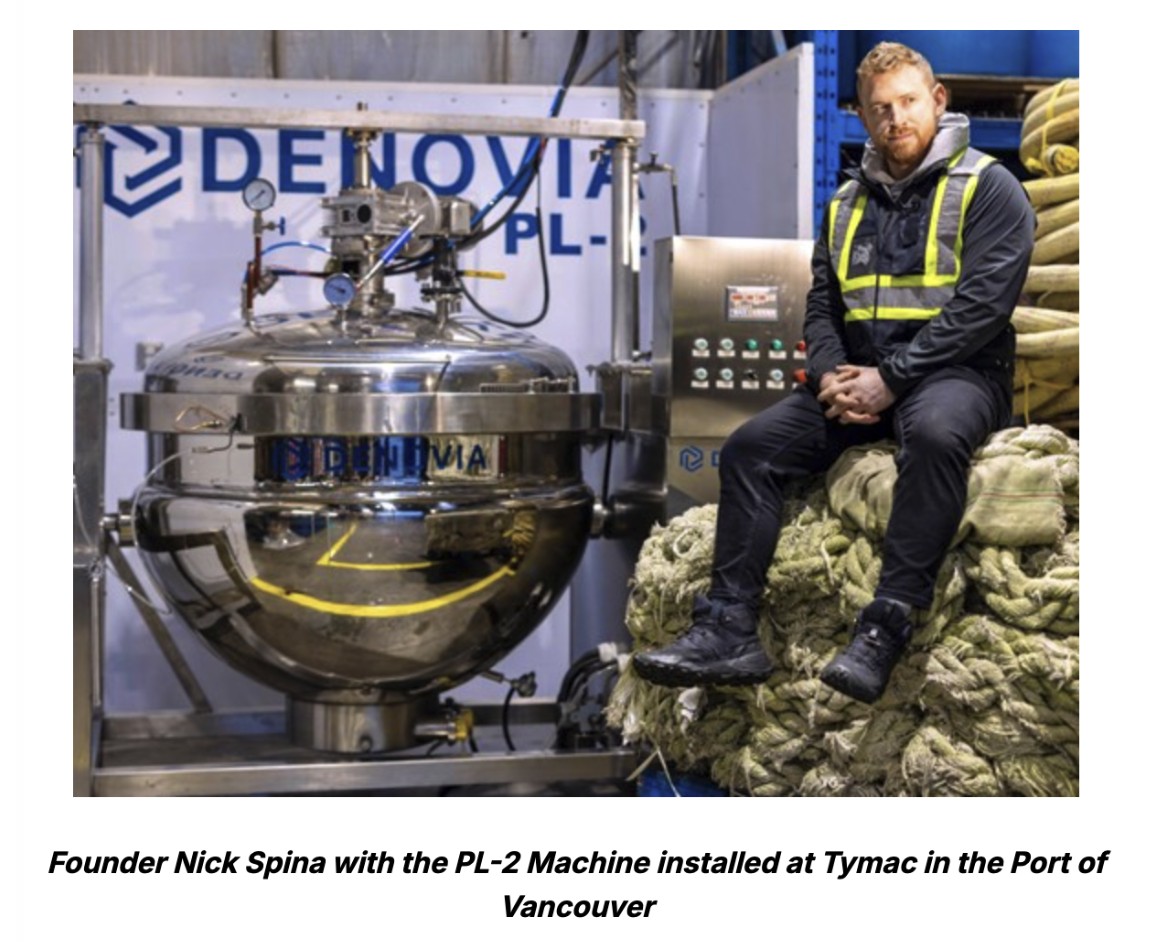
The process breaks polyester back down into its original chemical building blocks, including terephthalic acid, which can then be purified for reuse in manufacturing.
The August agreement moves Denovia directly into industrial commercialization. Denovia and a major international polyester producer will evaluate the technology within the partner's existing polyester recycling and manufacturing operations, targeting a first commercial facility with annual processing capacity in the tens of millions of pounds.
Successful validation for Denovia from the first commercial facility then turns into a repeatable model that can be deployed across multiple sites, pushing potential annual processing capacity from tens of millions of pounds into the billions.
It all combines Denovia's molecular recycling technology with an international producer's existing manufacturing operations, giving the company an industrial platform for a much larger rollout.
The next milestone is industrial performance.
Denovia does not need to own the factories to make money from the billions of pounds moving through them. Its licensing model puts the technology inside industrial infrastructure built and operated by its partners, giving Denovia a share of the economics without requiring the company to finance an equally massive global buildout of its own.
Beyond Plastic Bottles
That versatility becomes more attractive by the day, as the world's plastic problem gets dramatically worse. Pew estimates 130 million tonnes of plastic already enters the environment every year, and without major intervention that will more than double to 280 million tonnes by 2040. The health bill is potentially even more staggering: research cited by Pew puts the annual cost of health effects from plastic chemicals alone as high as $1.5 trillion globally.
The money required to solve it will be enormous, but so is the commercial opportunity for companies that can turn that waste back into something manufacturers will pay for.
McKinsey already sees $50 billion to $75 billion in economic opportunity in plastics recycling by 2035, while manufacturers are already facing a looming shortage of the high quality recycled material they increasingly need.
That opportunity is already attracting some of the biggest names in the U.S. chemicals and waste industries.
Eastman Chemical ( NYSE: EMN ) is perhaps the closest large-cap comparison to Denovia's molecular-recycling approach. Eastman operates a commercial-scale methanolysis facility in Kingsport, Tennessee, capable of processing more than 250 million pounds of plastic waste annually. The technology breaks difficult polyester waste down to its molecular building blocks, which can then be used to manufacture new materials with virgin-quality performance. Eastman says revenue from its circular platform doubled during the first half of 2026 as it continues to scale the business.
Dow ( NYSE: DOW ) is pursuing plastics circularity through both mechanical and advanced recycling. The chemicals giant has invested in recycling infrastructure and partnerships designed to convert difficult plastic waste into feedstocks that can be used to manufacture new plastics. Its advanced-recycling strategy includes technologies that break waste plastics into raw materials suitable for high-value applications, while its acquisition of Circulus expanded Dow's presence in post-consumer recycled resins.
LyondellBasell ( NYSE: LYB ) is also betting heavily on a future in which plastic waste becomes industrial feedstock. The company is developing its proprietary MoReTec advanced-recycling technology, designed to convert mixed plastic waste into raw materials for new polymers, alongside mechanical recycling operations. LYB has set an ambition to produce and market at least 2 million metric tons of recycled and renewable-based polymers annually by 2030.
Republic Services ( NYSE: RSG ) approaches the opportunity from the other end of the value chain. One of America's largest waste-management companies, Republic is building dedicated Polymer Centers that sort and process discarded plastics before supplying recycled material back to manufacturers. The company processes roughly 5 million tons of material annually across 74 recycling facilities, illustrating how valuable the infrastructure for recovering plastic feedstock itself is becoming.
Together, these companies show that plastics recycling is evolving from an environmental obligation into an increasingly important industrial market.
Denovia is no longer trying to prove this with a few grams of plastic in a laboratory. It has put equipment into the Port of Vancouver, processed difficult textile waste, moved into larger systems and now signed a framework with an international polyester producer for its first commercial facility and a potential rollout measured in billions of pounds.
Denovia began with a chemistry problem: how to turn virtually permanent waste back into something valuable. It now has an industrial partner, a pathway to billions of pounds of processing capacity and a $75 billion recycling market opening up in front of it. That is a very different company from the one that started by proving it could break down a plastic bottle in minutes.