
During the heatwave that France has just experienced, the increase in swimming in natural areas, but also in the city, was accompanied by a marked rise in drownings. If mastery of swimming techniques does not protect against all risks in natural environments, how can we concretely develop the prevention reflexes necessary at all ages?
Since June 18, 2026 in France, Interior Minister Laurent Nuñez announced the death by drowning of 74 people during a period marked by a heatwave. As shown by the epidemiological surveillance data on drownings conducted by Santé publique France (2025), episodes of high heat are accompanied by an increase in the number of drownings, as more people swim to cool off.
However, once again, some attribute these drownings to the fact that the French do not know how to swim due to the lack of pools for teaching swimming.
Is this explanation, often put forward in public debate, sufficient on its own to understand and stem this carnage?
Differentiating cause and correlation
Between June 1 and September 30, 2025, 1,418 drownings occurred in France, 409 of which resulted in death. These figures for summer 2025 are higher than for the same period in 2024, when there were 1,246 drownings and 350 deaths.
Drowning deaths in rivers or bodies of water accounted for about half of these deaths, regardless of age. For other locations, drowning deaths occurred more often in private pools for minors and at sea for adults.
Although we do not yet have precise data on drownings in June 2026, it seems these mainly involve male adolescents and young adults in unsupervised or even prohibited swimming areas. Referring to previous years' reports, we know that not knowing how to swim was a factor in 10% of drowning deaths.
Therefore, the idea that there is a strong correlation between not knowing how to swim and drowning deserves nuance. In the vast majority of cases, people drown in contexts where mastery of swimming techniques does not protect against the dangers inherent in the environment (currents, waves, depth variations, water temperature, obstacles, etc.), nor against misjudgment or risky behavior.
While not knowing how to swim is undeniably a risk factor, it alone cannot explain the occurrence of drownings. These most often result from a combination of individual, environmental, and behavioral factors.
Learning and the question of facilities
Faced with an aging public pool infrastructure and particularly energy-intensive, the state and local authorities must continue the mobilization initiated by Sports Minister Roxana Maracineanu (2019-2022) in favor of learning to swim and developing facilities. The goal is to enable as many people as possible to learn to swim within the school framework, in associations, and at the municipal level.
However, the situation is not uniform across regions. For example, between Seine-Saint-Denis and the rest of France, despite an increase in public resources allocated to swimming proficiency and facilities, the gap with the national average (86%) continues to grow. Between 2012 and 2023, there was a 20-point drop in swimming proficiency in ten years (66%), raising questions about the organization of quality aquatic education.
On the other hand, pool closures due to dilapidation are countless. According to estimates, about 400 pools are missing to allow for more widespread swimming instruction and thus reduce access inequalities nationwide.
The development of aquatic centers and leisure parks should not mask a worrying reality: France currently lacks "basic" pools, i.e., facilities primarily designed for learning to swim and training. Not to mention the increased costs for local authorities due to transporting students to pools increasingly distant from schools and under pressure to obtain slots.
As Olympic champion Alain Bernard demands, a "Marshall Plan" should be deployed to equip France more uniformly with this type of pool. At a time when, in the face of global warming, we observe a renewed interest in urban swimming and learning to swim in natural environments.
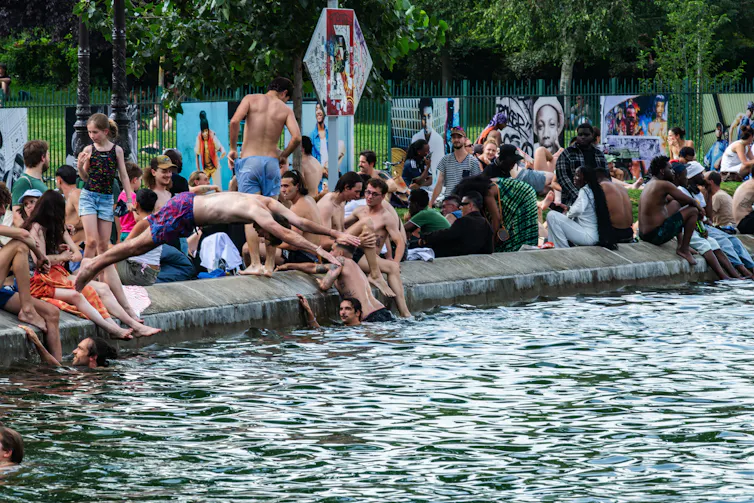
During the June 2026 heatwave, along the Canal Saint-Martin in Paris. Shutterstock (no reuse)
Although limited in space and time and contrary to the history of school swimming instruction, these trends are legitimate and interesting. Mirroring what has been done abroad for many years (Denmark, Germany), they offer the opportunity, in addition to pools, to swim in city centers, as in Nantes and Paris, and to learn to swim by analyzing one's natural swimming environment and accordingly adopting proper behaviors in the face of risks and vicissitudes of an open space, while being supervised by qualified professionals.
Emphasizing prevention
Included since 2006 in the common core of knowledge and skills for middle school, swimming proficiency is a national priority that extends the aquatic ease developed in elementary school. However, according to results from the European project "Aquatic Literacy For All Children" (ALFAC), French children lag significantly behind European standards. While they show a lower level in basic aquatic motor skills, they progress with age, but without closing the gap with other countries.
As research on aquatic literacy, i.e., the ability to move safely, confidently, and enjoyably in the aquatic environment, highlights, drowning prevention is still often lacking in training programs for children aged 4 to 12, both on the part of parents and learners.
Young people are receptive to preventive messaging even at a very young age. Regarding the attestation of swimming proficiency in safety (ASNS), it is based on completing 9 actions without swimming goggles. Its validation certifies mastery of skills allowing safe movement in a supervised and closed environment. Additionally, it includes teaching knowledge and attitudes related to prevention:
- knowing how to identify the person responsible for supervision to alert in case of a problem;
- knowing and respecting basic hygiene and safety rules in a bathhouse or supervised area;
- knowing how to identify environments and circumstances where the ASNS allows safe movement.
According to our observations, these dimensions are not sufficiently taken into account and certified to teach the student how to use them appropriately depending on the location: public pool, private pool, supervised or unsupervised natural areas, etc. Yet, we now have a range of educational tools that allow prevention and education on the dangers of swimming.
Adapting swimming according to life stages
Regarding adult drownings in 2025, compared to 2024, the number of drowning deaths at sea increased by 20% and with age. In terms of prevention, they need to be made aware of adapting their swimming habits to different stages of life. For example, instead of swimming out to sea to reach the 300-meter buoy, it becomes more reasonable to swim parallel to the beach.
As they age, they should not hesitate to seek professional advice to adapt their swimming to their health status and physical condition before venturing too far and too long.
Reducing drownings to just a question of swimming proficiency or infrastructure deficit obscures the complexity of the phenomenon. The circumstances of drownings also involve other factors: overestimation of one's own abilities, lack of knowledge of risks associated with aquatic environments, risky behaviors, alcohol consumption, environmental conditions, or the absence of a genuine prevention culture according to life stages.
Therefore, combating drownings cannot be limited to learning swimming techniques alone; it also requires developing a true education in aquatic ease, risk management, and decision-making in spaces supervised or not by qualified professionals. Also exposed to the consequences of heatwaves, this profession is under strain and deserves the utmost attention from public authorities and respect from swimmers/bathers.


