
The editor-in-chief of the US military newspaper Stars and Stripes has expressed concerns about censorship following his dismissal by the US Department of Defense (DoD) for "insubordination".
"This is a time when we really need to hear what's happening," Erik Slavin told the BBC, adding that Pentagon officials seemed "less and less inclined to speak on the record".
Slavin believes he was fired for stating in an interview that "in a hypothetical situation, censorship would be a red line". A reporter and the paper's publisher were also dismissed.
The Pentagon has declined to comment to the BBC. However, the sackings occur amidst tensions between the Trump administration and the US media.
 Getty Images
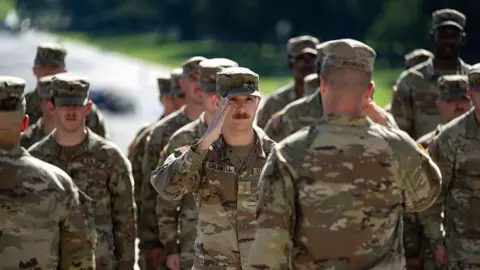
Stars and Stripes provides news to US troops around the world
Despite being partially funded by the Pentagon, Stars and Stripes has maintained editorial independence through a congressional mandate and DoD rules.
The newspaper's Middle East reporter, Lara Korte, also stated she was informed of her dismissal. Both Slavin and Korte believe their sackings, both for insubordination, are linked to an interview they gave to CBS's Sunday Morning program last month, according to the BBC's US partner CBS News.
Stars and Stripes reported that publisher Max Lederer was also fired. Lederer had announced his retirement on Tuesday, citing fundamental differences in understanding the paper's value and mission compared to the Pentagon's plans for the publication.
Slavin, who has been with the paper for 21 years, told the PM program that he had not received an official explanation for his dismissal and was considering his response, despite being unable to appeal.
He mentioned uncertainty about whether his dismissal was related to his paper's initial reporting on conditions aboard the USS Abraham Lincoln, a warship deployed in the Gulf amid the ongoing US-Iran conflict. The vessel has spent a record 240 days at sea without docking, and family members of sailors have voiced concerns about their mental health, with some reportedly attempting to harm themselves.
However, Slavin noted that his dismissal occurred in an environment where the Pentagon had not held a press conference since May, and journalists had resisted attempts to interfere with their reporting.
Korte wrote on X: "It's a shame for the institution and service members, who swore to defend the Constitution and deserve the right to a free and independent press."
Mark Schoeff Jr, president of the National Press Club, described Slavin's firing as "another brazen attempt by the Pentagon to dictate coverage of the military and should be immediately reversed."
Stars and Stripes' content is consumed daily by an average of 1.4 million people, primarily online, according to CBS. The paper is still printed outside the US for military personnel in locations with unreliable internet access.
In October, leading US news outlets rejected a new policy that barred journalists from entering a building unless they only reported information officially authorized by the DoD. At the time, The New York Times, The Washington Post, CNN, and the BBC were among the major outlets that refused to comply with the new rules. The Trump administration argued that the changes were necessary for national security.
In April 2025, a US judge ordered the administration to reinstate the Associated Press's access to presidential events after it was blocked in a dispute over the term "Gulf of America". A few months prior, the White House broke with tradition and took control of the press pool that covers the US presidency.
'Quiet, quiet, quiet!' - What triggers Trump to shut down reporters?


