Jessie Wagoner/Gazette
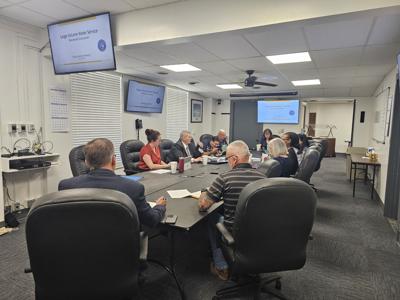
Emporia city commissioners discuss a proposed Large Volume Water Service policy during a study session Wednesday. The policy would establish requirements for future high-volume water users.
The Emporia City Commission spent more than an hour Wednesday discussing a proposed Large Volume Water Service policy designed to protect existing water customers while establishing rules for future industrial users with high water demands.
City officials said the proposed policy is not tied exclusively to the proposed Flint Hills Digital Campus, but acknowledged the discussion was prompted by recent economic development projects that could require significantly larger amounts of water than the city traditionally serves.
The proposed policy would apply to new customers using an average of 500,000 gallons of water per day or more, or peak usage of 1 million gallons per day. Existing customers expanding beyond those thresholds also would be subject to the policy.
City Manager Trey Cocking told commissioners the goal is to ensure current residential and commercial customers are not asked to subsidize large industrial users.
“This policy gives us a tool to mitigate that,” Cocking said during the study session. “For anybody. Any industry.”
Under the proposed framework, large-volume users would be required to enter into individual water service agreements approved by the commission. The agreements generally would last at least 10 years and require customers to pay for at least 75% of their contracted water capacity, even if they use less water.
The policy also would require customers to fund infrastructure improvements necessary to serve their projects. City officials said existing ratepayers would not bear the costs of water system improvements made to accommodate large users.
Cocking said staff may strengthen language before the policy returns to the commission to make clear that major capital costs would be paid upfront by the customer.
The draft also allows the city to require financial assurances equal to 12 to 24 months of minimum billings, although Cocking said he would like flexibility to extend that requirement to as much as 36 months depending on the financial strength of the customer.
“We need these rules and regulations before we proceed, and that’s where we are now,” Cocking said.
Utility Director Jack Taylor said the proposed thresholds appear reasonable and fall within the city’s existing water planning parameters.
Commissioners also discussed concerns frequently raised by residents regarding water quality and wastewater from industrial users.
Cocking said industrial wastewater does not mix with the city’s drinking water system and that backflow prevention devices are required whenever there is any potential for contamination.
“Your water is coming in one. Everything else is going in another,” Cocking said. “There is no crossover.”
City officials noted Emporia already serves significant industrial customers and maintains pretreatment programs, testing requirements and discharge standards for existing industries. Staff said the city conducts monthly water quality testing at 25 locations throughout the community and also monitors stormwater and wastewater discharges.
According to city staff, industrial customers currently account for about 50% of the water sold by the utility system.
The city maintains approximately 159 miles of water mains and 5 million gallons of water storage capacity. Officials said engineering studies would be required before approving any large-volume customer to determine whether the system can support the additional demand and what infrastructure improvements may be necessary.
The proposed policy also states the city is not obligated to provide service beyond available capacity or in a manner that would adversely affect the reliability or financial stability of the utility system.
Staff will use feedback from the study session to revise the policy before returning to the commission with potential ordinance changes, service agreement templates and implementation procedures.