
Google revealed Gemini 4 Argon a few weeks ago, saying that it needed to move cautiously toward a full release because of the potential for nefarious use. Google seems to have worked all that out pretty quickly, though. Argon is beginning its wide rollout today, but it’s only coming to paying users at this time, and even those on lower-tier plans won’t have full access.
Nothing about Gemini 4 Argon’s capabilities has changed. Google still points to the benchmarks it published late last month as evidence of the model’s advanced reasoning and agentic coding capabilities. The model is supposedly trained to refuse malicious instructions, and an automated misalignment monitor can stop processing if it detects an unintended workflow. Google claims Argon needs that because it’s so capable.
The company has a few new examples of how Argon has helped inside Google, where it has been used by thousands of Googlers. Argon has reportedly been instrumental in making YouTube’s comment system more efficient. Argon identified redundant emoji rendering that, when eliminated, dropped server load by 45 percent. Engineers also turned Gemini 4 loose on the proprietary drone physics simulator used in Project Wing, and the AI found critical bugs that had been in the codebase since 2018. Google also notes that Argon has advanced its robotics program, showing a measurable step increase in embodied reasoning.
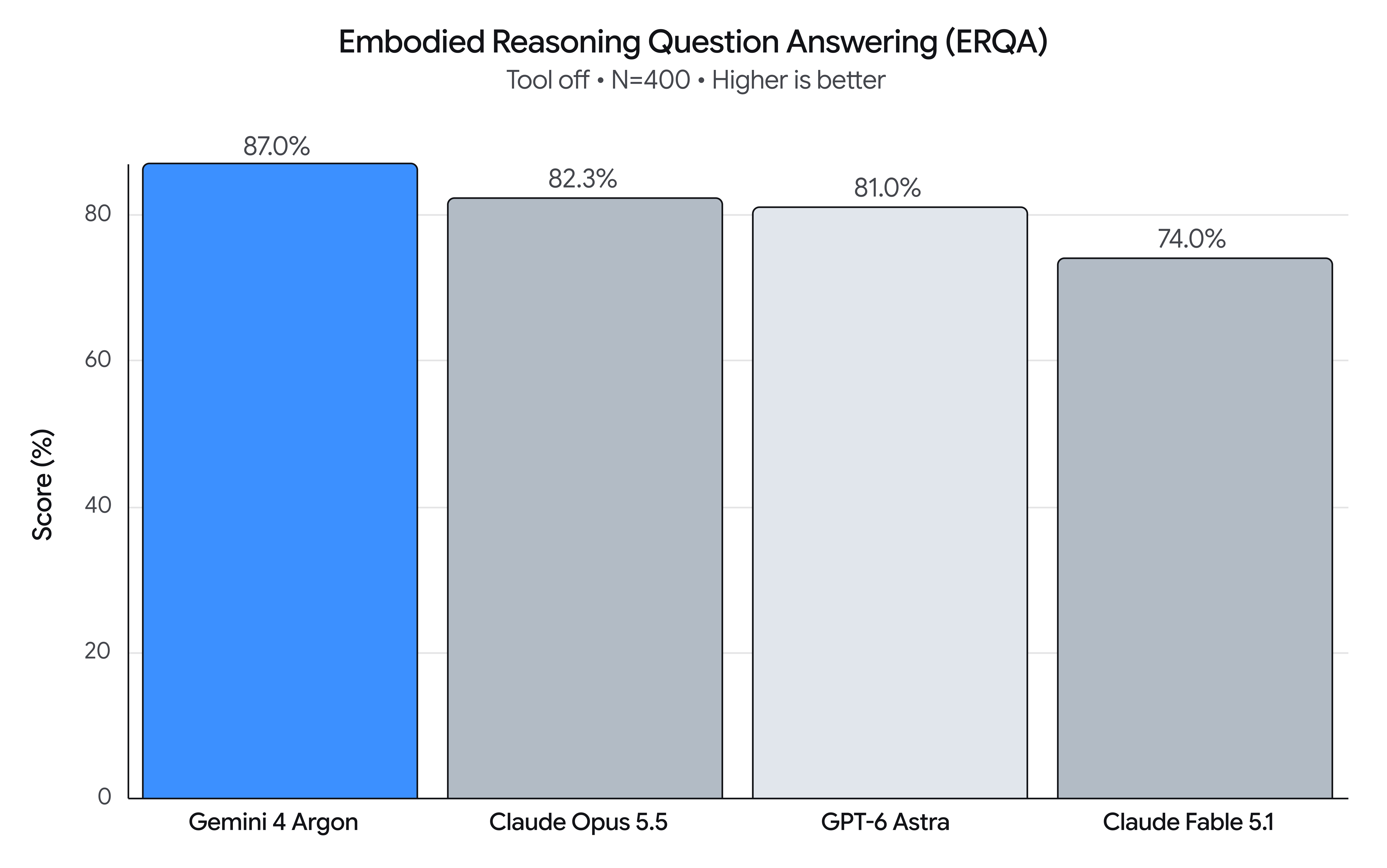
Argon is apparently better at solving spatial problems in 3D environments.
Credit: Google
Argon is apparently better at solving spatial problems in 3D environments.
Credit:
For your general AI queries, Gemini 4 Argon will be rolling out today in the Gemini app. However, it’s only going to be available for those on AI Pro ($20/mo) and AI Ultra (starting at $99/mo) plans. This isn’t a shock, as Google also recently restricted access to the Flash models for free users, leaving them with just Flash-Lite.
That’s not all—there are additional restrictions on Argon for coding-focused products. In Antigravity and AI Studio, the new model will only be available for those on AI Ultra plans. Code generation has become even more important in the frontier of AI development since Google’s last Pro model release, but it can eat up a lot of compute cycles.
You can generate code with Argon in the Gemini app’s Canvas mode even if you’re a Pro subscriber, but the multi-threaded agentic workflows in Antigravity are probably too expensive. If you need something more capable than Flash models, Google says it’s keeping Gemini 3.1 Pro around for the time being. Google has declined to clarify when (or if) Argon will come to Antigravity for other subscription tiers.
For developers accessing Google’s models via the paid API, the company will happily sell you some Argon tokens. Pricing is temporarily set at $2 per million input tokens and $10 per million output tokens, with a 95 percent discount for cached tokens. This deal is only good through November 30, when the rate will jump to $4 per 1M input tokens and $20 per 1M output tokens. Devs will have to factor that in before building workflows around Google’s new model.
Ryan Whitwam Senior Technology Reporter
Ryan Whitwam is a senior technology reporter at Ars Technica, covering the ways Google, AI, and mobile technology continue to change the world. Over his 20-year career, he's written for Android Police, ExtremeTech, Wirecutter, NY Times, and more. He has reviewed more phones than most people will ever own. You can follow him on Bluesky, where you will see photos of his dozens of mechanical keyboards.


