
What Big Food Did to Ice Cream
The “encrapification” of the American pint — a chemist’s plain-language dissection
in late March, the Ben & Jerry’s Foundation won the right to join a lawsuit against The Magnum Ice Cream Company — the newly independent Unilever spinoff that now controls Ben & Jerry’s, Breyers, Talenti, and the rest of the freezer aisle you grew up with. The founders aren’t fighting over flavor. They’re fighting to preserve the independent board that was the last institutional check on exactly the kind of ingredient optimization this article documents. The courtroom battle is about governance. The molecular battle has been going on for years. This piece is about the one you haven’t been watching.
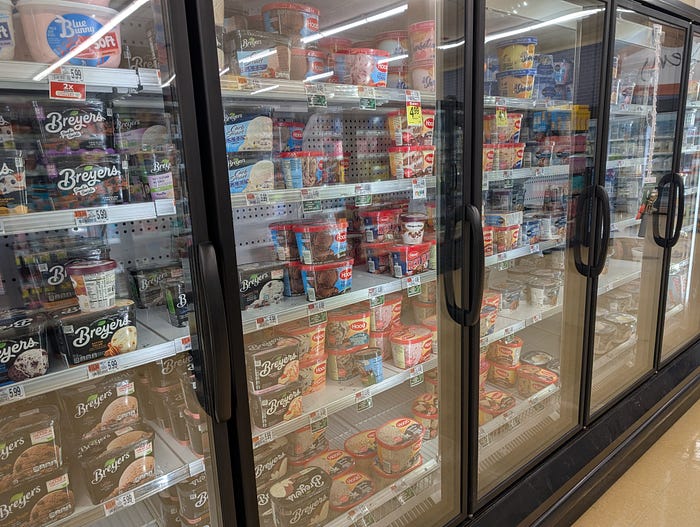
Today’s ice cream aisle at a major supermarket stretches 1–2 full aisles. A significant fraction of what you’ll find isn’t legally ice cream.
The freezer case used to be one of the few places in a grocery store where you could trust the label. You bought ice cream, and you got ice cream. That era is over.
For years, if you suggested that the products we buy today are inferior to the versions from twenty or thirty years ago, you were dismissed with a “Hello, Boomer” or told that “memories are always better.” But as someone who values evidence, I’m here to tell you that this isn’t nostalgia. It’s a documented, technical retreat. Store-bought ice cream hasn’t just “changed”; it has been systematically reformulated by multinational food conglomerates using regulatory arbitrage and formulation science to determine how much cream they can remove from “ice cream” before we notice.
This is the story of the dairy frog, boiled by ever poorer ice creams.
The Regulatory Arbitrage of “Frozen Dairy Dessert”
In the United States, “Ice Cream” is a legally protected term. According to the FDA’s Standard of Identity (21 CFR 135.110), a product must meet two hard thresholds to earn that name: it must contain at least 10% dairy milkfat, and it must weigh at least 4.5 pounds per gallon. These rules were designed to prevent unscrupulous manufacturers from selling a carton of air and stabilizers under the guise of a dairy treat.
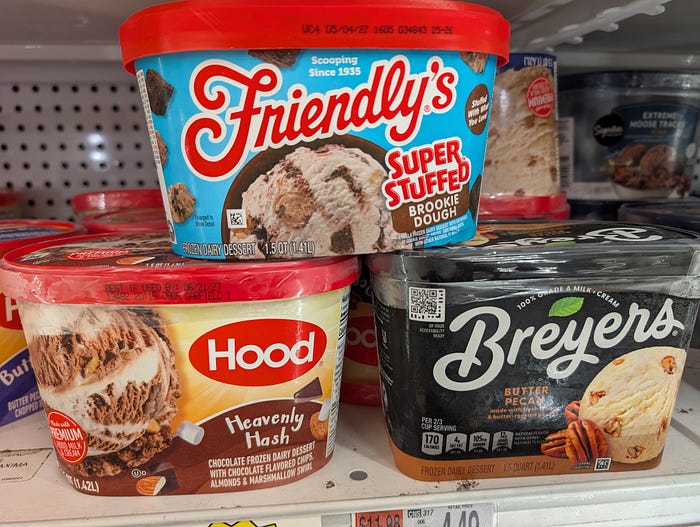
What do these three tubs have in common? Not one can legally be called “Ice Cream.” That label is missing from every container — because none of them qualify.
But walk down the aisle today and look at the label of a brand like Breyers. You will notice that many of their most popular flavors are now legally required to be labeled as “Frozen Dairy Dessert.” This isn’t a branding choice; it’s a confession. By dropping below that 10% milkfat threshold and pumping the product full of air, they have exited the legal definition of ice cream.
It’s not as if cheap barrel-bottom frozen desserts are a new thing. For decades, Sealtest was the brunt of “at least it’s not…” jokes — a giant national brand that occupied the very bottom shelf and knew it. The product was fine. It served its purpose. Perfect for feeding 20 hungry four-year-olds who wouldn’t know the difference. But few adults were fooled, and the brand never pretended otherwise. There was a kind of integrity in that. They held a specific spot in the ecosystem and carried that mantle honestly.
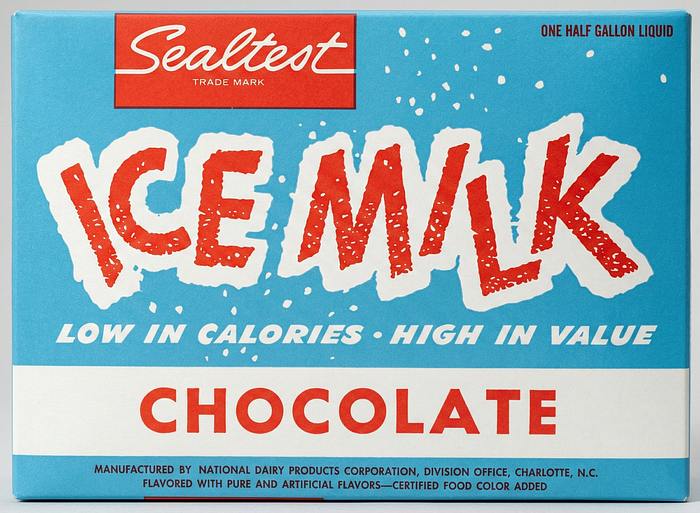
Before marketers came in and turned a negative into a promotion, Sealtest offered up a low-quality dairy dessert that couldn’t legally be called “ice cream.” Sealtest was part of Kraft, which sold off its ice cream holdings (Sealtest, Breyers) to Unilever in 1993. Unilever terminated the brand entirely in the US in 1999.
Unilever, which acquired Breyers in 1993, is the architect of this decline. They took a brand that was founded on a “Pledge of Purity” — a 150-year-old promise signed by Henry Breyer that the product would never contain “adulterants, gums, gelatins, powders or fillers” — and effectively shredded it. The original recipe was four ingredients: milk, cream, sugar, and vanilla. Today, a tub of Breyers Extra Creamy Vanilla contains twelve ingredients, including corn syrup, whey, and three different thickening agents.
Side-by-Side Ingredient Analysis: Breyers Vanilla
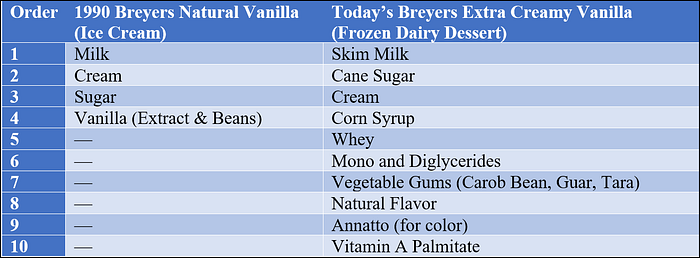
Cream being pushed to third place is the whole story in one row: the fat that once defined the product has been demoted beneath sugar (with whole milk replaced by skim milk, to boot). It’s worth noting that Breyers actually sells three vanilla products simultaneously. The Extra Creamy, as detailed above, can’t legally call itself ice cream. “French Vanilla” manages to clear the “ice cream” bar (while possibly offending the French) with 13 ingredients, including corn syrup and three gums. And “Natural Vanilla” is genuinely close to the original — though it quietly adds skim milk, tara gum, and swaps real vanilla for “natural flavors.” That last one is the cleanest thing in the entire Breyers line, which tells you everything you need to know about where the brand has landed.
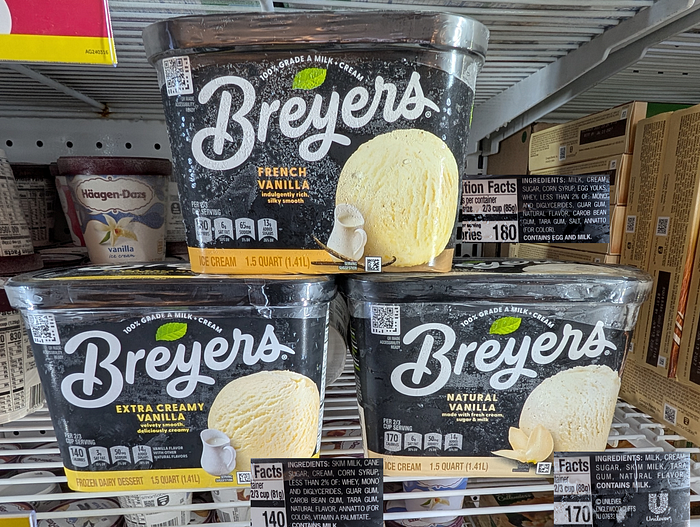
A tale of three vanillas. One (Extra Creamy) can’t be called ice cream. The French vanilla adds eggs, but also adds a bushel of gums and diglycerides. Only the Natural Vanilla, bottom right, is anything like what the brand used to sell.
The Physics of Profit: Air as an Ingredient
The most profitable ingredient in a mass-market frozen dessert is air. In the industry, this is called “overrun.” Overrun is the volume of air incorporated into the mix during churning, expressed as a percentage:

A 100% overrun means that for every gallon of dairy base, you produce two gallons of “product.” While premium brands like Häagen-Dazs operate at roughly 25–30% overrun, many mass-market brands approach the 100% ceiling — doubling volume with air and, in some cases, requiring “Frozen Dairy Dessert” labeling.
Corporate marketing teams have become remarkably adept at selling this air back to us as a feature. The “Slow Churned” or “Double Churned” revolution, pioneered by Dreyer’s (Edy’s) and quickly adopted by Unilever’s Breyers, is a masterclass in this deception. These processes use lower temperatures and higher pressures to break fat globules into smaller sizes, allowing the product to mimic the mouthfeel of full-fat ice cream while containing significantly more air and less actual cream. They tell you it’s “smoother” or “easier to scoop.” What they don’t tell you is that they are charging you premium prices for a stabilized foam that deflates if left on the counter.
Lousier Living Through Chemistry
To be clear, stabilizers and overrun aren’t inherently problematic. At appropriate levels, they improve texture, slow ice crystal growth, and create a smoother product. You’ll even find small amounts of them in some of the best high-butterfat premium brands. The issue isn’t their existence — it’s the degree to which they’ve become substitutes for dairy rather than complements to it.
As you remove the fat (which provides structure and flavor) and add air (which provides nothing), the resulting mixture becomes physically unstable. It would normally turn into a grainy, icy mess the moment it left the factory. To solve this, food scientists have turned to a cocktail of hydrocolloids — guar gum, carob bean gum, carrageenan, and the now-ubiquitous tara gum.
These gums are “magic dust” for the bottom line. They manage water mobility and increase the viscosity of the mix, creating a “chewy” or “gummy” texture that mimics the richness of cream without the cost of actual dairy. If you’ve ever noticed that your ice cream now feels slightly “rubbery” or doesn’t actually melt into a liquid, but rather stays in a foamy, gelatinous blob, you are experiencing the effects of over-stabilization.
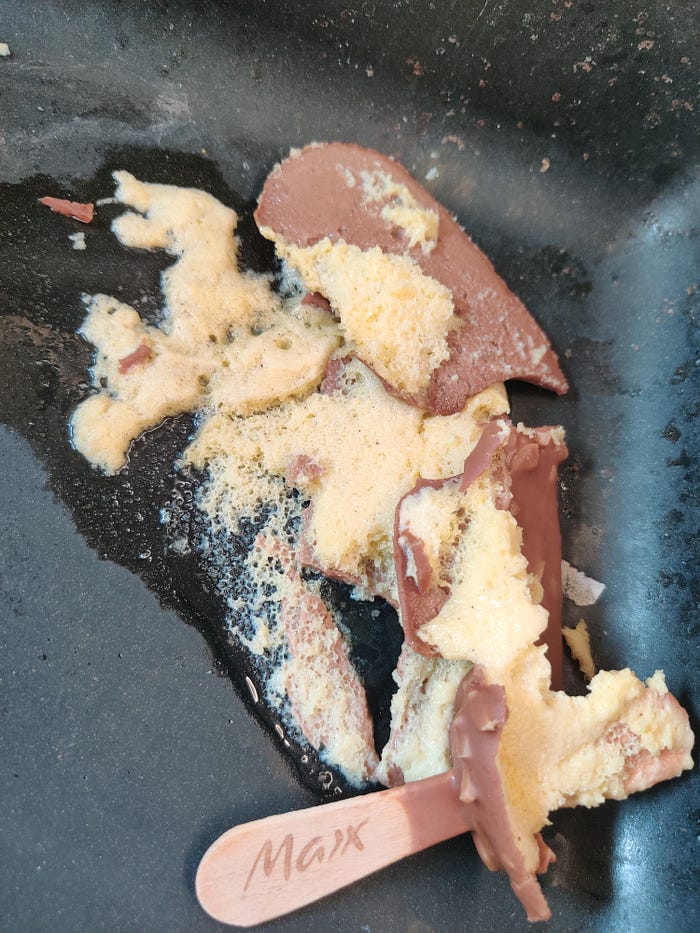
Sad example of what happens with highly gummed ice cream-like product tries to melt. Ugh. Kaufland’s “treat.” Photo from Reddit.
These stabilizers (“hydrocolloids,” if you want to impress your friends) work by trapping water in microscopic networks that prevent ice crystal growth. At low levels, this keeps ice cream smooth; at high levels, those same networks become elastic, giving the product that uncanny, almost bouncy texture. When someone says that ice cream seems too “chewy,” this is what they’re talking about. Turning a smooth, soothing spoon of ice cream into something you have to chew is not innovation.
This isn’t just about Breyers. Since Unilever acquired Talenti in 2014, long‑time fans have noticed a marked decline. The first ingredient in their Salted Caramel Truffle gelato is no longer “caramel,” and other flavors have quietly picked up extra help in the form of coconut oil, sunflower oil, dextrose, and gums. Today, there are plenty of public complaints about a base that feels increasingly “gummy” and “bland,” padded out with cookie chunks and engineered air pockets to fill the jar visually without filling it substantively. It’s the food industry equivalent of shipping a half‑empty bag of chips filled out with nitrogen. (Wait, they do that too? Yeah, they do.)
Though Unilever’s trudge toward profits over enjoyment has been relentless, it would be unfair to suggest they are alone. The majority of sub‑super‑premium ice cream brands you’ll find on the shelves of your local store are filled with gums and subject to significant overrun — and, frequently (but not always), not enough butterfat to legally call themselves ice cream. That includes Blue Bunny, Friendly’s, Dreyer’s/Edy’s, Turkey Hill, Hood, and most of the other familiar names filling the mid‑shelf real estate. The easiest field test? Flip the carton over and check the calories per serving (2/3 cup). If it’s below ~220, it’s very likely the product is leaning heavily on air and stabilizers rather than butterfat. The label doesn’t lie — but it also doesn’t volunteer anything.
Rate Ice Cream Like a Boss
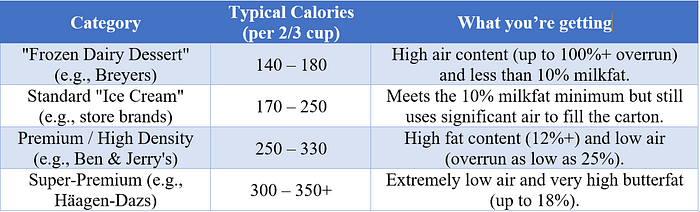
Note that some variants can bump up the calories without improving quality, by loading in high‑calorie inclusions like chocolate or candy pieces. But this still gives a pretty good starting guide.
And this race to the bottom repeats across nearly every brand Unilever touched, which brings us to Ben & Jerry’s.
Even Ben & Jerry’s, despite its independent board, has faced criticism for thinning out mix‑ins and moving toward more stabilized formulations under Unilever’s “Path to Growth” strategy — a phrase that should be understood to mean “path to margin.” Gums now run rampant in the Ben & Jerry’s line, as does corn syrup (mostly from the mix‑ins). Fats have transitioned to soybean and coconut oils from butter in some varieties. In 2010, they removed the “All Natural” label from their ice cream because… well, you do the math.
The Beacons of Integrity
Just because the midline has been decimated doesn’t mean “good science” has vanished entirely. There are still brands where the “can” and the “should” remain in alignment.
Häagen-Dazs remains the gold standard for grocery store minimalism. While many of their specialty flavors have started to include limited stabilizers, their core pillars — Vanilla, Chocolate, Strawberry — rely on a high milkfat content (up to 18%) and an extremely low overrun (approx. 25–27%) to deliver richness. They don’t use gums in these core flavors because they don’t have to; the density and fat provide the stability.
And then there is Graeter’s. If Häagen‑Dazs is a triumph of minimalism, Graeter’s is a triumph of artisanal engineering. They still use the French Pot process in 2.5‑gallon batches, built on a French‑style egg‑custard base — cream, milk, cane sugar, eggs — whose natural lecithin provides the emulsification that makes a gum cocktail unnecessary, though a few flavors use small amounts at a fraction of what props up a Frozen Dairy Dessert. Their overrun is naturally capped around 20–25%, producing an ice cream so dense it has to be hand‑packed because automated fillers can’t move it. Some tubs hit 380 calories per ⅔ cup — not just passing the dairy field test but obliterating it. This is what happens when you treat product quality as a hard constraint and the supply chain as the adjustable variable. Unfortunately, in early 2025, Kroger pulled Graeter’s from all regions outside the Midwest — a predictable outcome for a product that refuses to cut corners. The brand doing it right is becoming harder to find. If you needed one data point to explain everything wrong with the freezer aisle, that would be it.
A Quick Cheat Sheet: What’s in Your Freezer?
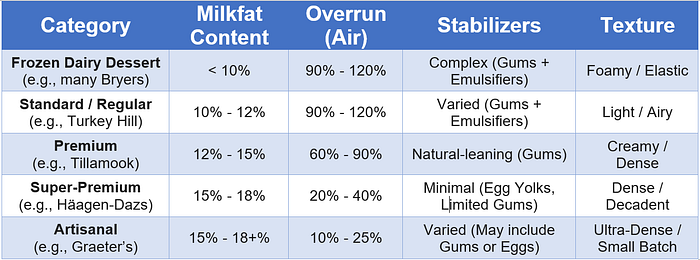
Gums include guar, tara, and locust bean, along with carrageenan. Emulsifiers include mono and diglycerides. Use this cheat sheet to avoid getting cheated by high prices and getting less of what you expect
Another Path to Profits: Shrinkflation
While their competitors raced to the bottom, Häagen-Dazs found another way to improve margins without diminishing the product: shrinkflation. In 2009, they reduced the 16oz pint to a 14oz “pint” — prompting the expected (and deserved) howls from what amounted to an overnight 12.5% effective price increase. (Also a bad lesson for any child trying to understand the meaning of “pint.”) But by doing so, they found a road to profits that didn’t crapify the product itself. The market has (mostly) forgiven the shrinkage and continues to reward the quality they’ve maintained.
For a long time, Ben & Jerry’s made a point of staying at a full 16oz and even took public shots at brands that quietly shaved their “pints” to 14oz. More recently, though, they’ve found their own way to play the size game. The new Sundaes and Topped lines come in packages that look like standard pints but often clock in well under 16oz — for example, a “Turtle Sundae” at 14.44 fl oz or a Topped Dirt Cake at 15.2 oz, with a whipped‑topping layer and extra mix‑ins on top. You still pay pint prices, but more of that money is now going to air, whip, and candy sitting on the surface rather than to actual ice cream underneath. Pay attention to the Topped Tax, and shop carefully.
Talenti has taken a similar approach with their Layers line — alternating bands of gelato, sauces, and inclusions stacked inside a standard pint container. The result looks generous and photogenic, but the actual gelato component is substantially less than what fills a traditional pint. Same form factor, same price point, less of what you came for. Great margin increasers think alike.
Ironically, most mid-tier brands underwent shrinkflation too — moving from 2 quarts to 1.75, and then to 1.5 — while simultaneously dumbing down what went inside. A classic pincer movement, taking down the hapless consumer from both sides. At least there’s now less of it not to love.
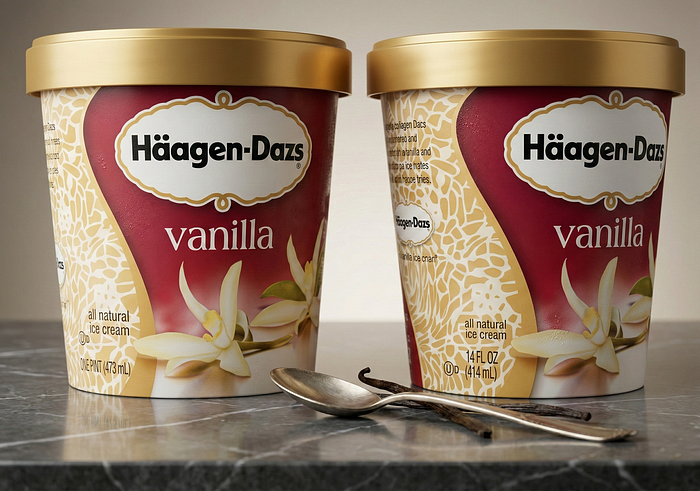
Shrinkflation as an alternate road to not encrapping your product. Haagen Dazs went from a real pint (16oz) to 14oz without any other obvious changes. The product was just as good, but there was less of it. Same price, though.
The Profit of Erosion
It is tempting to look at the “encrapification” of ice cream as an inevitable result of inflation or shifting consumer health trends. But the data doesn’t support that. Dairy prices have fluctuated, but the pivot to “Frozen Dairy Dessert” wasn’t a survival move — it was a margin-expansion move. It was a strategic decision to trade brand equity for short-term earnings.
Food scientists have known for decades that consumers can’t reliably detect fat reductions of 2–3 percentage points in blind tests — a finding confirmed in modern controlled trials. Overrun, meanwhile, can be increased without any change in declared ingredients and no regulatory trigger until the product falls below the 4.5 lbs/gallon threshold. Once companies understood these thresholds, they pushed them — slowly, incrementally, and profitably.
The more uncomfortable question isn’t what they did — it’s why it worked. Food scientists didn’t exploit some exotic vulnerability; they exploited convenience, habit, and the fact that most of us stopped reading labels the moment we trusted a brand. We let it happen because trusting the label was easier than interrogating it. Corporations noticed. They always do.
What we’re seeing now isn’t accidental decline. It’s late-stage optimization: brands engineered to the edge of consumer detection, tuned for cost efficiency rather than experience. Much of that decision-making power has consolidated into a handful of global conglomerates. In 2025, Unilever finished spinning off all its ice cream brands into a standalone company, The Magnum Ice Cream Company. Good luck to them.
As a computational scientist, I recognize this as a constrained optimization problem — one in which the constraints were gradually redefined to favor producer economics over consumer experience. Every manufacturer optimizes for margin; the distinction lies in which variables are treated as fixed and which are allowed to move. Brands like Häagen-Dazs appear to treat ingredient integrity and sensory appeal as hard constraints. Others have treated those variables as adjustable, relying on incremental changes that remain below the threshold of consumer detection. One approach preserves product identity and adjusts price transparently. The other is optimization by dilution.
The next time you’re in the freezer aisle, ignore the “Slow Churned” slogans and the “Smoother Texture” promises. Turn the carton over. If it doesn’t say “Ice Cream,” or if the ingredient list looks like a chemistry final, put it back. We shouldn’t reward corporations for the sophisticated debasement of the things we love.
The data doesn’t care about nostalgia. And the data says that Breyers used to be better. Talenti used to be better. And “frozen dairy dessert” is just a polite way of saying they’ve figured out how to sell you a bubble for five dollars.
Ice cream is just the canary — this same optimization-to-failure pattern is unfolding across the entire packaged food system, and the only way to stop it is to start noticing and stop buying.
Just because you’re a boomer doesn’t mean you’re wrong. It just means you’re tired of being slowly boiled.
If you liked this teardown, there’s more where it came from. Half Life is my Substack — where I apply forty years as a computational chemist to culture, consumer behavior, and the corporate logic hiding in plain sight. Free to subscribe.


