Hyosung Heavy Industries' stock price has surged eightfold in one year. Here's why.
- Revised 2026-06-05 09:04
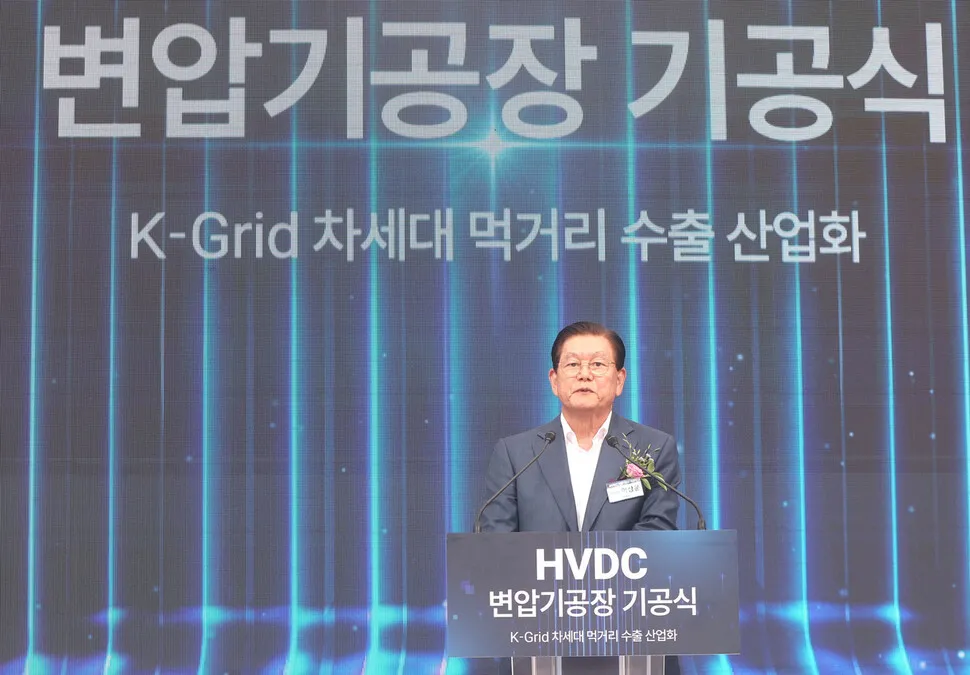
[Image: Hyosung Heavy Industries' corporate value has grown more than eightfold in one year, largely thanks to power equipment such as transformers and circuit breakers. Hyosung Vice Chairman Lee Sang-woon gives a speech at the groundbreaking ceremony for Hyosung Heavy Industries' Changwon HVDC transformer plant in Seongsan-gu, Changwon, South Gyeongsang Province, July 2025. (Yonhap News)]
Hyosung Heavy Industries is the most expensive stock in South Korea. Buying one share costs over 4 million won. Stocks priced above 1 million won per share are called "emperor stocks," and there are about 11 such stocks in our market.
A year ago, Hyosung Heavy Industries' stock was trading in the 500,000 won range. But in just one year, it has risen more than eightfold, becoming quite a heavy stock. Because of the high psychological barrier for individual investors, daily trading volume is only around 60,000 shares, leading to growing calls in the market for a stock split.
Growing calls for a stock split, like Samsung Electronics
In 2018, Samsung Electronics' stock was around 2.5 million won. After splitting shares with a face value of 5,000 won into 100 won, the per-share price dropped to around 50,000 won, and the number of shares increased 50 times. If Hyosung Heavy Industries performs a 50:1 stock split like Samsung Electronics, the stock price would fall to around 80,000 won, and the number of shares would increase 50 times to over 460 million shares. In 2018, during the semiconductor boom, Samsung Electronics shares were too heavy for smooth trading, but after the split, trading became active, and the company's value eventually rose further.
Of course, in theory, there is no change in corporate value before and after a stock split, so a split does not directly boost the stock price. However, the market expects that lighter shares will attract stronger buying, pushing the price higher than before. So management should consider it carefully.
Power equipment drives growth
The eightfold increase in corporate value in one year is largely due to the power equipment that Hyosung Heavy Industries produces. While apartment brands like Harrington Place may be more familiar to us, 70% of Hyosung Heavy Industries' sales and 99% of its operating profit come from power equipment such as transformers and circuit breakers.
As big tech companies ramp up investment in AI data centers, not only memory semiconductor companies like Samsung Electronics and SK Hynix but also power equipment companies like Hyosung Heavy Industries are on a strong growth trajectory. This is partly because NVIDIA's high-performance GPUs consume a lot of power, but also because the rapid pace of IT development continuously fuels demand for expansion and upgrades of power infrastructure.
Indeed, Hyosung Heavy Industries' order backlog for power equipment stood at about 10.7 trillion won at the end of 2024, but by the end of 2025, it had increased 43% to 15.3 trillion won. With annual power equipment sales of 4.1 trillion won, the company has secured work for over three years.
Hyosung Heavy Industries, known for developing Korea's first 765 kV transformer, specializes in ultra-high-voltage transformers. Transformers change voltage; they step up voltage at power plants to reduce current and minimize transmission losses, then step down voltage for consumers. With a 765 kV transformer plant in the U.S., it holds the top market share in the largest transformer market.
Competitor HD Hyundai Electric also produces 765 kV transformers domestically and plans to manufacture them at its U.S. plant. However, these two companies are not the only manufacturers. Japanese firms Hitachi Energy and Mitsubishi, Germany's Siemens Energy, and America's GE Vernova are also competitors.
To distribute transmitted power within data centers, equipment like distribution transformers and switchgear is needed. LS Electric has strengths in such distribution and power solutions, while Hyosung Heavy Industries and HD Hyundai Electric also cover some areas.
In 2025, Hyosung Heavy Industries' power equipment sales amounted to 4.1 trillion won, while HD Hyundai Electric and LS Electric posted 4 trillion won and 4.9 trillion won, respectively—no significant difference. However, all three companies have market capitalizations around 40 trillion won, meaning their stock prices are quite high relative to earnings. While Samsung Electronics and SK Hynix trade at about 6 times expected EPS, these three have PERs exceeding 50 times. The reason can be found in the industry growth section of Hyosung Heavy Industries' business report:
"The electrification of energy is accelerating across various sectors—industry (heat pumps, electric furnaces), buildings (heating and cooling), and transportation (electric vehicles). As the share of renewable energy increases, investment in facilities to secure power grid flexibility and stability is also expanding.
In line with these trends, global electricity demand, which significantly impacts our business, is expected to continue growing until 2050. Demand for replacing aging grids in developed countries such as Europe and North America is increasing, and the Russia-Ukraine conflict has spurred energy independence and green energy transition policies, boosting demand for eco-friendly, high-efficiency products. Additionally, emerging economies like China and India are expected to drive electricity demand growth through sustained economic development and industrialization."
While memory semiconductor companies have seen a sharp rise in earnings, their stock prices are not high relative to profits because large-scale investments are expected to wind down within a few years. In contrast, the power equipment sector is expected to grow for at least 20 years, supporting strong stock prices. Just as semiconductor materials, components, and equipment companies ride the same supercycle as semiconductor firms, companies in the power equipment value chain are expected to benefit similarly.
Sales are declining—take the long view
However, there are caveats. While semiconductor companies are posting huge immediate profits, the power equipment sector is not seeing rapid earnings growth. Samsung Electronics and SK Hynix saw first-quarter sales rise 43% and 60% respectively quarter-on-quarter, but the three power equipment companies actually saw declines of 22%, 11%, and 10%, respectively. Although orders are increasing, the production structure is not like semiconductors, which can ramp up quickly with large factories. Near-term earnings may be disappointing, but the growth outlook remains valid, so investors should take a long-term view of this industry.
Park Dong-heum, Certified Public Accountant and Adjunct Professor at the Korea Financial Training Institute
Park Dong-heum mainly writes and lectures to help people understand the meaning of corporate numbers. Instead of accepting news or rumors at face value, analyzing numbers gives you remarkable power to discern hidden meanings and predict the future. He aims to introduce that power.


