
I released a security fix for OCaml's cohttp 6.3.0 today, fixing a path traversal issue. The patch itself was straightforward and in normal times, the security procedure would have been to fix it privately, inform affected users, and then issue a public advisory. This time around though, I noticed probes in my live webserver logs with the exact bug pattern just minutes after opening the PR to fix the issue.
What's worse, I found I could use my own agents to find the exploit just by knowing roughly what it was about and so could have been exploiting it well before the public patch was available! Given that just the rumour of a security issue seems enough to give attackers enough info to find new exploits, we're going to need to change the way we deal with security responses in open source.
The rumour of a bug is all new agentic exploit systems need
This particular report arrived privately on a Slack channel via Jane Street last week, and was itself found via Claude Fable. That compresses all timelines considerably...
The timeline of a modern security report
Before examining the patch in detail, I pointed my own Claude at the affected code to see what else was lurking (asking it to investigate path normalisation issues). Fable frustratingly refused outright due to its security block since I don't have access to Glasswing, but DeepSeek V4 Pro 1 obliged me and independently turned up several related issues. My agent also trivially created an exploit to probe a local live server in under a minute.
- Language integrated LLMs as an OCaml function · 2026 · 3212w
After some back and forth with the bug reporter about possible fixes, I quietly opened cohttp#1145 publicly to get more eyes 2 on it. This normally takes a few days and a release within a week or two is reasonable. Within about ten minutes (!) this website was fielding probes for percent-encoded traversal sequences, indicating that automated watchers are keeping an eye on public repositories.
- .plan-26-33: Zarro rides out and evidence papers pour in · 2026 · 2209w
If it took me just a minute to create my own exploit locally, then ten minutes actually seems quite long for an automated attack window to start! A determined attacker who is monitoring package repositories could easily be exploiting them within seconds.
Security embargoes are no longer effective
Conventional security process involves embargoing the bug, and assumes that secrecy of the details protects users. However, all an agent needs today is a broad direction to search in, and it can do its own research. Fang et al. found that when given a CVE description, their GPT-4 agent exploited 87% of a 15-vulnerability benchmark, and without the description, just 7%.
Two years on, the mean time to exploit is -7 days. In other words, exploitation now precedes the patch! That same metric looks to be around 63 days in 2018-19, and crossed zero in 2024. A quick search finds lots of other similar cases these days... marimo's CVE-2026-39987 went from advisory to first exploitation attempt in 9 hours, even with no public proof-of-concept in existence. Langflow's CVE-2026-33017 took 20 hours. We seem to have crossed the rubicon for automated exploit generation...
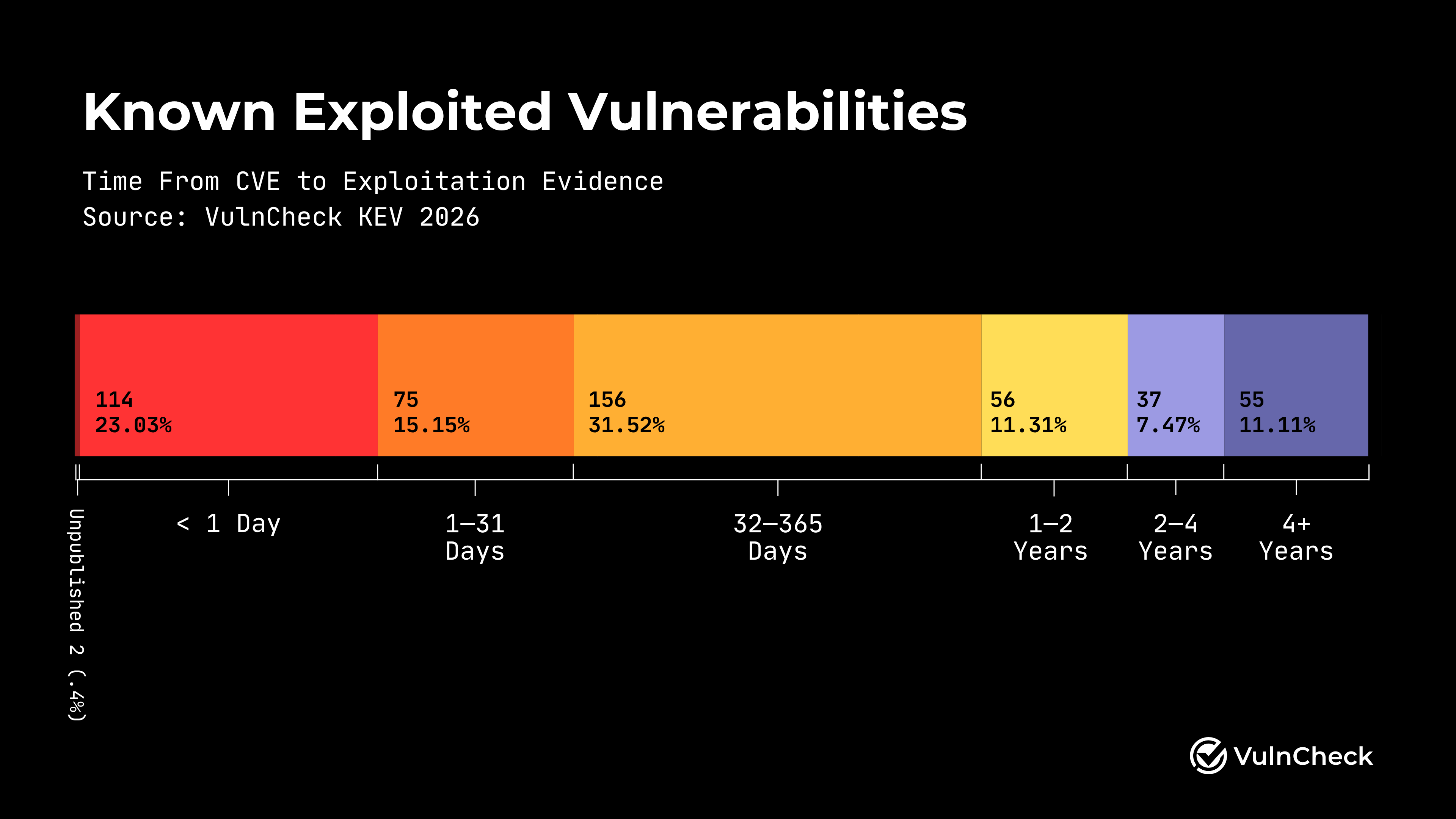 The state of LLM exploitation in 2026 (source: Vulncheck)
Are the bugonomics against OSS maintainers now?
It looks to me like our security processes need to invert somewhat, since just one person searching for the issue class (this could be a mailing list question, an odd commit in an orphan branch, or a context leak) is sufficient to alert someone else's agent and let them get exploit code. This is wild.
A May 2026 paper coined the term " bugonomics" and argues that the bottleneck has moved to "defender remediation throughput". LLMs are merrily generating exploits, but our ability to defend against them isn't necessarily improving as maintainer validation, triage and release rates stay flat. This unfortunately matches the view from my OSS maintainer's chair:
The question is not whether frontier models, open-weight models, or program analysis "win". The question is how to orchestrate them so that scarce validation, prioritization, and release capacity goes toward durable fixes rather than mechanical search and report drafting. A central defender opportunity is technical debt remediation: semantics-grounded, tool-verified, model-assisted workflows that help maintainers find, validate, prioritize, and fix security-relevant defects before they become tomorrow’s exploited vulnerabilities.
The article discusses a recent security vulnerability in the OCaml cohttp library and its implications for open-source security. The author, Anil Madhavapeddy, highlights how the vulnerability was discovered and exploited rapidly, even before a public patch was available. This rapid exploitation is attributed to the capabilities of modern AI agents that can quickly analyze code and identify vulnerabilities based on even vague descriptions. The article argues that traditional security embargoes are becoming ineffective because AI agents can infer exploit details from minimal information. It suggests a shift in security response strategies for open-source projects, emphasizing continuous delivery of fixes, better vulnerability triage tools, and proactive protection at the protocol layer. The author also touches upon the challenges faced by smaller open-source projects in accessing advanced AI models for security analysis and proposes research directions for developing more robust and automated security measures.


