
A 0.1% difference, three world records! Recently, leading photovoltaic companies have engaged in fierce competition in BC cell technology.
华夏能源网 noted that on April 26, 天合光能 (SH: 688599) announced that its self-developed new THBC hybrid passivated back-contact cell achieved a maximum conversion efficiency of 28.00%, setting a new world record for crystalline silicon cell efficiency.
Two days later, on April 28, 隆基绿能 (SH: 601012) announced that its self-developed hybrid back-contact solar cell (HIBC) achieved a conversion efficiency of 28.13%, breaking the world record for crystalline silicon cells.
On May 24, 晶澳科技 (SZ: 002459) followed by announcing that its collaboration with 金石能源 on HyperGen technology achieved a conversion efficiency of 28.2%, setting a new BC world record.
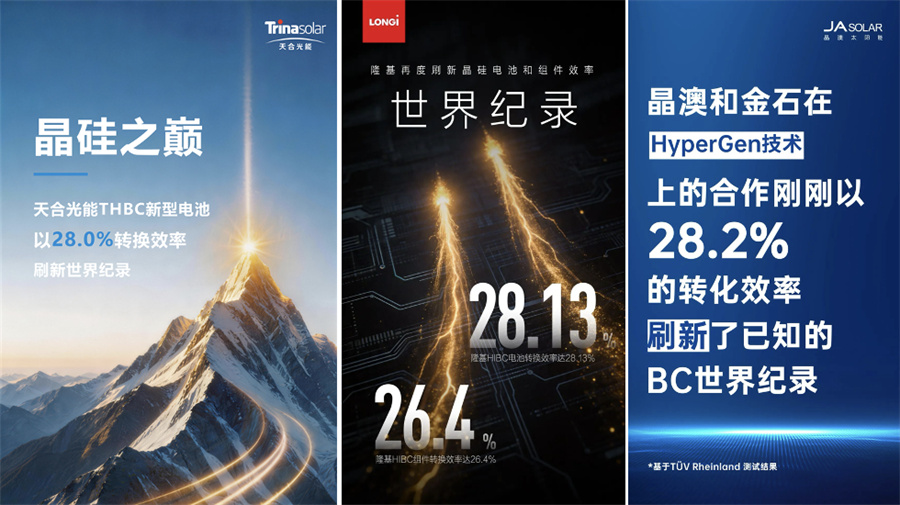
In just less than a month, three leading companies set three BC efficiency world records, with differences of only about 0.1% among them. Such fierce competition is rare in the history of photovoltaic development.
Behind the continuous world records is the rising heat of BC cells. Before 2025, BC photovoltaic cell technology was only deployed by a few companies like 隆基绿能 and 爱旭股份 (SH: 600732). Since last year, the BC camp has expanded, with 高景太阳能, TCL中环 (SZ: 002129), 通威股份 (SH: 600438), and 天合光能 all increasing their investment.
Now, as leading companies race in efficiency, the market inflection point for BC technology is approaching, which may reshape the competitive landscape among photovoltaic leaders.
BC Camp Expands, Mass Production Accelerates
Compared with the mainstream TOPCon cell technology, BC has always been a minority. In 2022, 爱旭股份, which bet early on BC, launched ABC modules. In 2023, photovoltaic module leader 隆基绿能 launched HPBC modules. Based on these two companies, along with the overseas company Maxeon, which holds many BC patents, the BC camp was formed.
Over the next two years, the BC camp remained a lonely path with no expansion until 2025, when the situation changed.
In January 2025, 爱旭股份 signed a contract with distributed photovoltaic leader 创维光伏 to jointly invest in BC cell and module production capacity in Baise, Guangxi. In May of the same year, 英发睿能 partnered with 隆基绿能 to produce the first BC cell. Wafer manufacturer 高景太阳能, through cooperation with 爱旭, also produced its first BC module in 2025.
华夏能源网 noted that in that year, most industry leaders also released their own BC-type products, including 通威股份's TBC, 天合光能's THBC, 协鑫集成's GPC, and 一道新能's DBC.
Entering 2026, BC cell technology development accelerated. On one hand, the camp continued to expand; for example, 中来股份 (SZ: 300393), which had earlier focused on the TOPCon track, released its modified BC product. On the other hand, multiple leaders began to compete on this track, pushing it from technology reserves to mass production and application:
On March 18, 通威股份 signed an agreement with 金石能源 and 金阳新能源 to jointly promote the large-scale mass production and commercial application of hybrid HBC cell technology, and build a large-scale mass production hybrid HBC cell factory at the 通威 base.
On May 7, 高景太阳能's 3 millionth BC module was officially produced, making it the third company globally to achieve large-scale production of BC modules.
On May 19, TCL中环 held a ceremony for the production of its new generation BC high-efficiency modules at its Tianjin base, with mass production entering the countdown. TCL中环 also stated that it plans to gradually build a product layout with dual product channels of BC and TOPCon in the next three years.
It is worth mentioning that one of the reasons TCL中环 intends to take control of 一道新能 is its accumulation in BC technology. In April this year, TCL founder and chairman Li Dongsheng visited 一道新能 for the first time, specifically touring the BC cell module production line, and said that the company and 一道新能 would focus on promoting the large-scale application and industrialization of key technologies such as BC cells.
In addition, 天合光能 also announced that it will gradually release THBC capacity within the year and promote THBC products for single-sided power generation scenarios, alongside TOPCon products as the company's dual-wheel drive.
BC Technology 'Route Competition' Begins
With the expansion of the camp, a route competition has also emerged within the BC camp.
The Chinese name of BC cells is back-contact cells, which refer to any cell that transfers the front gridlines to the back. That is, BC cells are a general term for a type of cell that is structurally similar, and can be integrated with P-type, HJT, TOPCon, and other technologies to form multiple technical routes. Therefore, although many photovoltaic companies are developing BC cells, their processes vary widely.
In fact, the technical route competition within the BC camp has existed for some time. In September 2023, 隆基绿能 launched HPBC 1.0 cell technology, which used a P-type + BC combination. However, subsequent market performance showed that the product's market acceptance was low. 隆基 chairman Zhong Baoshen admitted the mistake in technology selection in the 2024 annual report.
Since then, TBC cell technology (TOPCon + BC combination) has become the mainstream in the BC field. The current mass-produced 隆基 HPBC 2.0 and 爱旭 ABC both belong to TBC cell technology.
TCL中环's recently produced BC product, although not announced which BC technology it uses, is likely also TBC. 华夏能源网 noted that recently, TCL中环 stated that it has three irreproducible advantages in the BC field compared to other BC manufacturers, one of which is cell efficiency exceeding 27% and a temperature coefficient as low as -0.26%/°C.
However, starting this year, the position of TBC technology has also begun to be challenged.
The BC technology released by 天合光能 in April is called THBC, which integrates the advantages of TOPCon, HJT, and BC technologies. 天合光能 made a comprehensive comparison between THBC and TBC, believing that this technology is expected to replace TBC in the next 1–2 years.
天合光能 stated that traditional TBC cells have inherent defects of single high-temperature diffusion passivation, while THBC will compensate for this defect. In addition, the THBC production line can be modified based on existing TOPCon production lines, with better delivery flexibility, investment intensity, and cost structure than TBC.
晶澳科技 did not disclose which BC cell broke the world record, only calling it HyperGen technology. However, its partner 金石能源 publicly stated that the technology is HBC (Hybrid BC), a perfect combination of TOPCon, HJT, and BC technologies.
华夏能源网 noted that 金石能源 released this technology as early as March 2023, calling it hybrid HBC technology. In November 2024, the cell conversion efficiency had reached 27.6%. 金石能源 asserted that this technology is the mainstream direction for future photovoltaic industry development.
Although each company is confident in its own technology, which technical route will become the mainstream of BC cells still needs to be observed and let the market give the final answer.
BC Dividend Not Everyone Can Share
In addition to technology bets and accelerated mass production, BC modules have also been popular in central enterprise procurement recently.
For example, the 2026 procurement of PowerChina added 4 GW of BC modules, the 2026 BC module procurement of Datang Group increased from 1 GW last year to 4 GW, and the module procurement of Jingneng Group changed from N-type single-crystal bifacial modules last year to TOPCon and BC modules this year.
Amid a series of favorable factors, some believe that 2026 will usher in a turning point battle for BC products, with market share significantly increasing. So what is the future of BC cell technology? Can all photovoltaic companies get a piece of the BC pie?
Currently, BC technology is a preferred option for differentiated competition for companies with strong technical accumulation and R&D strength, but it may not be suitable for all photovoltaic companies. Due to the following four reasons, widespread adoption of BC technology is difficult.
First, in terms of efficiency, BC cells are undoubtedly the technical route closest to the ultimate efficiency of monocrystalline silicon cells. However, there is a difference between laboratory efficiency and actual application. In addition, reliability, cost, and market acceptance are issues that companies betting on BC technology need to consider. The BC path is not easy and is full of bumps; the technical dividend is not something everyone can enjoy.
Second, in terms of cost, BC module costs have always been higher than TOPCon. Currently, only companies like 爱旭股份 and 隆基绿能 can achieve full production, and only by using silver-free technology can they achieve cost parity with TOPCon. Without cost advantages, it is difficult to gain an upper hand in competition with TOPCon.
Third, in terms of market, as of the end of 2025, BC's market share was only 5%–8%, far lower than TOPCon. In terms of application scenarios, although BC's share in central enterprise procurement has increased, its main application scenario is still in distributed and other single-sided power generation scenarios. Data show that single-sided power generation scenarios account for only 15% of the photovoltaic market. This small cake may not be enough for many companies to share.
In addition, there is a big challenge for BC — technical barriers.
In the past few years, due to the lack of patent protection for TOPCon technology, many companies replicated it at low cost, leading to overcapacity and severe homogenization competition. This is a lesson for BC companies, and BC technology patent protection is much stricter.
Previously, Maxeon, which holds many BC patents, filed patent lawsuits against several domestic photovoltaic companies. Earlier this year, Maxeon's subsidiary MSPL signed a Patent License Agreement with 爱旭股份, under which 爱旭股份 agreed to pay up to 1.65 billion yuan to obtain the BC technology patent license from Maxeon. This shows the high threshold of BC patent technology; companies without patent resources and independent R&D capabilities simply cannot do BC.
In response, leading companies are also exploring more feasible approaches. Recently, Ni Lili, President of the Photovoltaic Products Division of 天合光能, said in an interview with 华夏能源网 that 天合 has joined with 晶科能源 and 晶澳科技 to establish the first TOPCon patent pool in the photovoltaic industry, and will also include THBC in the future. Establishing a patent pool where companies needing to use the patents pay a fee may be the most economical and feasible way to quickly acquire BC technology.


