When engineers at Renault began examining whether the French car maker should branch into drones, they pulled apart devices from several manufacturers to see how they were built.
They were quickly stumped by processes and designs that were alien to their auto world – including innumerable small screws or high-spec materials – that needed simplifying if the drones were to be produced in far greater numbers and more cheaply as part of a rearmament drive in France and elsewhere.
“We thought – wouldn’t it be a good idea to think about doing this carbon fibre part in plastic?” says Jean-Philippe Billai, who oversees industrial excellence at Renault. “The process is otherwise long and complicated on a large scale, whereas you can make moulds and get the parts out more quickly in plastic.”
The car maker is one of several companies in the struggling auto sector seeking tie-ups in defence, from General Motors in the US to Volkswagen in Germany. Suppliers including Continental, Forvia and Valeo are also doing the same.
Some have turned to defence collaborations to revive ailing factories or to help them diversify amid sluggish consumer demand. Others, including Renault, have been urged by governments to help accelerate national weapons manufacturing.
Renault seeks to bring mass production to drones, typically made in small runs by specialists, using techniques honed in an industry that turns out tens of millions of cars a year and has been forced by constant crises to find new ways to cut costs.
In a tie-up with French defence electronics specialist Thales announced in June, Renault will co-produce its “Toutatis” drones and increase the current output 100 times over to 1000 a month at full capacity, with production ready to go from next year.
The drones are so-called loitering munitions equipped with a warhead that can take out an armoured vehicle or infantry, and advanced systems to ward off scrambling.
The companies jointly reverse-engineered the designs to “not only divide the costs but also divide the complexity”, Renault chief executive Francois Provost told reporters.
The revamped model will have 20 per cent fewer parts and 40 per cent fewer fixations, such as screws, though the price has not been disclosed.
Cecilia Aguero, Thales’ director of drone systems, says even simplifying the wiring of the drone’s “quite cluttered innards” is a game-changer.
In another project Renault is working on with defence contractor Turgis Gaillard, dubbed “Chorus”, this time for a larger drone that can rival a long-range missile. The devices will cost €100,000 ($161,000) each, says France’s defence procurement agency.
The price for such drones normally runs at €1 million or much more, say people in the industry.
The companies are planning to expand capacity to make 600 a month.
The new Renault Trafic electric van. Western car makers are slashing production as Chinese EVs make inroads to global markets. Bloomberg
The drone industry has become increasingly competitive, as wars in Ukraine and Iran highlight how ubiquitous they have become in warfare, incentivising manufacturers to update designs faster and produce more competitively.
Ukraine’s TAF Industries, one of its most prolific drone makers, has increased its production capacity for surveillance drones eightfold since 2023 to 80,000 units a month now, says founder Oleksandr Yakovenko. That also includes simplifying designs with continuous feedback from the front lines to “eliminate unnecessary features”, he says.
European governments also want to be sure they can quickly produce drones in large numbers. Unlike conventional munitions, governments do not want to build large stockpiles of drones given the Ukraine war has shown the need for frequent upgrades to software and technology to avoid becoming obsolete.
Family-owned Schaeffler Germany, which makes bearings and other components for car makers, signed a deal with French army supplier and drone maker Delair in June to help it with a “very quick and rapid ramp-up” of its manufacturing capabilities, says Remy Triouleyre, the head of Schaeffler’s European business.
Schaeffler was able to supply “high-precision components and systems” for large-scale production, he says, while also eventually assisting with the design of specialised machinery. The companies want to be able to produce 100 drones and interceptors a day by November, up from 10 a day now.
“We don’t want to reinvent the wheel. We just want to reuse what we know, what we do [well] … and to tackle a new sector with that,” says Triouleyre.
“You need a resilient supply chain. You need good products, and you need a good manufacturing footprint. So from that perspective, all those challenges are the ones we have been facing for decades in the automotive industry.”
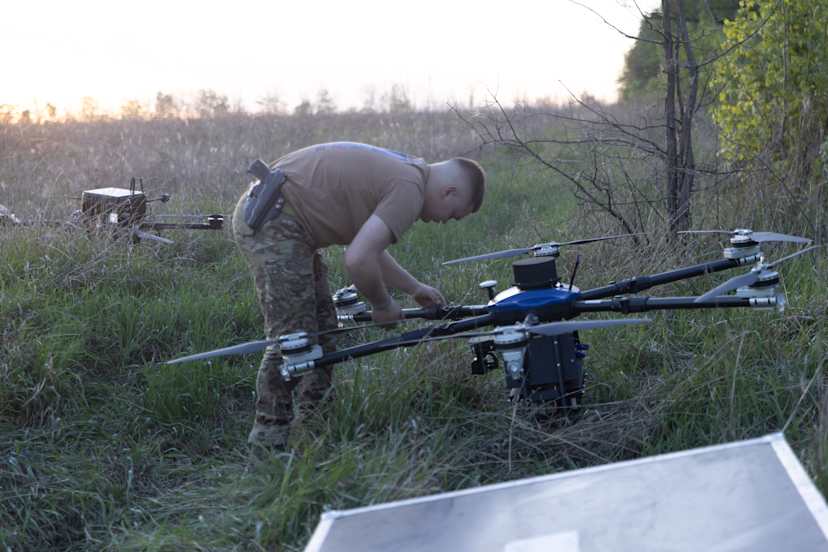
Ukraine companies have become prolific drone makers. Getty
Car suppliers and makers are wary of overstretching themselves in an industry in which the desire for mass output is only just starting to be confirmed, and production volumes remain relatively low compared with their core industries.
Encouraged by the French state, one of its shareholders, to look at drones, Renault says it is only embarking on projects that make sense owing to the scale it can bring, and it wants to keep defence revenues at a low threshold.
It faces its own challenges in its core auto business, as it looks to slice electric car production costs by 40 per cent and develop them in two years rather than three or four to keep up with Chinese rivals. Some Renault unions, particularly the leftist CGT, have objected to the defence pivot.
But its Chorus drone project with Turgis Gaillard has already sparked interest from Ukraine, says Patrick Pailloux, the head of France’s defence procurement agency, adding that the designs and methods involved could be exported under licence.
“You’re not going to find many [drones of those specifications at that cost] on the market, developed with an automaker, with the costs of parts from the auto sector,” says Pailloux.
Related

ASX defence stocks soar as the world becomes more dangerous

Defence giants provide record backing for military start-ups
Financial Times
News and analysis from AFR correspondents on the biggest global stories.
Sign up to the World View newsletter.
Save
Log in or Subscribe to save article
Share
Copy link
Copied
Email LinkedIn Twitter Facebook
Copy link
Copied
Share via...
Gift this article
Subscribers can give anyone free access to articles.
Gift this article
Subscribe to gift this article
Gift articles to anyone you choose each month when you subscribe.
Already a subscriber? Login
When engineers at Renault began examining whether the French car maker should branch into drones, they pulled apart devices from several manufacturers to see how they were built.
They were quickly stumped by processes and designs that were alien to their auto world – including innumerable small screws or high-spec materials – that needed simplifying if the drones were to be produced in far greater numbers and more cheaply as part of a rearmament drive in France and elsewhere.
“We thought – wouldn’t it be a good idea to think about doing this carbon fibre part in plastic?” says Jean-Philippe Billai, who oversees industrial excellence at Renault. “The process is otherwise long and complicated on a large scale, whereas you can make moulds and get the parts out more quickly in plastic.”
The car maker is one of several companies in the struggling auto sector seeking tie-ups in defence, from General Motors in the US to Volkswagen in Germany. Suppliers including Continental, Forvia and Valeo are also doing the same.
Some have turned to defence collaborations to revive ailing factories or to help them diversify amid sluggish consumer demand. Others, including Renault, have been urged by governments to help accelerate national weapons manufacturing.
Renault seeks to bring mass production to drones, typically made in small runs by specialists, using techniques honed in an industry that turns out tens of millions of cars a year and has been forced by constant crises to find new ways to cut costs.
In a tie-up with French defence electronics specialist Thales announced in June, Renault will co-produce its “Toutatis” drones and increase the current output 100 times over to 1000 a month at full capacity, with production ready to go from next year.
The drones are so-called loitering munitions equipped with a warhead that can take out an armoured vehicle or infantry, and advanced systems to ward off scrambling.
The companies jointly reverse-engineered the designs to “not only divide the costs but also divide the complexity”, Renault chief executive Francois Provost told reporters.
The revamped model will have 20 per cent fewer parts and 40 per cent fewer fixations, such as screws, though the price has not been disclosed.
Cecilia Aguero, Thales’ director of drone systems, says even simplifying the wiring of the drone’s “quite cluttered innards” is a game-changer.
In another project Renault is working on with defence contractor Turgis Gaillard, dubbed “Chorus”, this time for a larger drone that can rival a long-range missile. The devices will cost €100,000 ($161,000) each, says France’s defence procurement agency.
The price for such drones normally runs at €1 million or much more, say people in the industry.
The companies are planning to expand capacity to make 600 a month.
The new Renault Trafic electric van. Western car makers are slashing production as Chinese EVs make inroads to global markets. Bloomberg
The drone industry has become increasingly competitive, as wars in Ukraine and Iran highlight how ubiquitous they have become in warfare, incentivising manufacturers to update designs faster and produce more competitively.
Ukraine’s TAF Industries, one of its most prolific drone makers, has increased its production capacity for surveillance drones eightfold since 2023 to 80,000 units a month now, says founder Oleksandr Yakovenko. That also includes simplifying designs with continuous feedback from the front lines to “eliminate unnecessary features”, he says.
European governments also want to be sure they can quickly produce drones in large numbers. Unlike conventional munitions, governments do not want to build large stockpiles of drones given the Ukraine war has shown the need for frequent upgrades to software and technology to avoid becoming obsolete.
Family-owned Schaeffler Germany, which makes bearings and other components for car makers, signed a deal with French army supplier and drone maker Delair in June to help it with a “very quick and rapid ramp-up” of its manufacturing capabilities, says Remy Triouleyre, the head of Schaeffler’s European business.
Schaeffler was able to supply “high-precision components and systems” for large-scale production, he says, while also assisting with the design of specialised machinery. The companies want to be able to produce 100 drones and interceptors a day by November, up from 10 a day now.
“We don’t want to reinvent the wheel. We just want to reuse what we know, what we do [well] … and to tackle a new sector with that,” says Triouleyre.
“You need a resilient supply chain. You need good products, and you need a good manufacturing footprint. So from that perspective, all those challenges are the ones we have been facing for decades in the automotive industry.”
Ukraine companies have become prolific drone makers. Getty
Car suppliers and makers are wary of overstretching themselves in an industry in which the desire for mass output is only just starting to be confirmed, and production volumes remain relatively low compared with their core industries.
Encouraged by the French state, one of its shareholders, to look at drones, Renault says it is only embarking on projects that make sense owing to the scale it can bring, and it wants to keep defence revenues at a low threshold.
It faces its own challenges in its core auto business, as it looks to slice electric car production costs by 40 per cent and develop them in two years rather than three or four to keep up with Chinese rivals. Some Renault unions, particularly the leftist CGT, have objected to the defence pivot.
But its Chorus drone project with Turgis Gaillard has already sparked interest from Ukraine, says Patrick Pailloux, the head of France’s defence procurement agency, adding that the designs and methods involved could be exported under licence.
“You’re not going to find many [drones of those specifications at that cost] on the market, developed with an automaker, with the costs of parts from the auto sector,” says Pailloux.
Related
ASX defence stocks soar as the world becomes more dangerous
Defence giants provide record backing for military start-ups
Financial Times
News and analysis from AFR correspondents on the biggest global stories.
Sign up to the World View newsletter.
Save
Log in or Subscribe to save article
Share
Copy link
Copied
Email LinkedIn Twitter Facebook
Copy link
Copied
Share via...
Gift this article
Subscribers can give anyone free access to articles.
Gift this article
Subscribe to gift this article
Gift articles to anyone you choose each month when you subscribe.
Already a subscriber? Login
Read More
-
Explainer

How worried should we be about Russia’s suspected plague death?
-
Oct 6, 2026
-
Lena H. Sun and Dan Diamond
-
Analysis

Is pariah prince Andrew’s luck about to change?
-
Updated Oct 6, 2026
-
Andrew Tillett

Jeffrey Archer, best-selling author and disgraced politician, dies
-
Oct 6, 2026
-
Sam Tobin

Fears mount Russia covering up a lab plague leak
-
Oct 6, 2026
-
Emily Blumenthal, Lily Shanagher, Antonia Langford and Anne Gulland
-
Analysis

Why the Greens might want to rethink their UK role model
- Oct 5, 2026
- Andrew Tillett
content frame
An error has occurred
Subscribe for complete access
Save over 50% on unlimited access to Australia’s leading business news and insights across our digital platforms. Subscribe for $17.35 $7 per week for your first 3 months. Cancel anytime.
Subscribe for unlimited access.

‘You don’t understand a person’s character until they have power’
-
Matthew Drummond
-
The 10 most culturally powerful people in Australia in 2026
-
From shock jocks to TikTok – 25 years of cultural power

‘How silly’: Time tracking exercise made boss realise fatal mistakes
-
Emma McGrath-Cohen
-
How elite performers stay sharp, according to Rob Coombe
-
The $5b CEO with an unlikely method of de-stressing

Is a year-long cruise cheaper than living in Sydney? We ran the numbers
-
Anna McCooe
-
Welcome to the members’ club with a ‘no tech bros allowed’ ethos
-
This multipurpose home device is expensive, hazardous – and brilliant