
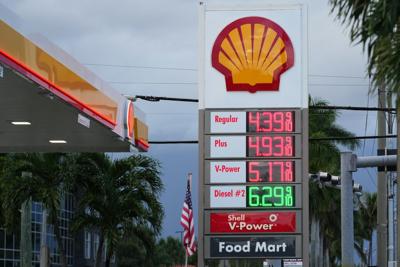
Gas and diesel prices are displayed at a Shell station, Tuesday, Sept. 22, 2026, in Doral, Fla. Associated Press Photo by Lynne Sladky

Mark Ballard
WASHINGTON — Support for banning diesel fuel exports — an idea Gov. Jeff Landry jumped on — swelled as vulnerable Republicans weighed the plan against a backdrop of a rising blue tide, which handicappers almost universally predicted last week would lead to Democrats replacing Republican majorities in Congress.
Republicans had been mulling the idea for a few days before Landry wrote his opinion on X.
But it was the tweet by U.S. Sen. Chuck Grassley that really fueled the debate on Capitol Hill. The longtime Republican fretted because his ruby-red state of Iowa suddenly was in play, with diesel costing an average of $6.52 per gallon, up from $3.69 a year ago, according to the AAA.
In addition to farm equipment, diesel is the main fuel for the trucks that take groceries to market.
Republican senators have fallen into two opposing camps over what to do — a situation that has pitted two of President Donald Trump’s staunchest allies against each other: the agriculture and energy sectors.
The main industry in Iowa is agriculture. Louisiana’s top two industries are farming and energy.
Though they represent roughly 25,000 farms, the state’s two senators, Bill Cassidy, R-Baton Rouge, and John Kennedy, R-Madisonville, also count stillmen, pumpers, and other operators in the state’s 19 petroleum refining facilities among their constituencies. Both oppose a ban.
Kennedy told reporters: "Everything I've read tells me it won't do any good."
Landry straddled the state’s two largest industries, demanding an export pause for the farmers and relaxed regulations for the refiners.
Trump has sent conflicting signals.
Cabinet secretaries Scott Bessent, of the Treasury Department, and Brooke Rollins, of Agriculture, suggested the administration would soon stop selling diesel to other countries for 90 days to build up supplies that would lower the cost.
But the Trump administration quickly backed off those hints, sending Energy Secretary Chris Wright to repeat variations on “We will not cease exports of U.S. diesel, but there may be some tweak” at multiple events last week.
If he wants to impose a ban, Trump can do so by calling a national emergency and using the International Emergency Economic Powers Act or the Defense Production Act.
With five weeks out from the November 3 congressional midterms, the cost of fuel has become a huge sticking point for Republicans wanting to maintain their control of all governmental levers.
“The costs of groceries, gas, and healthcare rank as top pain points for the rural voters, who were surveyed over two weeks starting in mid-August,” according to an Associated Press/KFF survey of 2,000 farmers.
Rural voters are the backbone of Trump's base. In Louisiana, for instance, the cities of Baton Rouge, New Orleans and Shreveport backed Joe Biden in the 2020 presidential elections, but 16 rural parishes gave Trump three-quarters of their votes.
That seems to have translated into election outcomes that don’t favor Republicans retaining majorities in the House and, perhaps, the Senate.
“The most likely outcome in the House is that Democrats pick up five to 15 seats, resulting in Democrats holding 220 to 230 seats in 2027,” (the majority is reached at 218 seats, which is the total number of Republicans in the House today), The Cook Political Report said in an analysis Friday. “In the Senate, the current range of possible outcomes we see is Democrats netting between one and five seats; they must net four to win back control of the chamber.”
Lost GOP seats are not a concern for Louisiana — though Republicans in Texas are definitely worried and the party is spending fortunes to shore up candidates in usually safe red bastions of Mississippi, South Carolina, Georgia, and Florida.
The nation’s 130 refineries make the U.S. the single largest global source, according to the American Petroleum Institute, producing about 1.6 billion of the 8 billion barrels traded daily on the world’s market. About 70% of the nation’s diesel stays at home to service the domestic market.
Professor Greg Upton, of LSU’s Energy Institute, explains that, very generally, a barrel of crude oil goes into the same piece of equipment that uses heat to separate the various petroleum products and produce kerosene, gasoline, jet fuel, diesel and other products including asphalt for roads.
Just how effective the export ban would be depends on how the refiners recalculate their equipment. Shifting product yields could put downward price pressure on gasoline.
“On the other hand, if refiners cannot find sufficient domestic demand or storage for diesel that would otherwise have been exported, they could respond by reducing overall refinery runs,” Upton said.
That scenario could raise prices.
Email Mark Ballard at mballard@theadvocate.com.


