
Breaking News:
Oracle’s $165 Billion Data Center Plan Hits a Gas Pipeline Delay
Oil Market's Glut Narrative Just Blew Up
Demand for crude oil globally…
US Oil Drillers Add Even More Rigs As Oil Prices Stay Higher
The total number of active…
Energy investors are raving about this new resource
"It's most important 8 minute read of my week…"
Russia's Oil Industry Is Running Out of Room to Absorb More Shocks
By Rystad Energy - Aug 15, 2026, 12:00 PM CDT
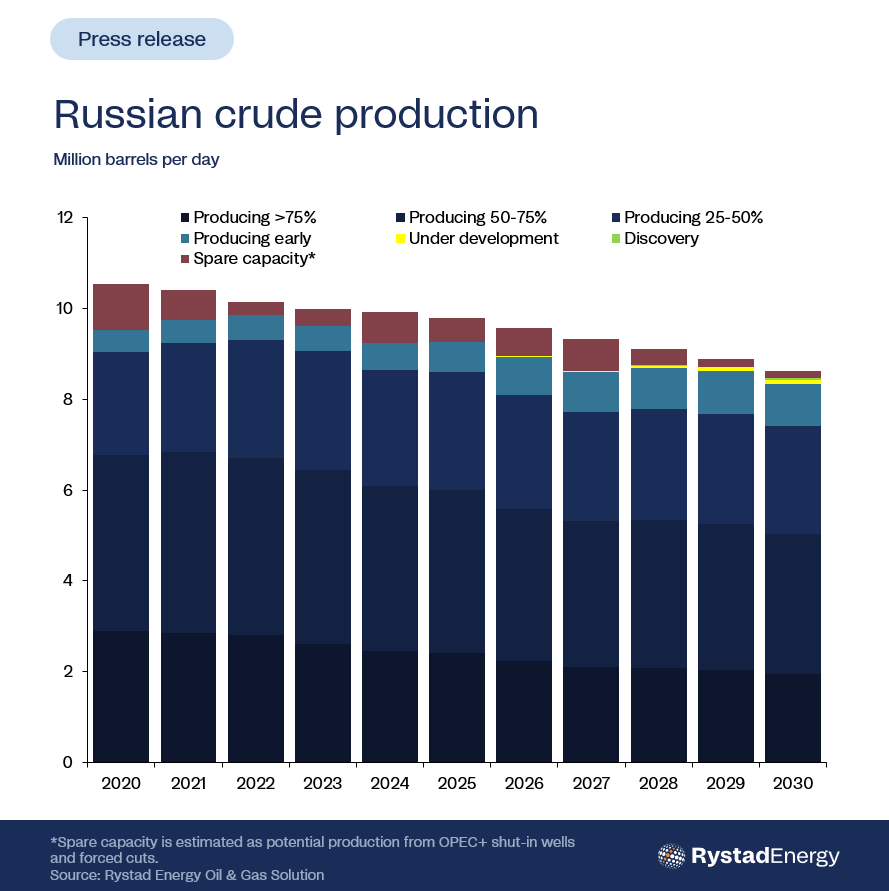
- Rystad Energy has cut its 2026 Russian crude forecast to 8.95 million bpd, with output sliding to 8.6 million bpd in 2027, a 90,000 bpd downgrade from its prior outlook.
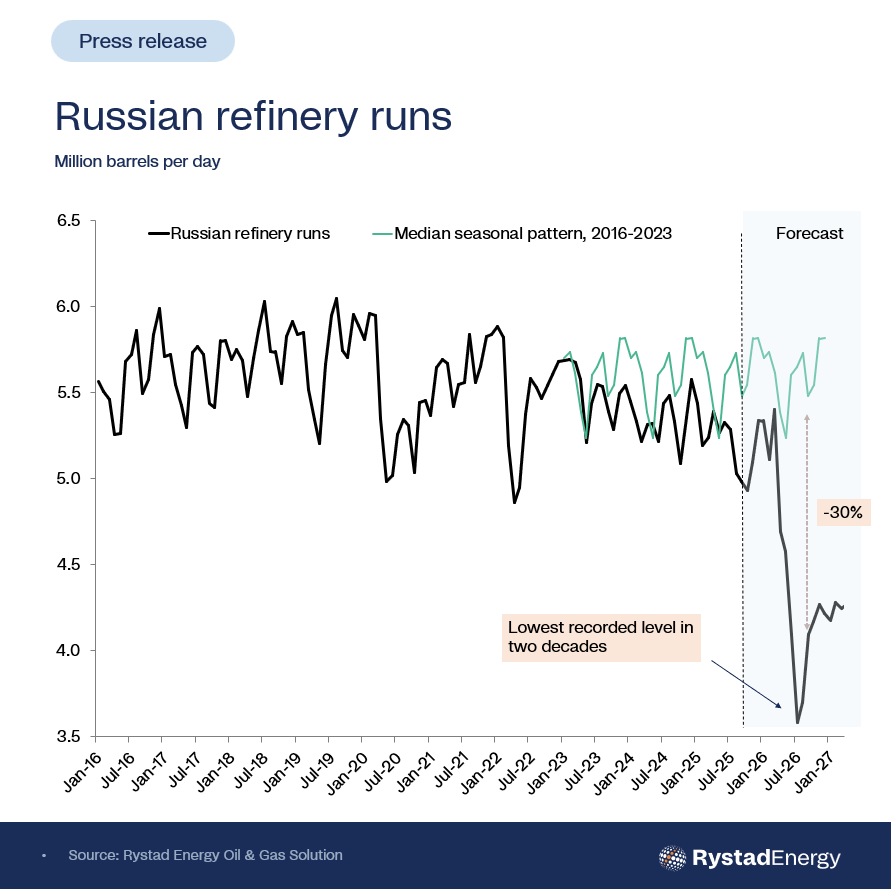
- Refinery throughput is set to average just 4 million bpd in the second half of 2026, nearly 30% below the 2016-2023 seasonal average, as drone strikes intensify.
- Russia's spare production capacity sits at only around 620,000 bpd, much of it tied to aging wells at growing risk of permanent abandonment the longer they stay shut in.

Following a year of tighter sanctions and Ukrainian attacks on refineries, ports and tankers, Russia’s crude output has fallen further in the second half of 2026, severely affecting the nation’s crude production outlook. Factoring in these disruptions, Rystad Energy has revised its Russian crude production forecast to average 8.95 million barrels per day (bpd) in 2026, before declining to around 8.6 million bpd in 2027. This represents a decline of 90,000 bpd compared with our previous forecast, reflecting the continued impact of renewed disruptions at western Russian export terminals and rising risks to seaborne exports, which have become less reliable and more expensive.
The nation also has little scope to absorb further supply disruptions, with onshore crude inventories already at levels where sustained production cuts become increasingly difficult to avoid. Even if operational constraints are eased, a meaningful recovery in output appears unlikely. A projected global oil surplus in 2027 is expected to pressure benchmark prices, eroding Russia's bargaining power with buyers while deep crude discounts, sanctions-related costs and lower sales volumes continue to weigh on producer revenues. Beyond the near term, the country's production outlook is becoming increasingly constrained as aging, high-water-cut wells remain offline for longer, reducing effective spare capacity, while a lack of sizeable greenfield developments limits its ability to offset declines from mature fields after 2027.
The increasing frequency and effectiveness of drone attacks on Russian oil and gas infrastructure is no longer affecting only refineries; it’s constraining the country's upstream sector as well. Refinery runs in June and July were among the lowest recorded in the past two decades, while throughput is forecast to average around 4 million bpd between July and December, almost 30% below the 2016-2023 seasonal average of roughly 5.7 million bpd. We expect refinery activity to recover gradually as the intensity of drone attacks eases. Even so, Russia is still likely to process around 1.4 million bpd less crude in the second half of the year than historical seasonal patterns would suggest. Every barrel not processed by a refinery must either be exported, placed into storage or removed from production. While Russia was able to absorb that imbalance in June, July demonstrated that its export system cannot consistently handle the additional volumes,
Learn more with Rystad Energy’s Oil & Gas Solution.
The impact of these attacks is becoming increasingly difficult for Russia's upstream sector to absorb. With inventories already above the threshold that triggers production cuts, operators no longer have the flexibility to ride out short-term disruptions while waiting for export or refining capacity to recover. As a result, disruptions of the same scale now translate into faster and deeper production cuts at the field level.
Furthermore, Rystad Energy estimates Russia's spare production capacity, defined as barrels that could return quickly if all constraints were lifted, at around 620,000 bpd in 2026, rising modestly to 700,000 bpd in 2027. Much of that capacity is tied to ageing, high-water-cut wells shut in under the current round of production cuts. The longer these wells remain offline, the less likely they are to return at previous rates, as extended shut-ins increase the risk of costly interventions, lower productivity and in some cases, permanent abandonment once repair and water-handling costs outweigh the economics. As a result, part of the spare capacity created by recent production cuts is expected to be permanently lost over time, further reducing its ability to increase production from existing fields.
Taken together, these factors make a meaningful production recovery in 2027 unlikely. Rystad Energy expects the global oil market to move into surplus next year if the conflict in the Middle East eases and disrupted supply flows normalize. Such a scenario would put downward pressure on benchmark prices just as Russian producers continue to contend with wider discounts and higher logistics costs. At the same time, buyers in China, India, Türkiye, Hungary and Slovakia would gain greater access to non-sanctioned crude, reducing their willingness to accept the legal, financial and operational risks associated with Russian barrels without demanding even steeper discounts.
More Top Reads From Oilprice.com
- U.S. West Coast Refiners Tap Malaysian Supply
- Why a Record-Strength El Niño Still Might Not Save Europe's Gas Market
- Ranked: How Dirty Are the Eight Biggest Names in AI
Previous Post\n\nUS Oil Drillers Add Even More Rigs As Oil Prices Stay Higher
Rystad Energy
Rystad Energy is an independent energy consulting services and business intelligence provider offering global databases, strategic advisory and research products for energy companies and suppliers,…
Related posts
Somali Piracy Surges Amid Hormuz Blockade Electric Aviation Won't Kill Jet Fuel - But It Could Take the Best Routes First US Oil Drillers Add Even More Rigs As Oil Prices Stay Higher
Leave a comment
First Name
Last Name
That email address is already in the database. Please login to your account to post your comment, or enter a different email address to continue with your comment & account creation.
Captcha
Comment
Please understand that, by submitting this form, you will be creating a free OilPrice.com account, and therefore agree to abide by our Terms of Use. Your details will be stored in our database and shared with our third party mailing list provider. You will be sent an email containing a link that will ask you to generate a new password - please follow the link to complete your OilPrice account activation.
We will save the information entered above in our website. Your comment will then await moderation from one of our team. If approved, your data will then be publically viewable on this article. Please confirm you understand and are happy with this and our privacy policy by ticking this box. You can withdraw your consent, or ask us to give you a copy of the information we have stored, at any time by contacting us.
Most Popular
 Inside the U.S.–Israel–Saudi Plan to Cut Iran Out of Global Oil
 How Engineers Are Reinventing the Wind Turbine
  5 LNG Megaprojects Poised to Power the Next Gas Boom
  The Hormuz Shock Is Far From Over
  Why Trump’s Waiver of the Jones Act Is Unlikely To Lower Gas Prices


