
The Dutch archaeological mission working in the Theban necropolis, led by Dr. Carina van den Hoven of Leiden University, has brought to light a tomb in the lower sector of Sheikh Abd al-Qurna, on the west bank of the city of Luxor, during the excavation campaign carried out by the team this season.
The discovery is part of a research and fieldwork project that the university group has been conducting in that area of the necropolis since 2018, in collaboration with the Egyptian Ministry of Tourism and Antiquities. Its main objectives are the implementation of preventive conservation and risk management programs at the site, as well as the production of the first comprehensive archaeological study of the area.
The Minister of Tourism and Antiquities, Sherif Fathy, has positively assessed the work of the foreign expeditions operating in the North African country, emphasizing that they contribute to revealing new aspects of Pharaonic civilization, which strengthens Egypt’s position as a world-renowned cultural and tourist destination.
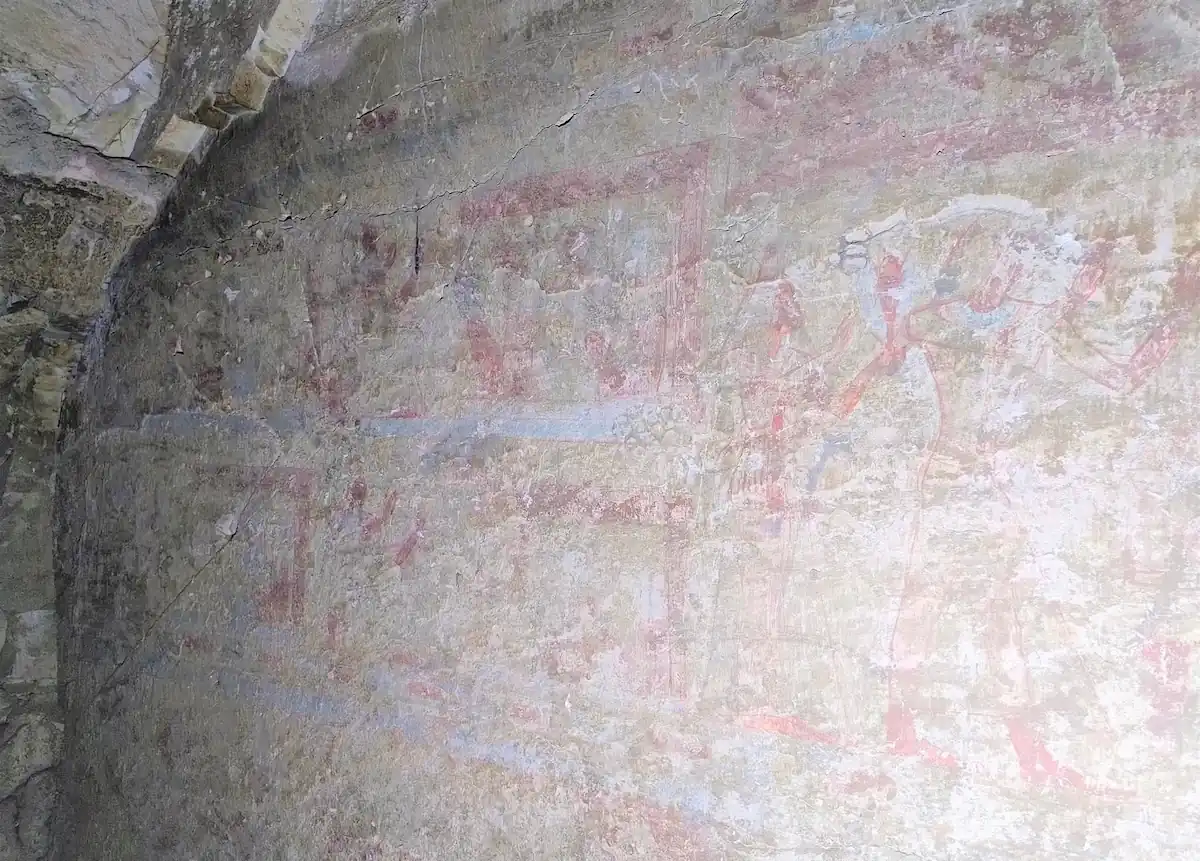 Paintings inside the tomb. Credit: Ministry of Tourism and Antiquities
In the same vein, the Secretary General of the Supreme Council of Antiquities, Hisham el-Leithy, specified that the newly located tomb is situated east of Theban Tomb 45, and recalled that the Dutch team has been carrying out an ambitious research plan for years with the institutional support of the Egyptian administration. This plan aims to establish the foundations for the long-term protection of the region’s funerary heritage and to generate systematic knowledge about the historical and cultural evolution of this specific area of the vast Theban necropolis.
After an initial epigraphic and paleographic examination of the texts adorning the walls of the hypogeum, specialists have determined that the tomb’s owner was an individual named Paser, whose identity is attested by the inscriptions bearing his name.
The artistic style of the representations and the craftsmanship of the hieroglyphs, according to Dr. el-Leithy, point to a chronology corresponding to the Ramesside period, that is, the 19th or 20th Dynasties of the New Kingdom, although the excavation leaders have noted that more detailed analyses will be required to refine the absolute dating and determine precisely the place that Paser occupied in the social and administrative hierarchy of his time.
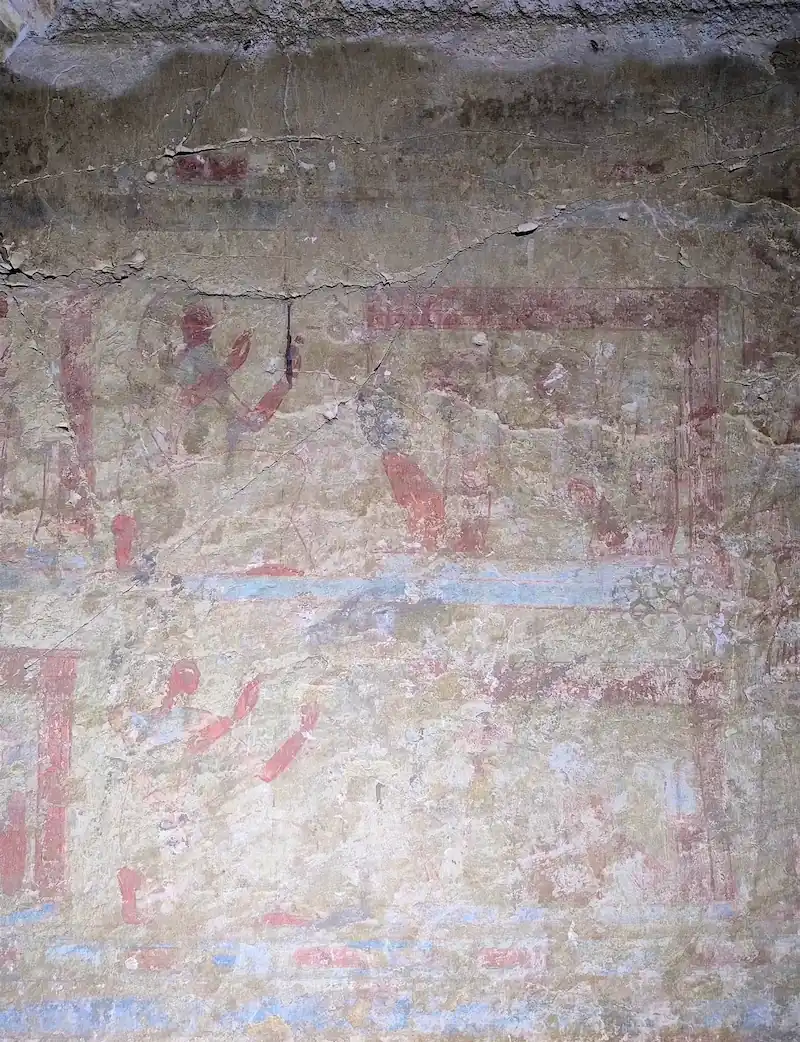 Detail of paintings. Credit: Ministry of Tourism and Antiquities
The Secretary General stressed that the team will continue documentation and study tasks within the funerary complex, aiming to determine the identity of those interred in its chambers and reconstruct their biographies from the material and textual evidence preserved. They also intend to understand the relationship of this tomb with the surrounding burials and the landscape, in order to shed light on the diachronic development of funerary occupation in the lower area of Sheikh Abd al-Qurna.
The head of the Supreme Council’s Egyptian Antiquities sector, Mohamed Abdel Badei, has provided a detailed description of the architectural layout of the monument, which follows the usual pattern of private tombs of the Theban elite during the New Kingdom.
The complex consists of an open courtyard outside, a main chapel or hall carved into the rock with a floor plan that reproduces the shape of an inverted T, and, below ground level, a series of chambers intended to house the coffins and funerary goods of the deceased.
The courtyard, according to Abdel Badei, preserves several well-preserved construction elements, most notably an adobe mastaba with a central cavity designed to hold a funerary stela, as well as a staircase flanked by lateral ramps that leads directly to the tomb entrance.
This layout, common in the necropolises of the Theban west bank, reflects the continuity of architectural canons established for the tombs of high officials and priests serving in the temples and royal administration during the 18th Dynasty and later.
Inside the chapel, archaeologists have documented various painted and carved scenes bearing the name of Paser, although a thin layer of dust and sediment partially covers some of the figures and color motifs, making a complete reading difficult at the moment.
The depictions examined so far show the deceased in an attitude of worship before several deities, each enclosed in its own chapel or naos, and also portray him alongside his wife, both seated or standing before a table laden with food and floral offerings. This composition repeats the iconographic schemes of Ramesside funerary art and seeks to ensure the perpetual sustenance of the tomb owner in the afterlife.
Cleaning and consolidation work on the paintings will be carried out in future campaigns, once the photographic and topographic recording phases of all the chambers are completed.
The expedition director, Dr. Carina van den Hoven, has confirmed that, starting with the next excavation season, the Leiden University team will begin a specific program of structural reinforcement and restoration of the polychrome decorations, in order to guarantee the monument’s stability and preserve its painted surfaces, which have suffered deterioration over time and due to local environmental conditions.
The researcher expressed her satisfaction with the results obtained so far and her desire to continue fieldwork at the site, confident that future work cycles will yield new findings to complete knowledge about the Sheikh Abd al-Qurna necropolis and the funerary practices of the Theban elite during the Ramesside period.
The Dutch mission, which has the authorization and logistical support of the Supreme Council of Antiquities, plans to extend its activities to other adjacent areas as part of its commitment to archaeological research and the preservation of Egypt’s cultural heritage.


