
Indie publisher Secret Mode has set up a new internal development studio in Sheffield to support the label's line-up of games, starting with recent hit Escape the Backrooms and Chained Together, which Secret Mode acquired in June. At launch the venture is just three people strong, but over the next twelve months it's planned to expand to around 20 people.
The Sheffield office came about following the arrival of Dan Secker as VP of technology and operations in November 2025. He "really quickly" identified the need for an internal studio.

Dan Secker | Image credit: Secret Mode
"We're spending large sums of money on external development teams," he explains. "My whole career is 28 years in development – we asked why we weren't building our own team to support our own portfolio of products, creating our own dedicated pipelines to update content." The Sheffield team is the answer, and will initially be supporting Escape the Backrooms and Chained Together with the goal of "keeping retention high" while also "bringing along new players for the journey".
"Both are products that we acquired that are doing really great numbers," Secker says. "They're driven by the community, and players are screaming out for more content, more levels. The development arm is going to start with building additional content, whether that be new levels, or something along the lines of the cosmetic system, or just porting that to different platforms as well. Chained Together is only available on Steam, but we're absolutely going to be looking at other platforms, such as Xbox, PS5, maybe Switch 2 as well."
Part of the pitch to potential staff is that their work will be available quickly; Secker says there are a lot of people out there who don't want to "spend their time on five-year AAA projects".
"Once we prove it out, we'll look at further titles, and hopefully our portfolio will expand, and that will extend the development arm as well"
"People want to be building things that will be straight into the hands of the community," he says. "This is a great opportunity to build a studio, build a development arm for Secret Mode, and actually allow people to make content that people can get their hands on almost instantly. That's the main intention behind those two existing titles. Once we prove it out, we'll look at further titles, and hopefully our portfolio will expand, and that will extend the development arm as well."
Jake Habgood, technical development director, adds: "As a game developer, these days you can spend a huge amount of your career working on something that just never sees the light of day. The opportunity to come into a project that's already got a huge audience and actually make a difference right away is really exciting."
Full-service support
Internal development support is a valuable addition to Secret Mode's services in an increasingly competitive and saturated indie and mid-tier publishing space.
"That's part of why we've looked at this," Secker confirms. "It's a long-term commitment for this dedicated internal team. We have titles that just keep going, and we'll see communities running games for years. We want to do this, and we want to do it with our own development team."
The goal is not, however, for the studio to develop its own titles – the trajectory followed by Secret Mode's original parent Sumo Digital, until it refocused on co-dev after being acquired by Tencent – or at least, not yet. "I'm not going to say that's not going to happen," says Secker of developing new IP, "because you can never tell how these things will pan out… maybe further down the line, once we prove this is successful. But that's certainly not the intention. That's not what we're building."
Steel city battalion
There's also an element of coming full circle for Secret Mode to set up a studio in Sheffield, as Sumo Digital remains headquartered in the city. Secret Mode itself is based in Leamington Spa, but Sheffield "just made sense" for the studio. "There's such a dynamic pool of talent," Secker says. "And Jake's links with the university are massive."

Jake Habgood | Image credit: Secret Mode
In addition to a CV that boasts stints at Gremlin Interactive and Sumo, Habgood has had an equally impressive career in education. He has lectured at the University of Sheffield, University of Nottingham and Sheffield Hallam, where he was also the director of that institution's Steel Minions game studio. His role heading up education partnerships for Sumo involved working with the studio's Academy, which recently released deckbuilding football management title Nutmeg. He says that Secret Mode Sheffield wants to retain strong links to the universities in Sheffield.
"We very much intend to maintain those links and have a real-world presence where we could be found, we could be talked to, we can help mentor new people coming into our industry," Habgood says. "I think one of the things we learned going through the process with Nutmeg was that junior teams can be extraordinarily passionate. They have a lot to offer, a lot to give, and they have none of the cynicism of older developers. It's one of the reasons we as a team love working with young people. They haven't got that, and they've just got so much energy and enthusiasm, and we want to bring that to these products."

Nutmeg! originated in Sumo's academic training program Sumo Academy. | Image credit: Sumo Digital/Secret Mode
In keeping with a recent drift by some businesses back towards in-person working, staff at Secret Mode Sheffield is that staff will be required to be in the office four days a week. This, Secker explains, is because sharing a physical space makes solving problems easier.
"What we've lost over the years since COVID happened is that going into the office, you didn't realise how much you learned just from going for a cup of tea and talking to somebody on a different team. You're like, I didn't realise you were working on that. Oh, how have you solved that? You don't get the informal team chats when you've got to schedule a Teams call."
"And it's all about that community side as well. When you're in and around people, you're looking at what they're doing, what they're working on, and it sparks interest. You solve problems before they even happen."
Habgood adds: "You just see somebody's body language in the office and you can tell whether they're unsure about what they're doing. You can drop in that support far quicker than if it was just a Teams call. With Nutmeg, it was amazing how agile we were able to be, just being in the office and being able to react, change and be very indie about what we were doing. I think bringing some of that to Escape the Backrooms and Chained Together, will be really beneficial."
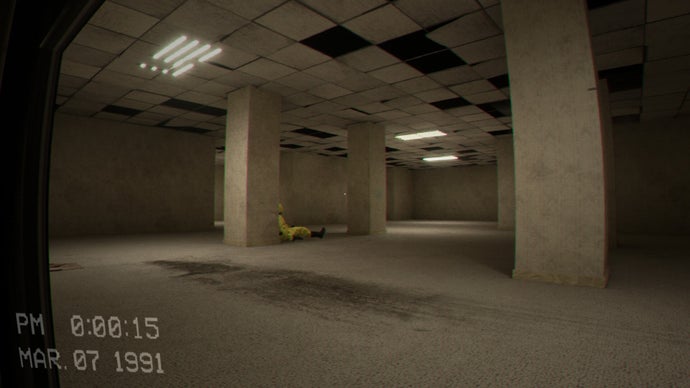
Escape The Backrooms was a major hit, boosted by the success of the movie. | Image credit: Fancy Games/Secret Mode
Onwards and upwards
Looking forward, Secker says the goal with the new studio is to "build on the same culture" of Secret Mode.
"We're not departing from Secret Mode," he says. "We're just repositioning it in a different city where we feel there's a lot of talent. We're going to build on the same culture and values, but we just want to add that development capability along the way. In five years, I'd love for us to become a technical centre of excellence, supporting multiple titles. I'd love there to be a world where we are supporting our external devs as well. And I'd love to see a world where we've got a budget to play with to create our own IP, something small, something community-based, similar to the titles in our portfolio.
"I'd love for us to become a technical centre of excellence, supporting multiple titles and external devs"
He continues: "It's about taking Secret Mode from just being a publisher to being a publisher with some actual technical standards that can help and improve all of our games going forward."
Habgood adds: "I really want it to be a place that people can come together, learn together and understand the products that we're working on. Share that knowledge, that's really important to me. Both Dan and I go back to the days of Gremlin Interactive and working for a publisher-stroke-developer. As a development studio, we can be more open-minded to the way that the publisher needs a development studio to work – so we can actually understand what's driving the work that we're doing and serve their needs better."
"Having a community that shares that understanding of what's going on in the business and in the development of products is going to be a really lovely thing to build," concludes Habgood. "I'm really excited about it."


