The GST InvoiceNow Requirement is coming – acting early could save your company money
From April 2028, GST-registered businesses in Singapore will need to submit invoice data directly to IRAS via InvoiceNow, and early adopters get access to grants, smoother implementation and earlier efficiency gains

Businesses across Singapore are gearing up for the shift to mandatory e-invoicing under the GST InvoiceNow Requirement.
PHOTO: GETTY IMAGES
Published Jun 29, 2026, 04:00 AM
Under a phased mandate running through 2031, all GST-registered businesses in Singapore will be required to transmit invoice data directly to the Inland Revenue Authority of Singapore (IRAS) via InvoiceNow.
Over time, a further 90,000 GST-registered businesses are expected to come onto the InvoiceNow network. Currently, more than 63,000 businesses are already on it.
The move is part of Singapore’s broader effort to help businesses go digital, improve efficiency and drive productivity gains.
What is InvoiceNow?
Introduced in 2019 by the Infocomm Media Development Authority (IMDA), InvoiceNow is Singapore’s nationwide e-invoicing network.
Built on the internationally recognised Peppol standard, it allows businesses to exchange invoices directly between accounting systems in a structured digital format, eliminating manual data entry.
Invoices are transmitted through IMDA-accredited Access Points Providers (APs) or InvoiceNow-Ready Solution Providers (IRSPs), which are certified service providers that connect businesses to the InvoiceNow network.
Invoice data transmitted through the network is encrypted and stored securely in line with public sector security requirements.
As adoption grows, interoperability across the business ecosystem is expected to improve, cutting manual processes and boosting efficiency.
By submitting invoice data directly to IRAS through the InvoiceNow network, businesses also benefit from improved tax compliance with faster GST audits and refunds.
When will your business need to comply?
The GST InvoiceNow Requirement is already being phased in for certain groups ahead of the full rollout between 2028 and 2031. Since Nov 1, 2025, businesses that apply for voluntary GST registration have been required to transmit invoice data to IRAS via the InvoiceNow network.
Compliance timelines are staggered by business size and registration profile:
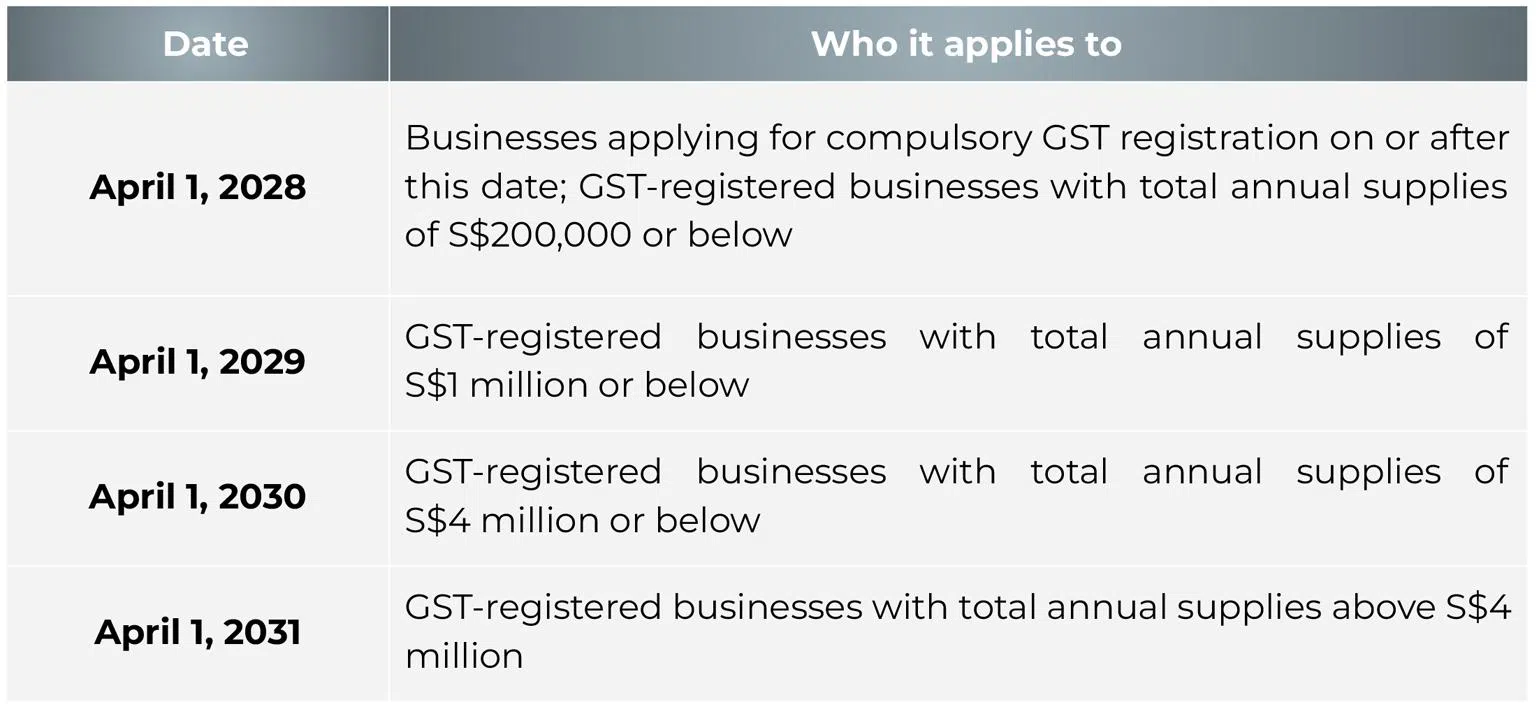
Existing GST-registered businesses can check their applicable timeline using a self-help calculator on the IRAS GST InvoiceNow Requirement webpage. IRAS will also notify businesses that were registered before 2026 of their specific implementation dates by mid-2026.
For small and medium-sized enterprises (SMEs), Free-of-Charge (FOC) InvoiceNow Solution Packages are available for SMEs to get started at minimal cost while reaping the benefits early. Given the complexity of their existing systems, larger enterprises typically require more time for ERP integration, testing and operational adjustments, and should plan in advance to ensure a smooth transition.
Benefits of InvoiceNow for businesses
Beyond compliance, InvoiceNow is designed to deliver real operational efficiencies.
Reduced manual work: Less time spent on data entry, reconciliation and processing.
Simplified invoicing: Manage all parties, including business partners and government entities, through a single invoicing solution of your choice.
Faster GST processing: Shorter audits, quicker refunds and built-in checks to reduce GST reporting errors.
Data security: Enhanced reliability and security under the international Peppol network.
Greater connectivity: Seamlessly connect with overseas businesses that are also on the Peppol network, across markets such as the European Union, New Zealand, Japan and Australia.
For many businesses, these benefits become most apparent once they start onboarding InvoiceNow.
Clinton Ang, managing director of CornerStone Wines, adopted InvoiceNow ahead of the mandate to streamline the company’s invoicing and reporting.
He says: “From our experience, early adoption led to better implementation, lower costs and a seamless transition for our team.
“We can now send e-invoices to our customers on InvoiceNow and transmit invoice data to IRAS seamlessly, cutting down on manual data entry significantly.”
For Annie Wong, director of 21 Max New Solution, early adoption gave her the breathing room to get things right. “Adopting InvoiceNow early meant I could tackle technical challenges with my vendor’s help well before the mandated deadline,” she says.
“I had time to master new processes like determining unit measurements and obtaining customer UENs without pressure.”
Government support to ease transition
IRAS and IMDA are providing funding and implementation assistance to help businesses get ready.
For SMEs (annual supplies of S$4 million and below):
- Free InvoiceNow-ready software solutions, available until March 2031.
- The GST InvoiceNow Transition Grant ($1k), available from July 2026 to March 2030.
For larger businesses (annual supplies above S$4 million):
- The GST InvoiceNow Transition Grant ($5k), available from July 2026 to March 2028.
- S$25,000 under the InvoiceNow Queen Bee Grant to support ERP integration and digital connectivity.
Businesses may be eligible and apply for both the GST InvoiceNow Transition Grant ($5k) and InvoiceNow Queen Bee Grant.
For details on eligibility and how to apply, visit IMDA’s webpage.
Where to find InvoiceNow guides and support
IRAS and IMDA have also developed a suite of resources to support businesses. These include IRAS’ video guide and e-Tax Guide, and IMDA’s InvoiceNow Technical Playbook.
Both agencies are also regularly hosting webinars to allow businesses to learn about InvoiceNow in an interactive way. Businesses can find out more about and register for the webinars here.
In addition, businesses can attend the InvoiceNow Fair on July 29, 2026 at Suntec Singapore Convention & Exhibition Centre, where more than 90 accredited solution providers will showcase solutions through live demonstrations and advisory sessions on grants and implementation support.
Some businesses are already getting ahead of the mandate, using the transition period to test systems and refine processes before the requirement kicks in.
Property leasing company Be Thou My Vision is one such example. Early adoption had helped the business position itself ahead of upcoming requirements.
A company spokesperson says: “The technical integration has been seamless for my business needs.
“While the immediate operational benefits may be modest for straightforward investment-holding businesses like mine, being an early adopter has positioned me well for future compliance requirements.”
Starting early puts businesses in the best position to meet their obligations without disruption – while gaining the efficiency benefits that come with full onboarding.
For more information, visit the GST InvoiceNow Requirement webpage .