
Beyond Nvidia: How Singapore is earning its place in the semiconductor value chain
It occupies the part which AI has made expensive to get wrong – this is starting to be reflected by the listed market
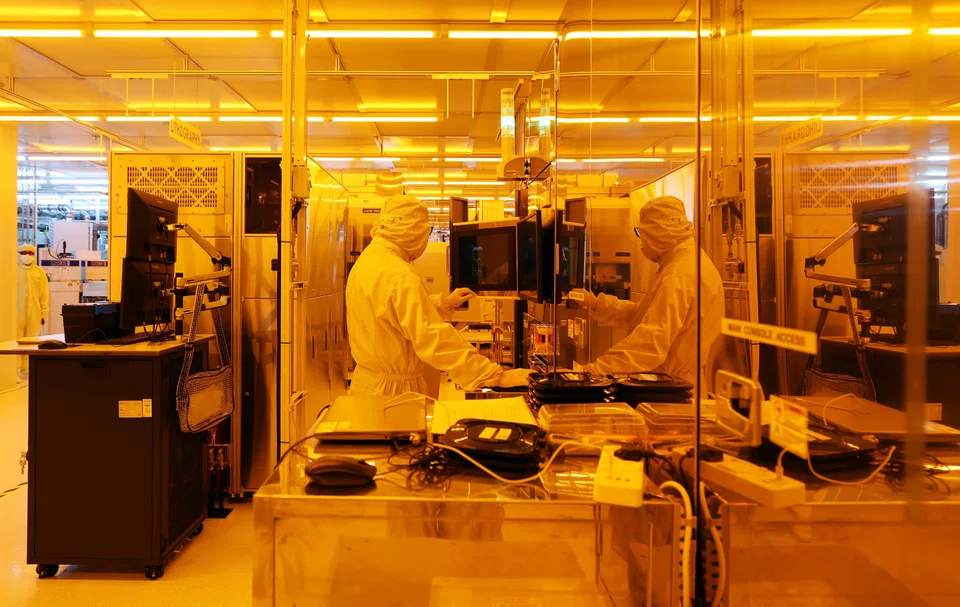
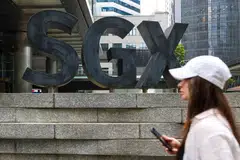
As semiconductor-related firms invest in advanced manufacturing, the gap between Tampines cleanrooms and Shenton Way ticker tape is narrowing quickly. PHOTO: BT FILE
[SINGAPORE] Drive out to Tampines and you can see a decade of decisions in one district.
Silicon Box runs a panel-level packaging plant in the Wafer Fab Park there, built for around US$2 billion. A few minutes away, VisionPower Semiconductor Manufacturing Company (VSMC), a joint venture between Taiwan’s Vanguard and Dutch chipmaker NXP, is putting up Singapore’s first 12-inch wafer fab.
In June, Applied Materials opened a S$600 million campus in the same district that more than doubled its cleanroom space here.
None of the three is listed on the Singapore Exchange (SGX). That contrast sits at the heart of the standard complaint about Singapore’s chip sector: the state has spent four decades building a physical ecosystem with foreign direct investment, while local equity markets wait patiently for the listed proxies to catch up.
But look at the board, and the gap between Tampines cleanrooms and Shenton Way ticker tape is narrowing quickly.
AEM : AWX -5.65%, for example, reported first-half net profit of S$31 million, up 904 per cent from a year earlier, on revenue of S$247.2 million. It also lifted full-year revenue guidance to between S$630 million and S$680 million.
Asean Intelligence
Get insights into businesses across South-east Asia
The test solutions provider’s share price started 2026 at around S$1.70, and was trading nearly five times that by early August.
UMS Integration : 558 0% posted second-quarter revenue of S$87.1 million and net profit of S$19.4 million, up 29 per cent and 89 per cent, respectively, with its share price more than doubling this year.
These are not chip designers competing with Nvidia, nor foundries trying to outgun Taiwan Semiconductor Manufacturing Company.
Singapore’s listed cluster can be sorted into five distinct layers:
- Test and validation, where AEM sits alongside Sunright : S71 0% and Avi-Tech : 1R6 -1.04%;
- Equipment and precision parts, covering UMS, Frencken Group : E28 -2.86% and Manufacturing Integration Technology : M11 0%;
- Consumables and materials, including Micro-Mechanics : 5DD 0%, Nanofilm : MZH 0% and Ellipsiz : BIX +3.77%;
- Industrial automation, where CSE Global : 544 -4% and ISDN : I07 -3.15% operate; and
- Hardware manufacturing, the domain of Venture Corporation : V03 0%, PC Partner : PCT 0%, Valuetronics : BN2 0%, Aztech : 8AZ -0.89% and InnoTek : M14 -3.26%.
Institutional capital is tracking that division closely. SGX data shows year-to-date net institutional inflows into the technology sector were strongest in the production layer, led by AEM and followed by Frencken and PC Partner.
Even Venture, the laggard of the group, worked through three years of falling revenue before returning to growth in the first quarter on an 11 per cent rise in artificial intelligence infrastructure products.
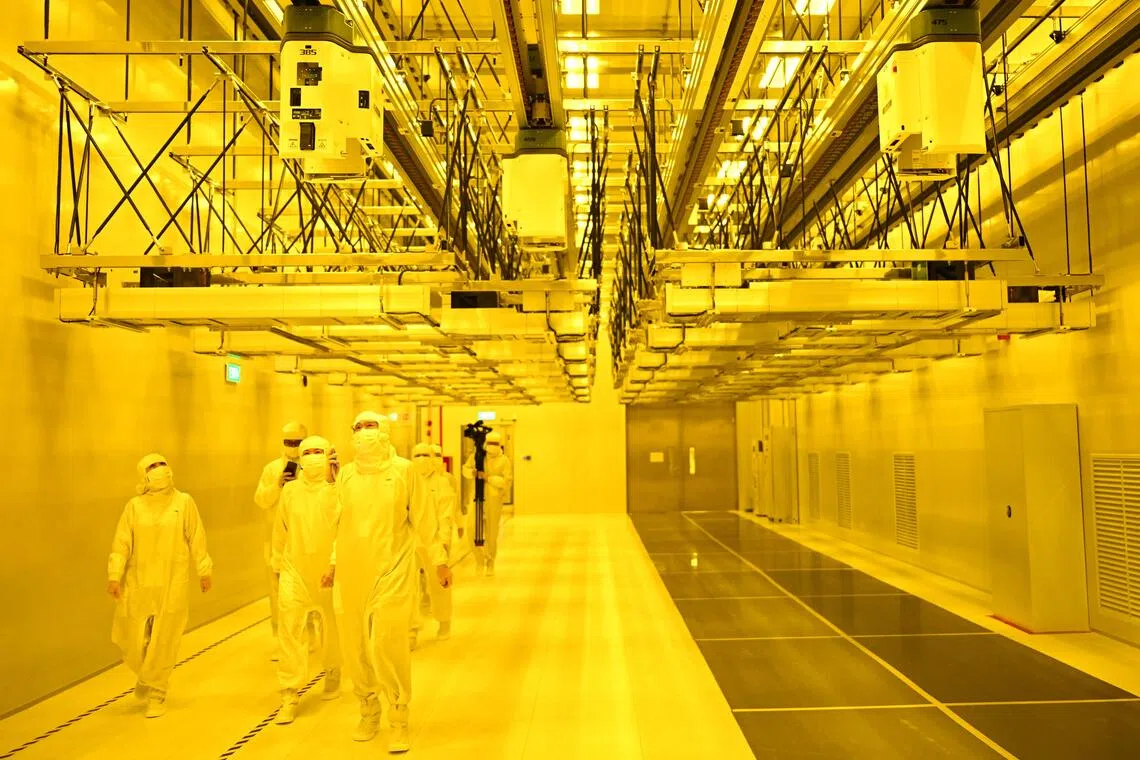
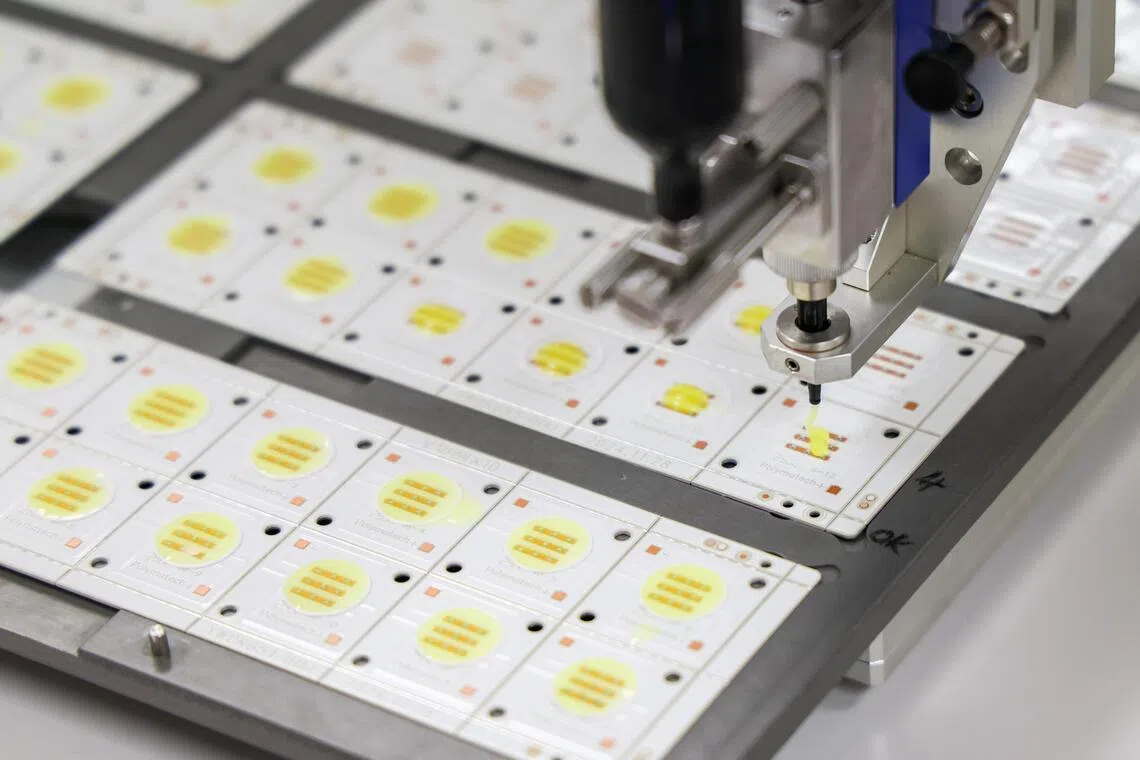
The technical reasoning for this cash flow is straightforward. Shrinking transistors is getting harder and more expensive, so more of the performance gain now comes from how logic, high-bandwidth memory, chiplets and photonics are put together.
That pushes value downstream towards advanced packaging, testing, interconnect and thermal management.
Structurally favourable shift
Merrill Tan, executive director for equity research at AR Capital, called the shift “structurally favourable for Singapore”, since those are the exact areas the country already works in.
The way he sees it, AI systems depend entirely on how well components run together at high power densities.
He said: “System performance therefore depends not only on the capabilities of individual components, but also on how effectively they are packaged, interconnected, cooled and tested, making areas such as advanced packaging, testing and thermal management much more critical to overall system performance and reliability.”
As those systems get more valuable, the price of getting them wrong climbs with them.
“As system complexity and value increase, so does the cost of yield losses or reliability failures,” he noted.
A ruined package is a much bigger problem when it is worth tens of thousands of dollars and sits in a data centre nobody can easily reach. That is where the supplier’s leverage lies.
“Suppliers that can materially improve yield, reliability, throughput, power efficiency or performance will therefore potentially achieve stronger and more defensible economics, particularly once they are qualified into a critical customer platform or production process,” Tan said.
Getting designed into a critical process takes years and is disruptive to undo.
Singapore’s physical moat underpins this listed strength. Its early commitment to semiconductor manufacturing brought in Micron and Applied Materials, and established manufacturers such as GlobalFoundries have continued to expand here since.
“Singapore’s most defensible advantage is the depth of its semiconductor ecosystem, built over several decades,” said Tan.
Those investments, he added, have created “a mutually reinforcing cluster of specialised suppliers, infrastructure, engineering talent and R&D capabilities that are difficult to replicate quickly”.
The country secured S$30 billion of semiconductor investment between 2022 and 2025, pushing semiconductors to roughly 7 per cent of gross domestic product.
Tan expects that advantage to hold as the industry matures, because complexity and supply-chain resilience push companies towards places with reliable execution, skilled talent and established suppliers.
Singapore’s advantage, he noted, “rests on the strength of the ecosystem as a whole, rather than simply cheaper land or larger subsidies”.
Policy and private capital have followed. Budget 2026 committed S$800 million to a flagship programme in semiconductors, aimed at advanced packaging and photonics.
Meanwhile, Micron broke ground in January on an advanced wafer fab worth about US$24 billion over a decade, and United Microelectronics Corporation’s US$5 billion Fab12i P3 facility begins phase-one production this year.
Moving up the chain
For the companies already here, Tan’s read is that the opening is to climb.
The opportunity, he said, is “to move into more technically demanding and critical parts of the production process”, where becoming embedded in a customer’s development and production work is what earns the better economics.
The listed universe has changed more quickly this year than in the decade before it to reflect this.
Ambiq Micro took a secondary listing on the SGX mainboard in July. The Texas company designs ultra-low-power chips for edge AI and is the first sizeable global fabless chip designer on the board.
PC Partner went the other way, delisting from Hong Kong in January to trade only here.
Frencken raised about S$100 million in late August via a placement. Its buyers included four managers appointed under the Monetary Authority of Singapore’s S$6.5 billion Equity Market Development Programme, a clear sign of strong interest from domestic money to fund this end of the market.
Private companies are also looking this way. Mi Material, the semiconductor materials arm of Malaysia’s Mi Technovation, received conditional eligibility to list here on Aug 25.
The company is a leading provider of solder spheres globally, enabling performance-critical interconnect solutions in advanced semiconductor packaging.
It focuses on precision miniaturisation – with fine and ultra-fine pitch solder sphere capabilities – which support higher-density memory packaging.
Simultaneously, its advanced materials science capabilities, with proprietary alloy formulations, enable demanding packaging applications.
“We would like to see SGX increasingly reflect the technology ecosystem that Singapore has already built in the real economy.”
Merrill Tan, executive director for equity research at AR Capital
Elsewhere in the advanced manufacturing value chain, Emage Group started in 2011 building custom optical systems for eye-care manufacturers, solving the awkward problem of inspecting a curved, transparent contact lens.
Its founder Wong Soon Wei makes the same point Tan does about qualification, from the other side: prove a system in a tightly regulated industry, and it rolls out across the customer’s sites without being re-evaluated each time.
Emage has stayed profitable since its first year. It focuses now on physical AI by producing AI-driven industrial robots for factory automation.
Its chairman Charles Cher – a former chief executive of AEM – has stated publicly that Emage may consider an initial public offering on SGX when it needs capital to scale globally.
Ben Lim, a senior analyst at pvtIQ, Smartkarma’s private markets research arm, observed that Emage “remains relatively small in absolute scale, but could become a listing candidate if it scales materially or demonstrates a clear path to doing so”.
He applies the same test to the larger names. Silicon Box has had a busier 2026 with further financing, a production ramp and expansion, but the analyst noted that “ disclosure on financial performance and operating metrics remains limited, so we await greater visibility before assessing its IPO readiness”.
VSMC is, again, a different case. As a strategic joint venture, Lim said, any listing “would likely depend more on the shareholders’ capital and strategic requirements”, including whether there is any reason to bring in outside investors.
What gives him confidence is precedent. Singapore has a long history of advanced-manufacturing and precision-engineering companies that have listed successfully, which he reads as a template for the current crop.
Closing the gap
Lim also reframed the usual question. “We see it as less of a choice between listing on Nasdaq or remaining private, and more of a choice between going public or staying private,” he said.
Staying private buys time to scale, build a financial track record and prepare for public investors, and private capital has become considerably easier to access over the past two decades.
When a company does go public, he noted, the key consideration is “access to the right investor base rather than simply the exchange itself”.
In his view, the local technology investor base, proximity to the broader Asian semiconductor ecosystem and a track record with listed technology and precision engineering companies are all real advantages.
The variable is the company, and whether it has the scale, liquidity and growth story to use them.
There is a subtler obstacle too, which is that investors have to understand what they are buying. Lim considers the sector as under-covered rather than ignored.
“Some of these businesses and business models are not necessarily straightforward to understand and can require specialist knowledge of areas such as semiconductors, advanced manufacturing or the broader technology supply chain,” he said.
That makes investor education and access particularly important, and he expects better disclosure, research coverage and engagement to close the gap as more of these companies become visible.
On whether the AI cycle has changed how global institutions view Singapore, he remains careful. It has brought more attention, though “this has been more of a selective rerating than a wholesale change”.
The opportunity, he said, is to “translate that strategic importance into more investable companies”.
Both Lim and AR Capital’s Tan land in a similar place from different directions.
“We would like to see SGX increasingly reflect the technology ecosystem that Singapore has already built in the real economy,” Tan said, referring to the listing of companies already embedded in the value chain operating here.
The point, he added, is not simply a bigger count of technology listings, but also “companies with a clear and differentiated value proposition” in areas with genuine structural growth.
After that, the requirements are the familiar ones. Institutional investors, Tan noted, look for “sufficient scale and liquidity, strong governance and disclosure, disciplined capital allocation and a demonstrated ability to deliver sustainable earnings and cash flow growth”.
Which brings it back to Tampines. The gap between what Singapore builds and what Singapore lists is real – but it is narrower this year than last.
Decoding Asia newsletter: your guide to navigating Asia in a new global order. Sign up here to get Decoding Asia newsletter. Delivered to your inbox. Free.
Uncovering the Singapore bourse Semiconductors SGX AEM UMS Integration frencken micro-mechanics Nanofilm CSE Global venture corp valuetronics PC Partner Group Aztech Global innotek
Copyright SPH Media. All rights reserved.
 \ Your guide to navigatingAsia and beyondin a new world order\ EXPLORE NOW
TRENDING NOW![]()




Next article
How Singapore can become the ‘Switzerland of chips’
The Republic can be a neutral place where chips, capital, talent and data all come together
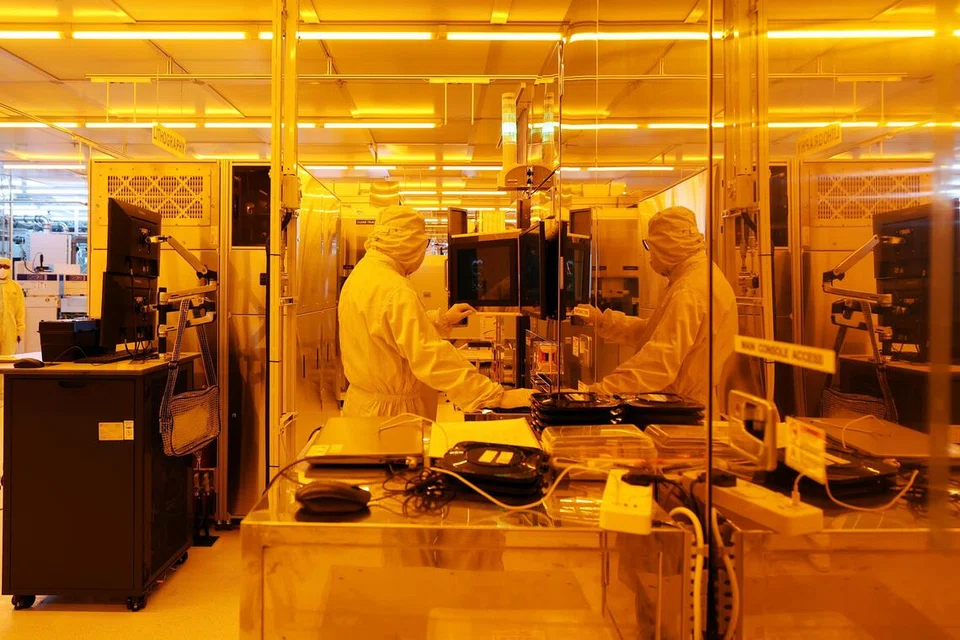
- The Republic accounts for about 10% of the global semiconductor output, and 20% of semiconductor equipment production, says EDB. PHOTO: BT FILE
Bruno S Sergi and Kevin Chen
Published Mon, Sep 7, 2026 · 04:02 PM
LEADERSHIP in semiconductor chip manufacturing is shifting away from developing smaller and faster chips, which are costly and dominated by a few tech giants. Building advanced fabrication plants can cost more than a dozen billion dollars and offer diminishing returns.
The new focus is on advanced packaging, high-bandwidth memory, power management, software and system integration.
Recent artificial intelligence bottlenecks show that Nvidia’s growth is limited by Taiwan Semiconductor Manufacturing Co’s (TSMC) chip-on-wafer-on-substrate packaging rather than transistor density, while AMD thrives on chiplet architectures.
TSMC is expanding packaging capacity, indicating that performance now hinges more on chip communication and power management.
Amid these developments, Singapore appears to be having a “Switzerland moment” – much like what the European country experienced in the 20th century.
Switzerland did not dominate manufacturing. It became indispensable by connecting finance, trade and competing political blocs. In a fragmented semiconductor world, Singapore can play the same role.
Asean Intelligence
Get insights into businesses across South-east Asia
The South-east Asian city-state already has the ingredients: political stability, trusted institutions, world-class logistics, and the ability to work with both Washington and Beijing.
What is missing is the narrative to match the investment. The investment is already happening.
In January 2025, Micron broke ground on a US$7 billion advanced packaging facility for high-bandwidth memory in Singapore. GlobalFoundries committed US$4 billion to expand speciality chip capacity.
The Economic Development Board of Singapore noted that the country already accounts for about 10 per cent of the global semiconductor output, and 20 per cent of semiconductor equipment production.
That footprint was built on packaging, testing, R&D and equipment – not leading-edge fabrication. So, Singapore can definitely become a global player in chips manufacturing.
The country does not need to compete with others at the top end. Most of the chip buyers do not need the high-performance graphics processing units that power massive data centres. Most electronics or cars need only simple routine chips to run.
Neither Singapore nor neighbouring Malaysia will replace Taiwan, South Korea or the US in advanced manufacturing, but they do not need to.
Malaysia’s deep expertise in assembly, testing and packaging complements Singapore’s strengths in finance, logistics and infrastructure. Together, they can form a regional ecosystem that matters more than any single fab.
Indispensable Singapore
To win this next phase, Singapore should do three things.
First, double down on advanced packaging, AI infrastructure and semiconductor talent. Stop trying to out-subsidise Intel or TSMC. Win where scale matters less than coordination.
Second, leverage geography. With 280 million people in Indonesia and more than 700 million people across South-east Asia in total, vast amounts of data are being generated in close proximity to Singapore.
Critical to Singapore’s strategy is data, the fuel for AI. The city-state can position itself as the trusted hub where regional data is computed, stored and used to train models – under strong governance.
Singapore can become the Switzerland of chips, if the governance structure is set up properly and respected by all the major players and neighbours.
Third, protect its neutrality. In a world split between US and China tech stacks, the most valuable real estate may be the place in which both sides still trust enough to meet, invest and coordinate. That is Singapore’s historic advantage.
While AI safety and governance rules are still in their infancy, Singapore could host and lead this conversation, helping to build consensus for a broader AI governance framework.
Data centres, power grids, advanced packaging plants and cross-border supply chains will decide the next decade of competition just as much as clean rooms do.
The decisive question in the race is no longer who can build the smallest chip, but who can turn computing power into usable capability at scale.
Singapore may never produce the world’s most advanced chips, but it can become the place where the chips, capital, talent and data all come together.
In a fragmented technological order, being indispensable is more valuable than being dominant.
Singapore’s land constraint is real, but solvable – by extending its connector model.
Orbital compute, water-based data centres – such as Microsoft’s Project Natick – and deeper collaboration with Malaysia and Indonesia for conventional capacity are all versions of the same strategy: building beyond its borders while keeping the control, trust and governance inside them.
For a city-state built on being the connector, this is a playbook it already knows how to execute.
Singapore does not need to win the race for developing the smallest chip. In a world splitting into rival tech empires, power could come from being the one place no one can afford to cut out.
In semiconductors, as in finance, the world does not need another superpower. It needs a Switzerland.
This is an adaptation of an article earlier published on the LSE South-east Asia Blog .
Bruno S Sergi is an instructor at the Harvard Extension School. He is also affiliated with the Harvard Center for International Development, the Davis Center for Russian and Eurasian Studies, and the Harvard University Asia Center.
Kevin Chen is the chief economist and chief investment officer of Horizon Financial, and partner and CIO of CoinBridge. An adjunct associate professor at New York University, he serves on multiple Nasdaq and international corporate boards.
Decoding Asia newsletter: your guide to navigating Asia in a new global order. Sign up here to get Decoding Asia newsletter. Delivered to your inbox. Free.
Semiconductors Singapore Asean geoeconomics Technology
Share with us your feedback on BT's products and services
\ Your guide to navigatingAsia and beyondin a new world order\ EXPLORE NOW
TRENDING NOW![]()
[ ### Beyond data centre Reits: The AI potential that Singapore investors are still missing
[
[
[
More
- Popular Topics
- Banks & Currency News
- Singapore Companies News
- Singapore Economy News
- Latest REITs News
- Property News
Latest T-bills Treasury Bills Results & Interest News Latest SSB Singapore Savings Bonds News Latest COE Certificate of Entitlement News Latest Johor-Singapore SEZ News Latest BTO Build To Order & Sales of Balance News Latest STI Straits Times Index News Latest SGX Dividends, Share Price News Latest Bonds Market News Latest Singapore Stocks To Buy News Latest Singapore Economy News
Credit Suisse Share Price, Dividends & News UBS Share Price, Dividends & News UOB Share Price, Dividends & News DBS Share Price, Dividends & News OCBC Share Price, Dividends & News Great Eastern Share Price, Dividends & News Citi, Citigroup Share Price, Dividends & News Malaysian Ringgit Rates & News Japanese Yen Rates & News US Dollar Rates & News
Sembcorp Share Price News Seatrium Share Price News Sheng Siong Share Price News 99 Group Share Price News CapitaLand Share Price News ST Engineering Share Price News Singtel Share Price News SIA Singapore Airlines Share Price News Keppel Corp Share Price News Genting Singapore Share Price News
CPF Central Provident Fund News MAS Monetary Authority of Singapore News Inland Revenue Authority of Singapore News MOF Ministry of Finance Singapore News Singapore Budget News Singapore Elections News Singapore Manufacturing News Singapore Inflation Rate News GST Goods & Services Tax News CDC Vouchers News
Keppel Pacific Oak US REIT News Keppel DC REIT News Capitaland Integrated Commercial Trust CICT REIT News Mapletree Industrial Trust REIT News Capitaland Ascendas REIT News Digital Core REIT News Frasers Logistics & Commercial Trust REIT News Mapletree Logistics Trust REIT News Mapletree Pan Asia Commercial Trust REIT News Frasers Centrepoint Trust REIT News
Singapore ABSD News Singapore Rental Market News GCB Good Class Bungalow News SLA Singapore Land Authority News CDL City Developments Limited News Landed Property News China Property News Residential Property News Commercial & Industrial Property News HDB Resale Flats and Housing News

News
Breaking News Property Residential Commercial & Industrial Singapore International Startups & Tech Opinion & Features ESG Working Life
Companies
Companies & Markets Banking & Finance Reits & Property Energy & Commodities Telcos, Media & Tech Transport & Logistics Consumer & Healthcare Capital Markets & Currencies
Wealth
Wealth Wealth & Investing Personal Finance Crypto & Alternative Assets Insurance
Living
Lifestyle Food & Drink Motoring Style & Society Watches & Jewellery Arts & Design BT Luxe Travel & Wellness Hospitality Partners
More
E-paper Videos Newsletters Podcasts Personal Subscription Group Subscription Paid Press Release Advertise with Us Events & Awards 中文版 (beta)
bt recommends
thrive Tech in Asia Asean Business Global Enterprise SGSME
Mobile


News titles published by SPH Media
The Straits Times The Business Times Lianhe Zaobao Berita Harian Tamil Murasu Stomp
MDDI (P) 046/10/2024. Published by SPH Media Limited, Co. Regn. No. 202120748H. Copyright © 2026 SPH Media Limited. All rights reserved.
reCAPTCHA
Recaptcha requires verification.
protected by reCAPTCHA


