
SpaceX’s Starship rocket thundered into the sky early Monday, marking the 14th test flight of the world’s most powerful launch vehicle. This time, the rocket’s massive upper stage achieved orbital velocity.
On previous flights, SpaceX had intentionally limited Starship’s capability to a suborbital trajectory. Following several successful suborbital flights, SpaceX decided this launch should reach low-Earth orbit, and it succeeded.
Furthermore, SpaceX loaded 26 of its newest generation Starlink broadband satellites into the rocket’s cargo bay. These flat-packed satellites, too large for SpaceX’s workhorse Falcon 9 rocket, were released from Starship’s payload deployer using a pulley and cable system, ejecting them like a Pez dispenser.
A dramatic morning
Starship Flight 14 launched from Starbase, Texas, at 8:49 am EDT (7:49 am local time; 12:49 UTC). Its 33 methane-fueled Raptor engines propelled the 407-foot-tall (124-meter) rocket off the launch pad, generating up to 18 million pounds of thrust.
Heading east, the rocket broke the sound barrier and soared into the stratosphere before its Super Heavy booster stage separated from the Starship upper stage. The booster performed a rapid high-altitude turnaround and began thrusting back toward the Texas coast, eventually making a controlled splashdown in the Gulf of Mexico.
The upper stage continued its ascent, shutting off its Raptor engines just over eight minutes into the flight. Up to this point, the trajectory mirrored previous Starship test flights.
SpaceX’s flight control team had a brief window to decide whether to proceed with restarting one of Starship’s Raptor engines to achieve orbital velocity. Initially, it appeared SpaceX might forgo the orbital flight, allowing Starship to reenter over the Indian Ocean as done previously.
The decision hinged on the performance of the Raptor engines. One of the six Raptors on Starship shut down prematurely during its ascent burn, with the other five compensating. Additionally, two of the 33 Raptor engines on the Super Heavy booster appeared to fail—one during launch and another during the booster’s return maneuvers.
Dan Huot, a SpaceX commentator, initially reported that mission managers would abort the orbit insertion burn. However, officials ultimately decided to proceed. The failed Raptor engine was not the one needed for orbit insertion or the de-orbit burn.
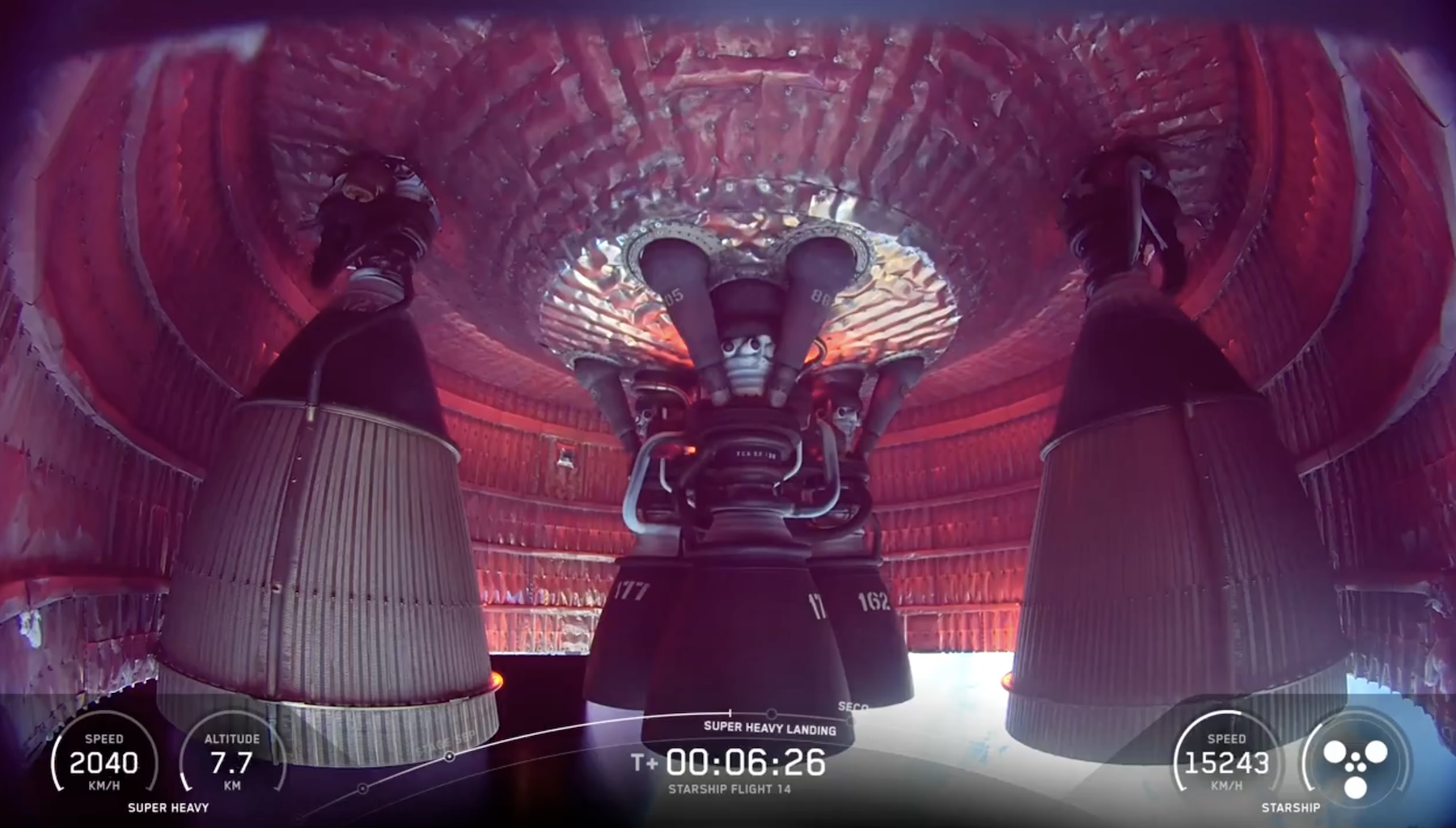
A view inside the engine bay of the Starship rocket, with three “sea level” Raptor engines in the middle and three “vacuum” Raptor engines in the outer ring. One of the steerable center engines was used for the orbit insertion and de-orbit burns.
Credit: SpaceX
A view inside the engine bay of the Starship rocket, with three “sea level” Raptor engines in the middle and three “vacuum” Raptor engines in the outer ring. One of the steerable center engines was used for the orbit insertion and de-orbit burns.
Credit:
SpaceX
SpaceX engineers were being “extremely conservative,” Huot stated. A worst-case scenario for Starship’s first orbital flight would have been the vehicle becoming stranded in orbit, potentially falling back to Earth uncontrollably and posing a risk to public safety.
“We were only going to go if we were very confident in the core systems that have to work to get you out of orbit once you’re up there,” Huot said. “We took some extra time, added some extra drama, but we were able to clear the … three center engines and do our first ever orbital insertion burn. So that was a huge success.”
The selected Raptor engine reignited flawlessly for 19 seconds, providing the necessary boost to reach a stable orbit at an altitude of approximately 171 miles (276 kilometers), adding about 204 mph to Starship’s speed.
Delivering for Starlink
Achieving orbit allowed SpaceX to proceed with deploying its newest generation Starlink V3 satellites. While a batch of Starlink V3s was launched on the previous Starship flight in July, that mission was suborbital, and the satellites quickly burned up upon reentry.
The Starlink V3 satellites offer significant upgrades to the Starlink constellation. They can only launch on Starship due to their size, exceeding the payload fairing capacity of the Falcon 9 rocket, which has deployed over 12,000 Starlinks since 2019. Each Starlink V3 weighs about 2 metric tons (4,400 pounds) and features larger solar arrays and improved antennas.
These enhancements enable each Starlink V3 to add 1 Tbps of capacity to the Starlink network, ten times more than older satellites launched on Falcon 9, according to SpaceX. The 26 satellites launched on Monday could be increased to up to 60 per flight in the future. SpaceX stated that Starlink V3s will “greatly expand the network’s capacity and user speeds.”
Upgraded Starlink satellites will also enhance direct-to-device connectivity. Future Starlink V3s could also support SpaceX’s Starshield service for the US military. SpaceX confirmed contact with all 26 deployed Starlink V3s.
The satellites were initially deployed into a low-inclination orbit (about 30 degrees north and south of the equator) due to range safety rules restricting overflights of populated areas during launch. SpaceX plans to launch Starship into higher-inclination orbits as it gains flight experience and debuts new launch pads in Florida and Louisiana.
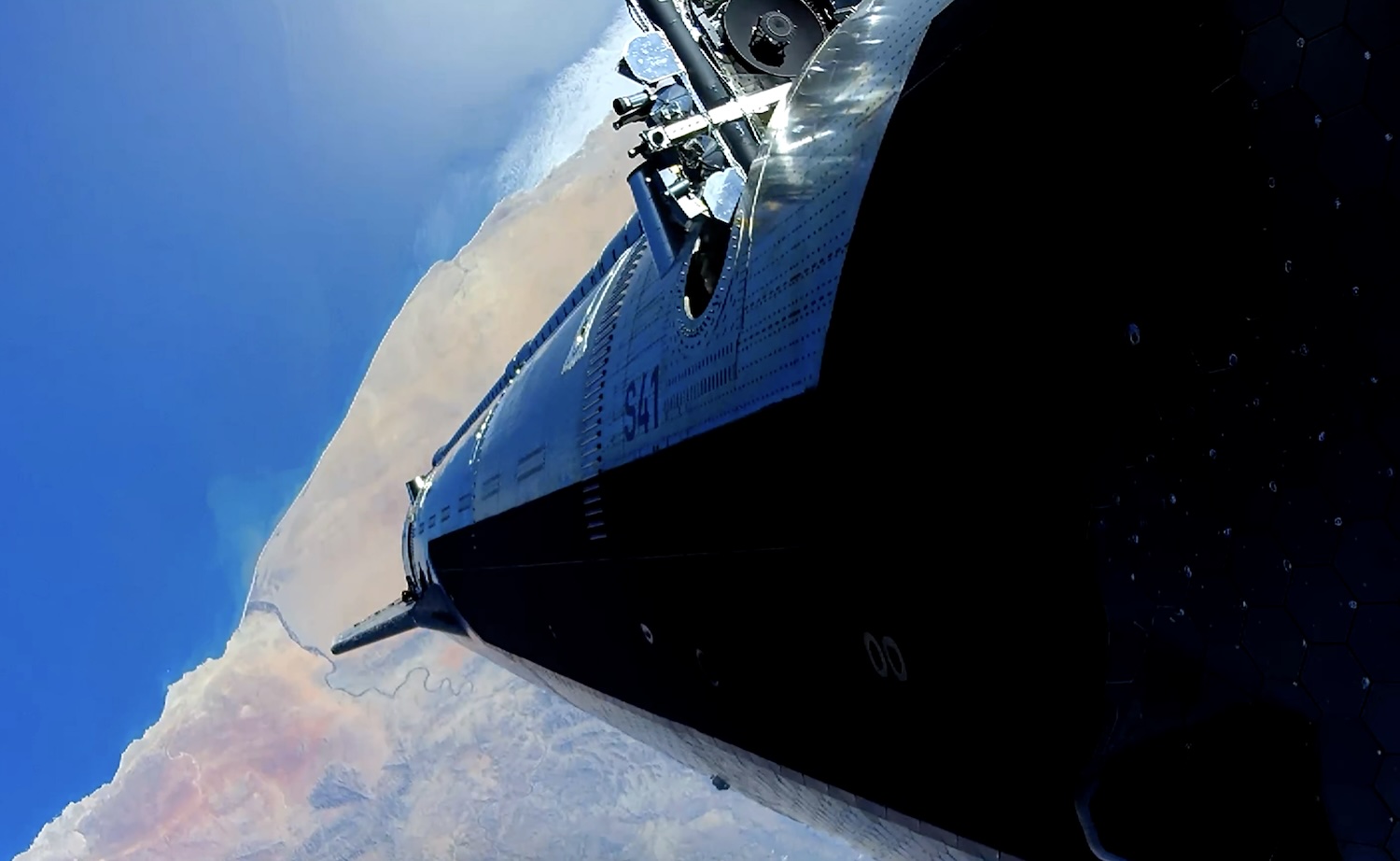
One of SpaceX’s Starlink V3 satellites is seen exiting the rocket’s Pez deployer as the vehicle soared over South Africa.
Credit: SpaceX
One of SpaceX’s Starlink V3 satellites is seen exiting the rocket’s Pez deployer as the vehicle soared over South Africa.
Credit:
SpaceX
SpaceX began phasing out Starlink launches on the Falcon 9 earlier this year, with no further Falcon 9 Starlink launches scheduled from Cape Canaveral. Falcon 9 launches for older-generation Starlink satellites into polar orbit will continue from Vandenberg Space Force Base, California.
Caleb Henry, director of research at Quilty Space, anticipates SpaceX will integrate the new Starlink V3 capabilities in the coming months. More Starlink V3s are expected on subsequent Starship flights.
“They just sat at a warehouse in Texas, as I understand it, because the satellites were finished well ahead of the launch vehicle,” Henry said during a Spaceflight Now broadcast, where the author of this story was also a guest.
SpaceX indicated that the current batch of Starlink V3 satellites will be integrated into the constellation and could begin serving customers within weeks, though a noticeable difference for users will likely require many more launches.
“It’s great that they have the capacity onboard in orbit, but until there is a meaningful number of V3 satellites launched, they won’t be the spacecraft that defines the user experience just yet,” Henry commented.
Calling it a day
Shortly after satellite deployment, SpaceX decided to end the mission earlier than planned, foregoing a test of the vehicle’s long-duration endurance in orbit.
“Out of an abundance of caution given the engine issue experienced during ascent, the flight control team decided to limit the duration spent on orbit and proceeded with de-orbiting Starship to a splashdown location in the northern Pacific Ocean,” SpaceX stated in a recap of the flight. “This area was one of two pre-coordinated landing zones identified before launch that was cleared of sea and air traffic.”
The de-orbit burn was successful, and Starship reentered the atmosphere over the Pacific Ocean, guiding itself toward a splashdown north of Hawaii. The reentry was uneventful, with the heat shield appearing to withstand temperatures up to 2,600° Fahrenheit (1,430° Celsius).
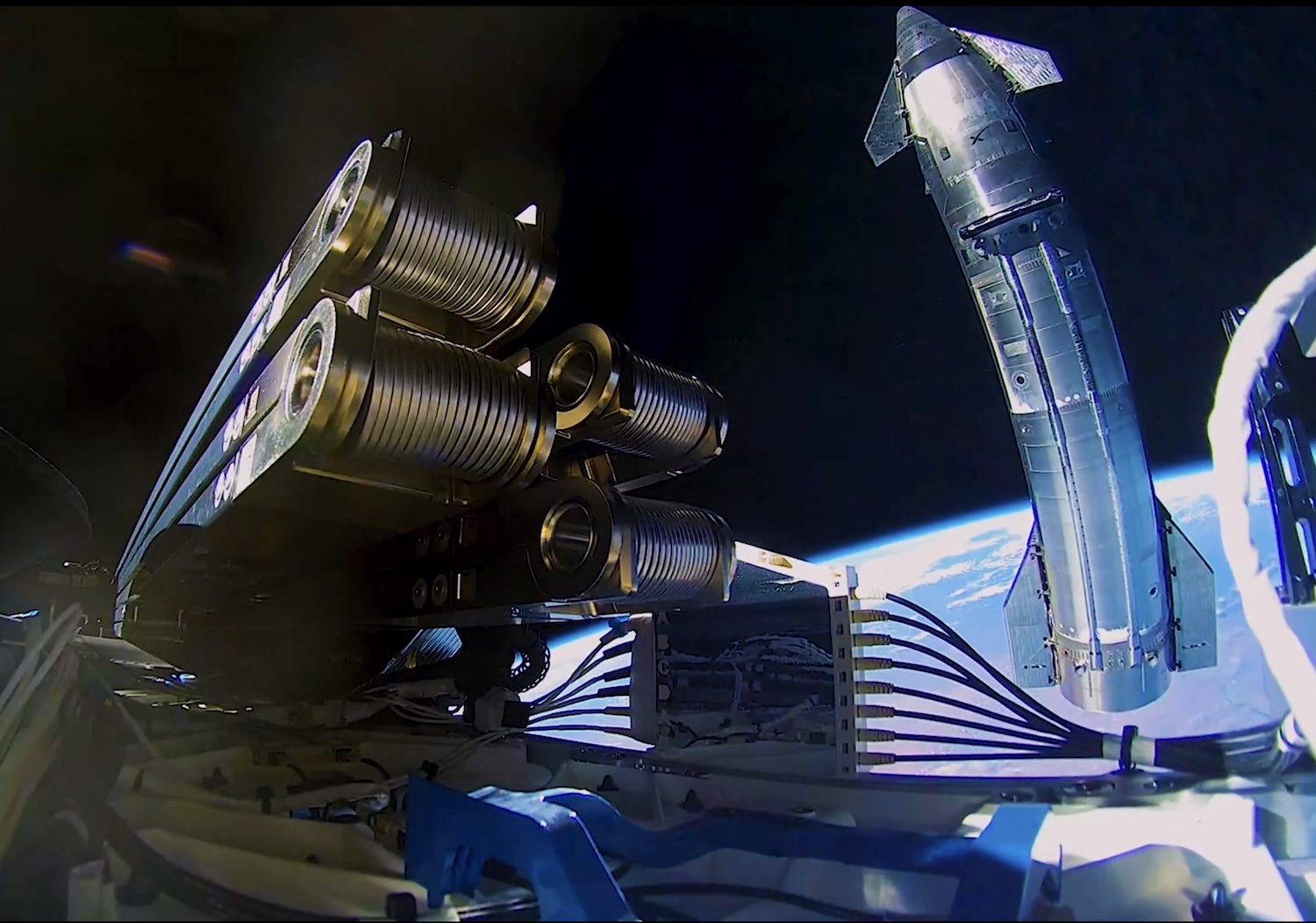
A bird’s-eye view of Starship in orbit captured by a camera on one of the Starlink V3 satellites.
Credit: SpaceX
A bird’s-eye view of Starship in orbit captured by a camera on one of the Starlink V3 satellites.
Credit:
SpaceX
Similar to recent flights, Starship descended belly-first through clouds before orienting upright for a final landing burn. The splashdown occurred precisely as planned, with a prepositioned buoy at the backup landing zone capturing the final moments of descent.
Splashdown occurred at 11:57 am EDT (15:57 UTC), just over three hours after liftoff, three times longer than Starship’s previous suborbital flights. The original flight plan anticipated a mission lasting nearly 10 hours.
As expected, the vehicle tipped over and broke apart upon impact with the ocean, unlike the intact splashdown on Starship’s previous flight in July. SpaceX anticipates most water landings will end in fiery destruction, but the era of Starship water landings may be drawing to a close.
“Most importantly, Starship made it to orbit,” Huot said post-splashdown. “We did our first ever orbital insertion burn. We kept the drama up a little bit as we were going through that coast time making sure everything was good. We were only going do all this stuff today if we were really, really sure that those sea level engines on Starship were going to perform because we needed to do that de-orbit burn.
“We were able to get there,” Huot continued. “We got on orbit. Teams continued to look at it. We were going to get the data that we wanted, so we made the call due to this earlier reentry to [near] Hawaii.”
What’s next for Starship?
SpaceX has a substantial number of Starships and Super Heavy boosters in production and testing at Starbase, indicating an increased flight cadence in the coming months. While official launch dates are unannounced, a schedule from the FAA’s Air Traffic Control System Command Center suggests the next Starship flight could occur in October.
Ground crews are testing and activating a new Starship launch pad at NASA’s Kennedy Space Center in Florida, with a launch anticipated before the end of the year. A new Starship factory is also under construction at Kennedy. SpaceX is expected to transport rockets from its Texas factory to the Florida launch site until the new production facility is operational.
The results from Monday’s flight suggest ongoing work is needed on the Raptor engine. The Raptor 3 variant features a lighter, streamlined design with fewer parts and higher thrust.
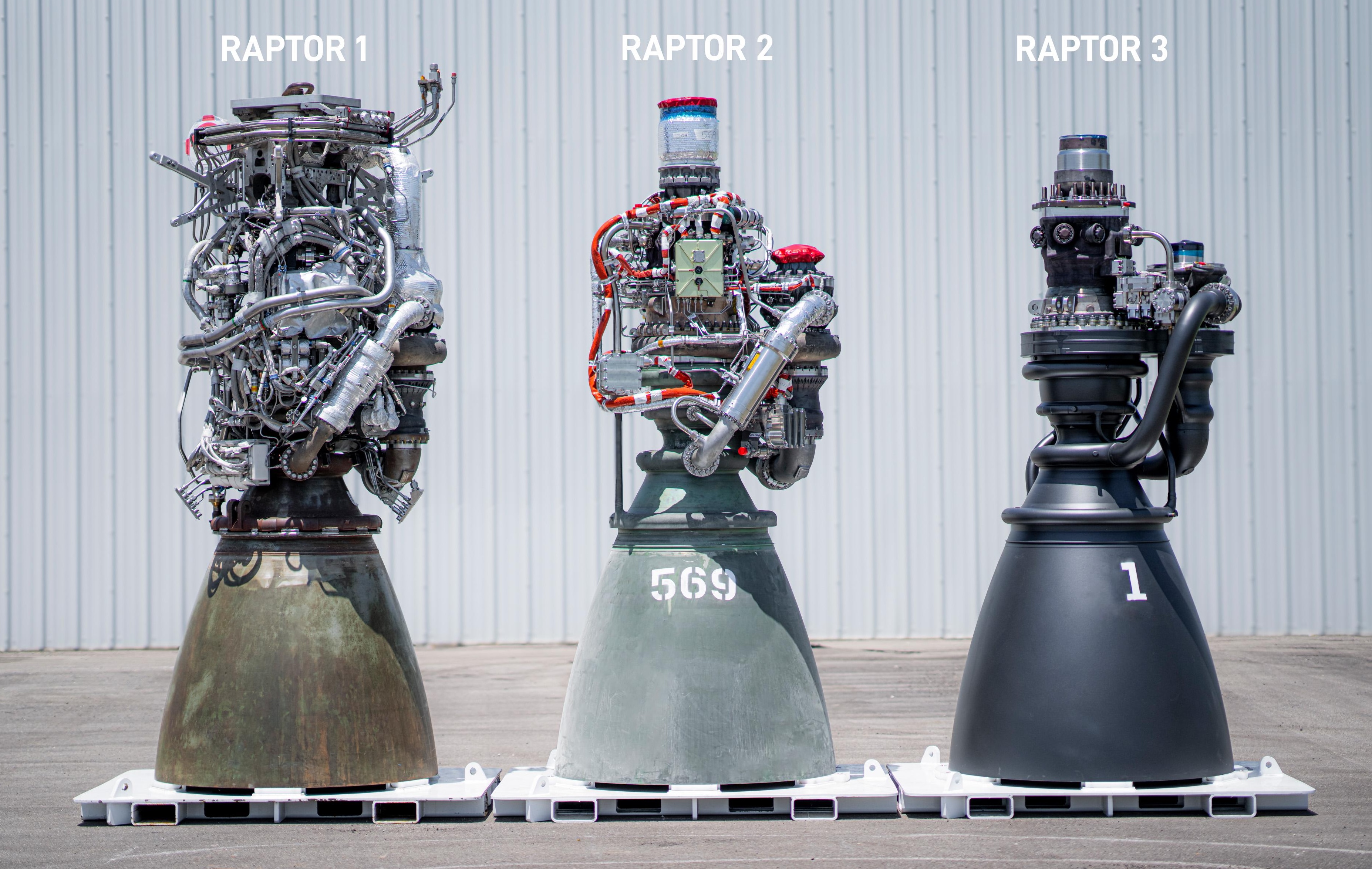
A family portrait of SpaceX’s Raptor engines.
Credit: SpaceX
A family portrait of SpaceX’s Raptor engines.
Credit:
SpaceX
SpaceX has encountered engine issues on each of the three Starship flights using Raptor 3s. During a May flight, one Raptor engine shut down prematurely on the Super Heavy booster, and another failed on Starship’s upper stage shortly after. In July, multiple Raptor engines failed to ignite on the launch pad, leading to a last-second abort. SpaceX replaced two engines before a successful launch the following week.
Elon Musk, SpaceX’s founder and CEO, stated on X that the Raptor 3’s design changes “greatly reduce mass and leak paths, but makes it harder to replace some parts.”
“While deleting parts sounds easy in theory, it is actually very difficult to figure out how to do so in practice and requires many iterations,” Musk added. He also noted that the Raptor 3’s internal geometry requires highly modified 3D metal printing.
Despite the ongoing work on the Raptor 3, these propulsion issues have not halted Starship’s progress and are unlikely to delay the next launch.
The FAA has cleared Monday’s flight, stating that all flight events for both the Starship vehicle and the Super Heavy booster occurred within authorized activities and will not require a formal mishap investigation.
SpaceX’s next objective is likely an attempt to recover Starship at Starbase using the launch pad’s mechanical arms, a feat already achieved with the Super Heavy booster. This would necessitate a reentry over land, requiring additional safety reviews for populated areas. Ultimately, SpaceX aims for full and rapid reuse of both Super Heavy and Starship.
Other near-term goals include longer-duration orbital flights and the first demonstration of in-orbit refueling, a prerequisite for future missions like landing astronauts on the Moon under NASA’s Artemis program.
In the interim, Starship is expected to launch numerous Starlink satellites. Commercial and government demand for Starlink services, coupled with SpaceX’s plans for orbital data centers, will keep Starship actively engaged as its advanced capabilities are brought online.


