
We accidentally built a synthetic cell factory
Akshay Maheshwari, CEO
We started b.next as a few academics looking to solve the problem of interoperability and integration in synthetic cell research, and help our community realize the potential of synthetic cells. Over the last few years, we've been hard at work on this with Nucleus. But that alone isn't enough: synthetic cells can only go so far without a dedicated physical supply chain. We took on the challenge and now operate a manufacturing plant building Cytosol—the core materials needed to build cells—made to Nucleus open specifications. We recently shipped our 100th kit. Building industrial-grade infrastructure wasn’t necessarily what we expected would be needed when we set out, but it's a critical next step for synthetic cells to grow from an academic effort to solving global-scale problems. This post shares that journey.
In 2023, we received a contract to build a simple synthetic cell sensor from fully open and specified components, as a means for jumpstarting collaborative and interoperable engineering of synthetic cells. A key part of our strategy was to build an open PURE system with easy-to-use protocols for construction, based on the OnePot PURE system. This was a clear need for the synthetic cell community, which had adopted the PURE system as its core platform, but practically only had access to non-extensible and non-modifiable commercial formulations. What we thought would take a few months turned into a multi-year undertaking as we uncovered foundational challenges in synthetic cell infrastructure and supply chains—and eventually led us to introduce and begin manufacturing “Cytosol” as a core substrate for building synthetic cells.
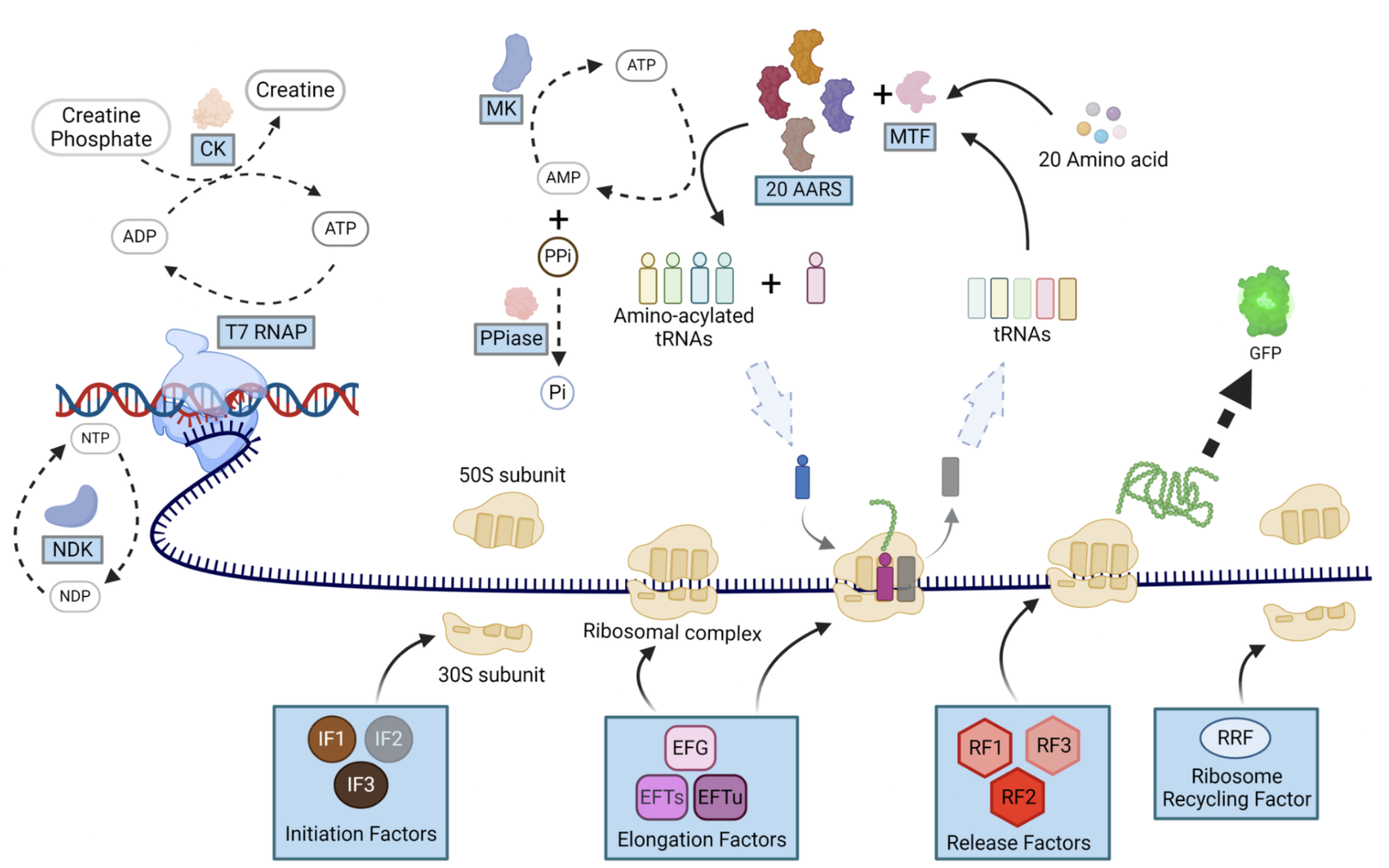
PURE is a defined molecular system composed of 36 proteins, 31 small molecules, a mixture of 43 tRNA, and ribosomes that together power transcription and translation. Figure by Ganesh and Maerkl, 2024 used under CC-BY-4.0 with modifications.
This should be easy…right?
We were blocked at the very first step. We couldn’t acquire the 36 plasmids needed to implement the OnePot PURE system proteins. They were only available under restrictive material licensing terms (UBMTA), which as a company, we could not access—even though our goal was to make PURE better for the community. As we spoke with PURE researchers, we also learned that the available PURE plasmid set was incomplete and contained mutated plasmids. To our surprise, only a handful of labs around the world had actually successfully built the PURE system, often taking over 18 months to do so—a sobering length of time to get to a baseline technology first published in 2001.
We took this challenge head-on, re-designing and synthesizing our own improved, open-access set of PURE plasmids, and developing straightforward protocols for PURE protein production and assembly. After nine months of painstaking development, we could finally achieve detectable output—a critical milestone that confirmed that the open system could work at all. We shared our first set of PURE protocols and plasmids in mid-2024 through the Nucleus platform, which we had recently launched as an open commons for the community to build synthetic cells together.
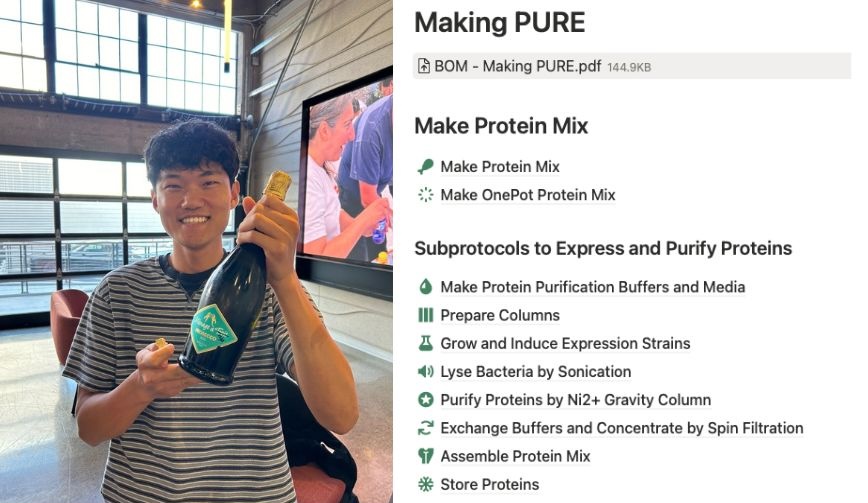
Yemo Ku—now b.next’s Manufacturing lead—popping champagne (”Ménage à 36”) to celebrate detectable output with our open PURE system in summer 2024. Nucleus v0.2 protocols for making PURE shown on the right.
We can't trust the supply chains.
But a functioning PURE system requires not just proteins—it also needs tRNA and ribosomes. When we started our work, tRNA were available from two providers: Roche and Sigma. In 2023, Roche stopped supplying tRNA. Then, just as we had gotten PURE proteins working with our open system, Sigma also stopped supplying tRNA. We learned that tRNA manufacturing had been deprioritized, and would be on back order indefinitely. A key reagent needed to build synthetic cells was suddenly unavailable.
We realized just how brittle the supply chains for synthetic cells were—a hodgepodge of different providers, often singular for a given reagent, none of whom cared about synthetic cell researchers in particular. As we began getting more requests for our open PURE DNA plasmid set, it became clear that achieving reliable synthetic cell engineering across the community would take more than we had originally planned for. The community needed reliable, open protocols not just for PURE proteins, but for every component.
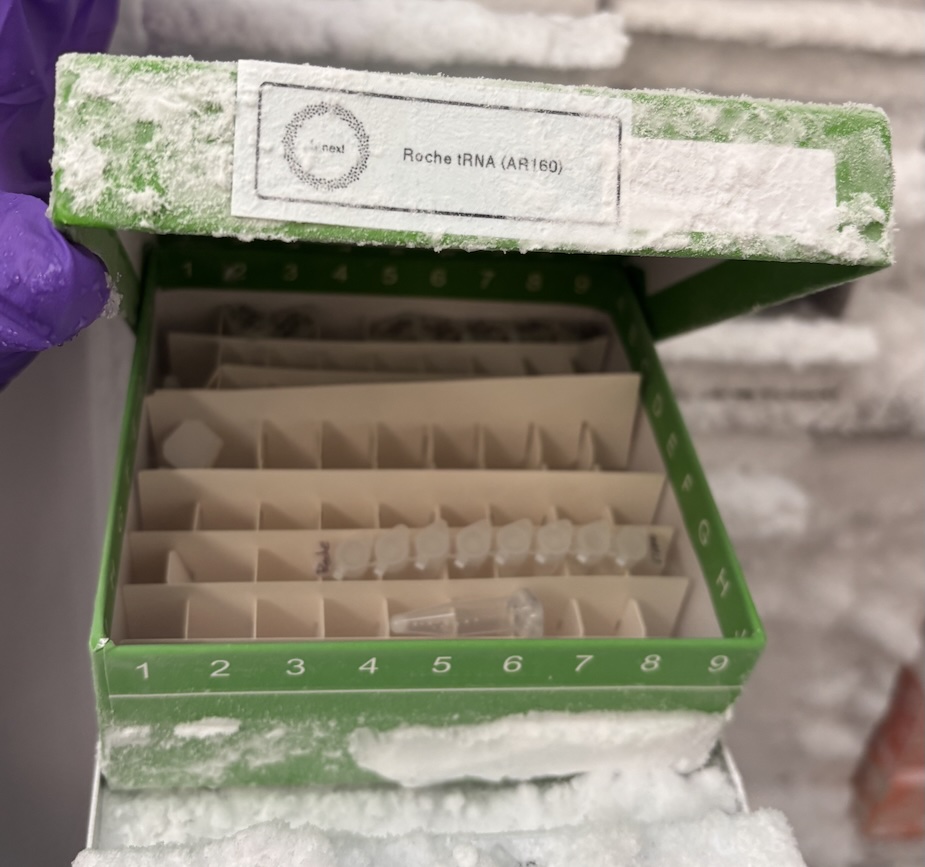
Our last precious tubes of tRNA, gifted by collaborators Kate Adamala and Evan Kalb.
The field needs more.
By mid-2025, we had developed and optimized open protocols, specifications, and materials for producing all PURE components—proteins, small molecules, tRNA, and ribosomes. We hosted our first PURE workshop with 8 graduate students and post docs from major synthetic cell labs to begin disseminating the technology—an intensive sprint in which participants built the full PURE system from scratch in just one week. We did so with the support of Build A Cell and experts from the community, convening an earlier PURE Development Workshop to improve the open system and make it easy to use.
As we began working with more researchers, however, we became aware of a fundamental reality. No matter how accessible we made it, for any individual student or lab, making PURE was still a time-consuming process that only led to a limited amount of baseline reagent—just the starting point. Moreover, making any modifications or additions to the baseline PURE system usually led to manufacturing complexities that were not the expertise of individual labs. While validated, open PURE protocols ensured that any researcher has the ability to produce their own reagents if necessary, direct access to validated, ready-to-use reagents for building cells would simply be better, faster, and more reliable. We became convinced that to most effectively catalyze synthetic cell research, we needed to (1) start thinking in terms of “Cytosol”—PURE-like defined systems built to operate synthetic cells and be used by synthetic cell researchers, that could grow in functionality with supporting tooling alongside the field, and (2) provide pre-manufactured Cytosol kits tied to Nucleus open specifications and protocols.

We hosted a workshop in 2025 to teach synthetic cell researchers how to make PURE from fully open Nucleus components and processes.
A first synthetic cell manufacturing plant.
From late 2025 to early 2026 we built and operationalized a dedicated manufacturing plant in San Francisco to supply Cytosol as a foundation for synthetic cell engineering. In the last six months, we have supported open projects at ~20 labs around the world with over a hundred Cytosol kits, and are continuing to scale our capacities. Our Cytosol kits are built to Nucleus open specifications, and can be constructed from scratch by anyone via the openly available Nucleus protocols and plasmid set. We are actively testing and sharing new, open synthetic cell modules validated in and extending baseline Cytosol—including modules for energy, control, and membrane translation. We have also been supporting collaborators with custom and modified Cytosol kits to enable more sophisticated synthetic cell development.
Going forward, we are excited to continue growing Cytosol’s capabilities alongside the community. We are starting to build digital and automation tools around Cytosol— for design and analysis, high-throughput screening and optimization, as well as AI-driven engineering and module integration; and are helping facilitate multi-institutional research programs building open, integrated, synthetic cell technologies using Cytosol. Stable infrastructure and supply chains are foundational to achieving the potential of synthetic cells, and access to a common, open-formulation Cytosol is a subtle but important milestone for the community, one we’re happy to have reached. We look forward to continuing to advance these foundations with our manufacturing plant, with Nucleus, and with whatever else we discover is needed next. If you want to build with Cytosol, propose a module, or collaborate, please reach out—we are always looking for ways to build synthetic cells together.

We are now manufacturing ready-to-use Cytosol kits built to Nucleus open specifications. Reach out!
_b.next is an SF-based company focused on realizing the potential of synthetic cells. We built and maintain Nucleus _, an open platform for building synthetic cells, and operate a manufacturing plant for synthetic cells. Read more about our story here and active programs here _. Reach out to us for anything at build@bnext.bio (we love to collaborate).


