
US and Iran exchange strikes in Gulf in latest test of ceasefire
Tom McArthurand Jaroslav Lukiv
Watch: The US military released this video said to show strikes on Iranian sites
The shaky ceasefire between the US and Iran has been tested further, with American forces targeting Iranian drones and radar sites, and Iran firing missiles at US bases in the Gulf.
The US military said the attacks were in response to four Iranian "one-way attack drones" launched towards the Strait of Hormuz, which it said "posed an immediate threat to regional maritime traffic". The drones were shot down, US Central Command (Centcom) said.
Tehran called the US strikes a "flagrant" violation of the ceasefire agreement between the two countries.
Iran retaliated by firing ballistic missiles at two US air bases in Kuwait, and US Navy facilities in Bahrain, Iran's Irib news agency reported.
Bahrain and Kuwait both condemned the attacks, saying the drone and missile fire had been successfully repelled.
Centcom said initial assessments showed that of the seven Iranian missiles fired at the two Gulf states, six were intercepted and one did not reach its target.
The United Arab Emirates and Qatar also denounced the Iranian attacks on their Gulf neighbours.
The Iranian foreign ministry said in a statement that the US strikes on radar installations in Sirik and at Qeshm island were a "flagrant" violation of the ceasefire and "an attack on the national sovereignty and territorial integrity of the Islamic Republic of Iran", according to news agencies.
"The US attack demonstrates this country's complete disregard for the principles of international law and the United Nations Charter," the statement added.
Iran's Islamic Revolution Guard Corps (IRGC) said it had hit "enemy bases" as retaliation to the American strikes.
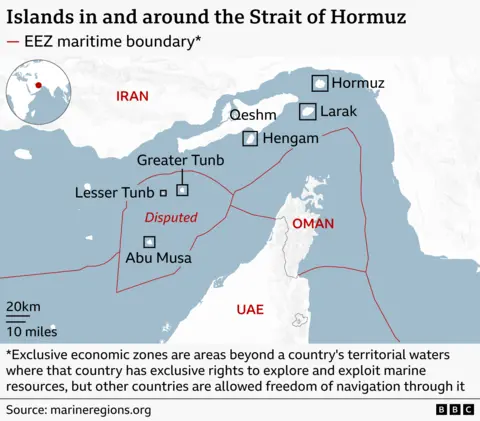
There have been several such exchanges of fire, threatening the ceasefire that has been in place since April.
However, even with the conflict between the two nations continuing, the US has granted visas to Iran's World Cup football team, ahead of their first match in Los Angeles on 15 June.
It is the first time the competition will see a host nation receive the team of a country it is at war with.
The attacks occurred as ceasefire negotiations between the US and Iran stalled, with a deal to end the war failing to advance, and US media reporting that President Donald Trump had requested changes to the terms of an agreement.
On Monday, Iran's foreign ministry spokesman said the US was "constantly changing its views and putting forward new or contradictory demands".
The US and Israel launched wide-ranging strikes on Iran on 28 February, sparking conflict across the Middle East.
Iran responded by attacking Israel and US-allied states in the Gulf, and effectively closing the Strait of Hormuz, through which around 20% of the world's oil and liquefied natural gas travels.
That oil comes not only from Iran, but also Gulf states such as Iraq, Kuwait, Qatar, Saudi Arabia and the UAE.
The closing of the strait sent oil prices soaring globally.
Shortly after a ceasefire was agreed in early April, the US established a blockade of Iranian ports, which Trump said would remain "in full force and effect until an agreement is reached, certified, and signed".


