
Saudi Arabia joins US in strikes on Iran-backed militias in Iraq
15 minutes ago
David Gritten
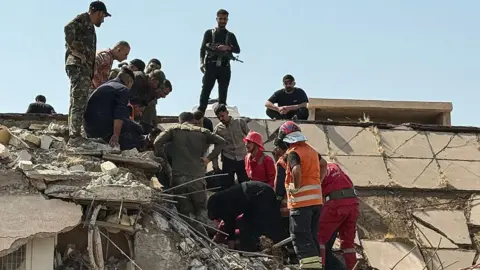
Saudi Arabia and the US have carried out strikes against Iran-backed militias in Iraq, in a potential escalation of the Middle East conflict.
US Central Command (Centcom) said the strikes were against "Iran-aligned terrorists that the Islamic Revolutionary Guard Corps (IRGC) directed to attack US forces and Saudi energy infrastructure".
Iraq's paramilitary Popular Mobilisation Forces (PMF), which is dominated by Iran-backed Shia militias, said at least 20 of its members had been killed in US-Saudi strikes on its bases.
It came hours after Centcom said Iran had launched missiles at US forces in the Middle East in an "attempted surprise attack", ending a lull in hostilities.
The US said the Iranian attack occurred at 17:45 EDT (21:45 GMT) on Tuesday, with all missiles "successfully intercepted".
The IRGC said the missiles had targeted a US air base and a command centre in Jordan "in response to the acts of aggression of the American child-killing army".
It also said that naval forces had struck three oil tankers in the Strait of Hormuz after they "ignored warnings" and sailed along what it described as an "unsafe and illegal route" through the vital Gulf waterway.
Centcom said US and Saudi fighter jets had struck "multiple terrorist logistics and weapons sites across eastern Iraq in a strong response to over 30 IRGC-directed aerial drone attacks in the last 72 hours".
It called the drone attacks "unwarranted" and added that they had failed.
"The IRGC and its terrorist proxies must cease these attacks to avoid further U.S. military response," the Centcom statement said.
A spokesman for the Saudi defence ministry, Maj-Gen Turki al-Maliki, also accused "Iran-backed terrorist militias" of launching drones from Iraqi territory at oil facilities in the Eastern and Riyadh regions on Monday and Tuesday.
He said Saudi Arabia, under its "right to self-defence", had responded by conducting strikes "against specific targets belonging to those militias".
"The Kingdom of Saudi Arabia reiterates that it does not seek escalation but will respond decisively to any aggression directed against it," he added.
The PMF said in a statement on Wednesday morning that at least 20 of its fighters had been killed and 32 others wounded in US-Saudi strikes on a number of its headquarters in the provinces of Baghdad, Wasit, Nineveh, Basra, Kirkuk, Karbala and Diyala.
An official told AFP news agency that the strikes in Nineveh, in the north, and in Diyala, in the centre, were the deadliest.
The PMF condemned what it called the "the treacherous terrorist attacks", saying they were "an extremely serious escalation and a violation of Iraq's sovereignty, targeting its official security institutions".
The PMF is an umbrella organisation of mostly Shia Muslim militias that has been formally integrated into the Iraqi armed forces. It includes several Iran-backed groups which are part of a network of proxies that Tehran has used to advance its interests across the Middle East for years.
Those militias have attacked US personnel and interests in Iraq on a number of occasions, aiming to force the remaining US troops to leave the country. The US has regularly struck back at the militias.
An Iranian defence official was quoted by state TV as denying any Iranian connection to the drone attacks on Saudi Arabia, according to Reuters news agency.
The official warned that attributing attacks on US interests in the region to Iran was a "major miscalculation".
The reignited hostilities between the US and Iran come two days after President Donald Trump spoke of "very friendly negotiations" to resolve a dispute over the Strait of Hormuz. At that point, the two sides had not exchanged strikes for three consecutive days.
The lull had followed 13 consecutive nights of bombing by the US, which said it had targeted Iranian weapons and military sites to diminish Iran's ability to attack commercial vessels attempting to transit the strait. Scores of people were reported to have died in the strikes.
Iran responded to the US attacks by launching missiles and drones at US military assets in neighbouring Arab states. Four US service personnel were killed Jordan and Iraq.
Access to and control of the Strait of Hormuz remain a key sticking point in negotiations between the US and Iran, which Iranian officials have denied are even happening.
Oil prices rose early on Wednesday over concerns that an escalation in the conflict could further disrupt energy shipments through the strait, which has been effectively closed since the start of the US and Israel's war with Iran at the end of February.
In morning trading in Asia, the global benchmark Brent crude was up by 4.3% to $87.70 (£65.98) a barrel, while US-traded oil was 4.2% higher at $82.62.
The latest strikes coincided with Israeli Prime Minister Benjamin Netanyahu's visit to Washington, where he met Trump at the White House and attended the funeral of US Senator Lindsey Graham, a prominent Iran hawk.
At least 624 US military service members have been wounded since Trump ordered strikes against Iran in February, according to recent Pentagon data.
The Pentagon said 417 of those personnel were injured in relation to Operation Epic Fury, the joint US-Israeli military operation against Iran.


