
Breaking News:
SPR Sinks Toward Operational Minimum as U.S. Crude Inventories Build
China Challenges Russia’s Arms Dominance in Central Asia
Iran Blacklists 45 Tankers as Hormuz Standoff Escalates
Energy investors are raving about this new resource
"It's most important 8 minute read of my week…"
The U.S. Power Play in Iraq That Moscow and Beijing Didn’t See Coming
By Simon Watkins - Aug 25, 2026, 5:00 PM CDT
- Washington is moving aggressively to strengthen its position in Iraq’s oil sector, as Baghdad targets a massive increase in production to 8–10 million bpd within six years.
- ConocoPhillips is taking a 42% stake in BP’s Kirkuk venture, while Chevron is advancing plans for the giant West Qurna 2 and Nasiriyah fields.
- Washington is seeking to capitalize on Russia’s retreat, curb Chinese and Iranian influence, and secure a larger role in one of the world’s cheapest and largest remaining oil-resource bases.
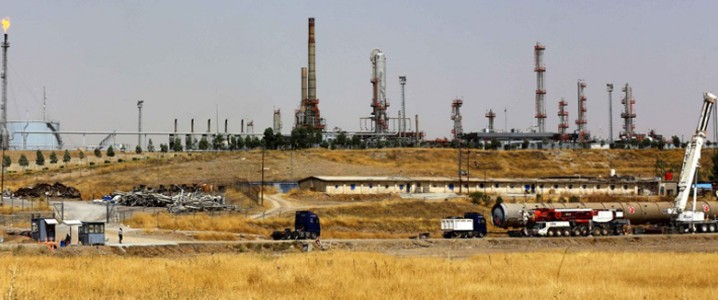
As Russia remains occupied with its war in Ukraine, Iran focuses on defending its territory against U.S. and Israeli attacks, and China maintains its involvement in both conflicts under the bar that would trigger direct conflict with America, Washington is leveraging its position in Iraq. These efforts by the U.S. and its allies have taken on further urgency as Iraqi Prime Minister Ali al-Zaidi announced last week that the country plans to raise oil production to between 8 million barrels per day (bpd) and 10 million bpd within six years -- so the U.S. and its allies want to be best positioned to benefit from that. So, what has Washington been up to in recent weeks and why?
Despite the recent damage done to its oil sector by the ongoing conflict in the Middle East, Iraq has four key qualities that all three global powers remain keen to use to their own advantage. First, it is still one of the biggest oil prizes in the world, with a very conservatively estimated 145 billion barrels of proved crude oil reserves (nearly 18% of the Middle East’s total, and the fifth biggest on the planet), according to the Energy Information Administration. It is extremely likely that it holds much more oil than this, and the US$2-4 per barrel lifting cost is the joint lowest in the world, along with Iran and Saudi Arabia. Second, it occupies the geographical heart of the region, lying west of Iran, north of Saudi Arabia and Kuwait, east of Jordan and Syria (with its long Mediterranean coastline offering access to further critical sea routes), and south of Turkey (affording an entry into the European continent). Third, it remains a key member of the ‘Shia Crescent of Power’ geopolitical arc that stretches from Iran through Iraq, Syria, and Lebanon, where Shia communities and Iran-backed groups exert significant influence over regional politics, economics, and security. And fourth, it has for years been the key conduit through which Iran has been able to move its own sanctioned oil out into the world under the guise of non-sanctioned Iraqi oil, which has ensured its economic survival, despite swingeing international sanctions. Related: Satellite Images Show Seven Tankers Loading Iraqi Crude at Once
Following the U.S.’s unilateral withdrawal from the Joint Comprehensive Plan of Action (JCPOA, or colloquially ‘the nuclear deal’) in 2018, China and Russia moved quickly to exploit perceived American weakness across the Middle East. In Iraq’s case, Russia had effectively seized control over the country’s semi-autonomous Kurdistan Region in the north through three initiatives analysed in full in my latest book on the new global oil market order. China had done a similar job in the south of the country through two wide-ranging cooperation deals in 2019 and 2020 -- the ‘ Oil for Reconstruction and Investment’, which allowed Chinese firms to invest in infrastructure projects in Iraq in exchange for oil, and the equally all-encompassing ‘Iraq-China Framework Agreement’, as also fully detailed in that book. The upshot of these strategies was that at the beginning of Donald Trump’s second presidency in 2025, Russia held sway over much of northern Iraq’s oil sector, while Chinese companies managed around 34% of Iraq's proven reserves and two-thirds of its full-capacity production. China was also busy linking together the individual pieces in southern Iraq’s oil jigsaw that it had quietly established through dozens of low-key ‘contract-only’ deals by relatively unknown Beijing-directed firms into a full exploration-production-refinery-export hub infrastructure that threatened to leave the U.S. excluded from key future exploration and production decisions.
Trump’s team at the beginning of the second term moved to neutralise several of these levers of influence over Iraq by Russia and China, beginning with sanctions that saw Russian companies effectively forced out of the Kurdistan Region, as fully analysed by OilPrice.com. The U.S. also fired sanctions warning shots at Beijing over Iran and Iraq, while at the same time Western firms secured key oil field and infrastructure deals across the north and south of Iraq. In the same context, two American oil and gas giants in recent weeks have moved to consolidate this advantage, in the shape of ConocoPhillips and Chevron. The former has agreed to acquire a 42% interest inBP Energy Company of Kirkuk Limited from British oil and gas supermajor BP, supporting the redevelopment of five producing oil fields in the Kirkuk area of northern Iraq -- the Baba dome (of the Kirkuk field), the Avanah dome (of the Kirkuk field), the Bai Hassan field, the Jambur field, and the Khabbaz field. This followed the activation by BP on 2 October last year of the US$25 billion five-pronged oil and gas megadeal, which is targeting a preliminary production target of 328,000 barrels per day (bpd), according to a senior source who works closely with Iraq’s Oil Ministry, exclusively spoken to by OilPrice.com at the time. This is expected to rise to at least 450,000 bpd within the next two to three years, and then to be reassessed with a view to an increase in output and plateau production figures. The lifting cost of many of these barrels will be at or close to Iraq’s average of US$2-4 pb, and the project is set to run 25 years, although the contract will then be open for renewal. Although the five fields are already estimated to hold up to 9 billion barrels of oil reserves, these are very conservative estimates, according to the Iraq source. “There’s at least another eleven or twelve billion barrels across the near surrounding area, and possibly much more,” he underlined recently. There are much broader geopolitical implications in this deal too. Beijing and Moscow have long worked for Kurdistan to be subsumed into a single unified Iraq, governed out of Baghdad, with the West pushed out of the country entirely. As a very high-ranking official from the Kremlin exclusively revealed to OilPrice.com some years ago: “By keeping the West out of energy deals in Iraq, [Russia and China will see] the end of Western hegemony in the Middle East will become the decisive chapter in the West’s final demise.”
Chevron, meanwhile, is moving forward with two of southern Iraq’s largest oil fields. Following the implementation of major sanctions by the U.S. and Great Britain, Russia’s Lukoil withdrew from the supergiant West Qurna 2 field, leaving the way open for the U.S. firm. The field, located 65 kilometres northwest of the southern port of Basra and with roughly 14 billion barrels of reserves in place, had been steadily producing around 400,000 bpd -- about nine per cent of Iraq’s total oil production at that time -- under the operation of Lukoil, which held a 75% stake in the field (the remainder held by Iraq’s state-run North Oil Company). The development plan was to increase crude oil production to 480,000 bpd in Phase 2, and then to add another 650,000 bpd to the total in Phase 3, which would focus on the deeper Yamama formation. The ultimate target of 1.13 million bpd might appear high to some (although the original target was 1.2 million bpd), but it is entirely justified both by US geologists when they were on the ground during the US occupation and by various international oil companies. Additionally beneficial to Chevron’s prospects here, and to Iraq’s target of achieving over 6 million bpd of oil production by 2029, are the synergies that will be available to the U.S. firm from other Western majors now in operation again across the country. Not the least of these is the Common Seawater Supply Project (CSSP), which involves taking seawater from the Persian Gulf and transporting it to oil production facilities to boost pressure at key oil reservoirs, as detailed in full in my latest book on the new global oil market order. The second oil field to be developed by Chevron is Nasiriyah, for which it also signed an addendum to a heads of agreement letter a few days ago. Situated in southern Iraq’s ThiQar province, the idea of developing the 4.36 billion-barrel Nasiriyah oilfield has been seriously mooted by each of the rapid succession of governments in Iraq since it was discovered by the Iraq National Oil Company in 1975. These plans have variously been for the standalone development of the oil field or its development within the broader scope of the ‘Nasiriyah Integrated Project’ (NIP) that also includes the corollary construction of a 300,000-bpd refinery. All major plans stalled in one way or another, but last week’s signing of the agreement with Chevron signals that a sustained and substantial development of Iraq’s hidden hydrocarbon gem may finally be underway, again aided by the parallel development of the CSSP.
By Simon Watkins for Oilprice.com
More Top Reads From Oilprice.com
- Treasury Expands Iran Sanctions Without Targeting Major Chinese Banks
- Europe Dodges a Rhine Crisis for the Worst Possible Reason
- Oil Nears $100 as Trump’s ‘Economic D-Day’ Raises the Stakes
Download The Free Oilprice App Today


ADVERTISEMENT
Set us as your preferred Google source
FACEBOOK Twitter LINKEDIN REDDIT PRINT
Previous Post\ \ UK Tax Rises Back on the Table as Burnham Faces Fiscal Crunch
Simon Watkins
Simon Watkins is a former senior FX trader and salesman, financial journalist, and best-selling author. He was Head of Forex Institutional Sales and Trading for…
Related posts
U.S. Refiners Face New Crude Squeeze as Canada Cuts Oil Sands Output Norway’s Troll Gas Expansion Buys Europe Time—But Not New Supply Oil Prices Fall as Iran Negotiation Hopes Return
Leave a comment
First Name
Last Name
That email address is already in the database. Please login to your account to post your comment, or enter a different email address to continue with your comment & account creation.
Captcha
Comment
Please understand that, by submitting this form, you will be creating a free OilPrice.com account, and therefore agree to abide by our Terms of Use. Your details will be stored in our database and shared with our third party mailing list provider. You will be sent an email containing a link that will ask you to generate a new password - please follow the link to complete your OilPrice account activation.
We will save the information entered above in our website. Your comment will then await moderation from one of our team. If approved, your data will then be publically viewable on this article. Please confirm you understand and are happy with this and our privacy policy by ticking this box. You can withdraw your consent, or ask us to give you a copy of the information we have stored, at any time by contacting us.
ADVERTISEMENT
ADVERTISEMENT
Most Popular
 \ \ Oil Prices Fall as Iran Negotiation Hopes Return
 \ \ Copper Backwardation Collapses After 20,000 Tons Hit LME Warehouses
  \ \ Hope Fades, Traders Brace for Extended Oil, LNG Squeeze
  \ \ U.S. Refiners Face New Crude Squeeze as Canada Cuts Oil Sands Output
  \ \ How Solar Panel Prices Fell 90 Percent In 15 Years

By signing up to our newsletter, you agree for your email address to be shared with our third party mail providers.
ADVERTISEMENT
ADVERTISEMENT
EXXON Mobil-0.35
Open57.81Trading Vol.6.96MPrevious Vol.241.7B
BUY 57.15
Sell 57.00


