
Blasts reported in Iran as US launches new wave of strikes
1 hour ago
Jaroslav Lukivand Toby Mann
 Reuters
The US launched a new wave of strikes against Iran for a sixth night in a row, its military said, as the two sides battled for control of the Strait of Hormuz.
US Central Command (Centcom) said the attacks were intended to "further degrade Iranian military capabilities", before saying it had boarded a vessel as part of its blockade of the strait.
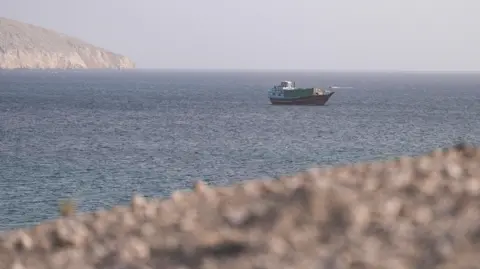
Iran's state media reported US missiles struck close to the island of Qeshm, near the strait, as well as in Bandar Abbas and Bushehr - the site of a nuclear power plant.
In an apparent escalation, it also said two bridges in Hormozgan province had been hit. The BBC has verified an attack on one bridge to the west of Bandar Abbas in Hormozgan province.
Earlier this week, US President Donald Trump threatened to strike Iran's bridges and power plants if the country did not return to talks.
After Trump said in April that the US would bomb civilian infrastructure in Iran, including bridges and power plants, UN human rights chief Volker Türk said "deliberately attacking civilians and civilian infrastructure is a war crime".
The 1949 Geneva Conventions on humanitarian conduct in war prohibit attacks on sites considered essential for civilians.
Centcom also said marines had boarded an oil tanker in the Gulf of Oman as part of the renewed US blockade of Iran's ports that began on Tuesday night.
It added it had "redirected 3 commercial vessels trying to run the blockade".
According to Centcom, US forces disabled nine ships and redirected more than 140 under its previous blockade of Iranian ports between 13 April to 18 June.
As the the renewed hostilities further strained the preliminary deal to end the war, White House press secretary Karoline Leavitt said on Thursday that Trump remained open to talks with Iran.
"The president will hold them accountable when they turn their back on the words that they state to the United States. But he is always open to diplomacy at the very same time," she told reporters.
She said Iran has expressed it still wants to make a deal with the US, adding: "We're talking to them, but again, the president is not going to allow them to fire on ships in the strait without paying a consequence for that."
As attacks escalate, the Strait of Hormuz - a critical waterway off Iran's coast that Tehran effectively blocked in response to US-Israeli strikes - has remained shut.
Earlier on Thursday, Tehran said it had struck US military bases in Jordan, Kuwait and Bahrain, while the US said it had inflicted a six-hour wave of strikes on multiple locations in the strait.
Those exchanges came after Trump warned Iran it had "better behave" or face further military action should Iran not return to negotiations.
Iran's top negotiator, Mohammad Bagher Ghalibaf, told state media that Tehran had "no reason" to abide by any agreement that did not benefit the country.
He added that Iran's national security depended on maintaining what he described as "Iranian arrangements" in the Strait of Hormuz.
The Strait of Hormuz
A very quick guide:
What is it?
The Strait of Hormuz is a narrow stretch of water located between Iran, the United Arab Emirates (UAE) and Oman.
The waterway - which is about 21 miles (33 km) at its tightest point - connects the Gulf to the Gulf of Oman, making it a vital global shipping route.
Who uses the Strait?
About 20% of the world's oil and liquefied natural gas usually passes through the Strait of Hormuz.
That oil comes not only from Iran, but also Gulf states such as Iraq, Kuwait, Qatar, Saudi Arabia and the UAE.
In 2025, about 20 million barrels of oil passed through the waterway per day, according to estimates from the US Energy Information Administration (EIA) – that's nearly $600bn (£447bn) worth of energy trade per year.
Since the US and Israeli strikes on Iran in late February, shipping through the Strait of Hormuz has been severely disrupted, impacting global oil prices.
Where does the oil go?
In 2022, around 82% of crude oil and other fossil fuels leaving the Strait of Hormuz were bound for Asian countries, according to EIA estimates.
China alone is estimated to buy around 90% of the oil that Iran exports.
Meanwhile, Trump on Wednesday praised Iran for freeing Dena Karari, a US detainee that he said had been "wrongfully detained" in December 2024.
"The United States of America appreciates this gesture of Goodwill by Iran!" Trump wrote on Truth Social.
Karari's attorney Jared Genser said she was on her way back to the US.
However, Iran's judiciary on Thursday said that no US prisoner had been released or exchanged from its prisons, Iranian state media reported.
Trump threatens to bomb bridges and power plants unless Iran resumes talks
Trump retreat over Hormuz tolls suggests he is struggling to end Iran war


