
The federal government is warning users of home and small office routers to secure their devices as Russia state hackers continue to mass-compromise them for use in obscuring nefarious actions against sensitive organizations in the public and private sectors.
Both the Russian and Chinese governments have been compromising routers for years, sometimes in prolonged tugs-of-war to wrest control of devices the other has already commandeered. The US government has occasionally issued covert commands and taken other steps to disinfect routers. Google and other companies have also worked to disrupt the massive botnets that control compromised routers in lockstep. The actions to date are little more than whack-a-mole exercises as the operators simply replace their botnets with new ones.
Proxy networks: The go-to tool
“Russian Federal Security Service (FSB) Center 16 cyber actors continue to exploit poorly configured and vulnerable networking devices worldwide, opportunistically compromising multiple critical infrastructure sector networks,” the Cybersecurity and Infrastructure Security Agency said Monday. The hacking groups are tracked under various names, including Berserk Bear, Energetic Bear, Crouching Yeti, Dragonfly, Ghost Blizzard, and Static Tundra. The advisory was co-issued by governments from around the world, including Australia, Denmark, New Zealand, and the UK.
The primary means of compromise the agency warned about was hackers scanning IP ranges with active Simple Network Management Protocol (SNMP) agents that accept common or default authentication credentials. These scans are run by the very sorts of router botnets the actors are trying to enroll the targeted device in. By sending malicious traffic from spoofed addresses, the hackers can use the SNMP agent on poorly configured routers to run malware. SNMP allows users to collect and organize information about managed networking devices or to modify that information to change device behavior.
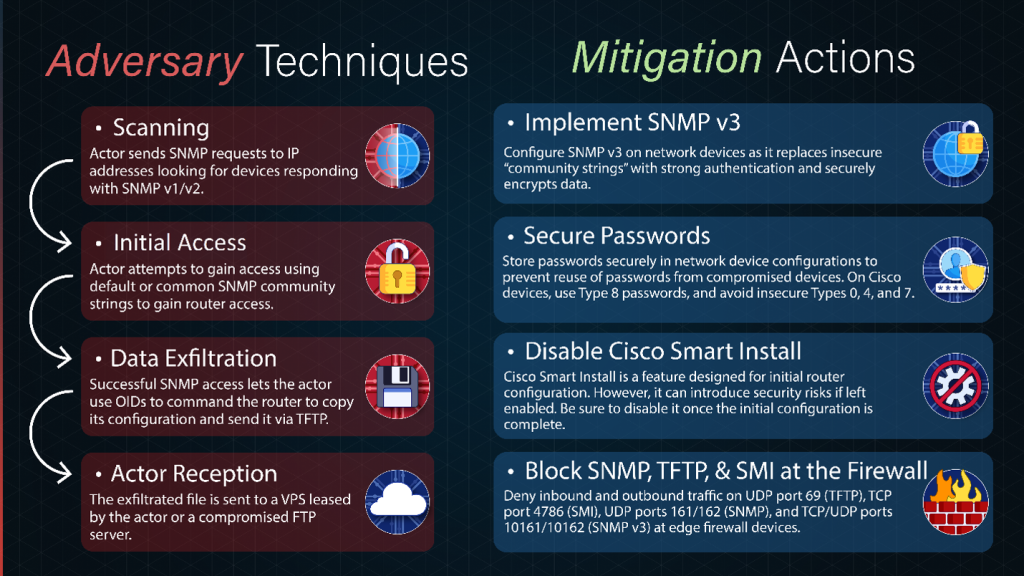
Credit: CISA
Credit:
CISA
With control of a device, the hackers then use it as an exit node when probing or attacking targets in the communications, defense, energy, financial services, and government sectors. By funneling the malicious traffic through a benign-appearing device on a trustworthy IP address, the attackers are able to lower the chances of getting blocked by firewalls and other security defenses.
Monday’s advisory made no mention of identical operations carried out in recent years by China. So-called residential proxies are also a go-to tool used by financially motivated criminal hackers to obscure their true IP address. In many cases, these sorts of proxies are made up of millions of streaming devices that are sold with preloaded malware.
The agency urged router users to lock down their devices. Chief among the suggestions is to ensure SNMP versions 1 and 2 are disabled, because they don’t encrypt passwords or follow other common-sense security practices. Instead, only SNMP version 3 should be used. A better option is to disable SNMP altogether unless it’s needed for a specific use. Other safeguards include disabling Cisco Smart Install on all devices, using strong passwords, updating firmware regularly, and avoiding the use of other networking protocols.

Dan Goodin Senior Security Editor
Dan Goodin Senior Security Editor
Dan Goodin is Senior Security Editor at Ars Technica, where he oversees coverage of malware, computer espionage, botnets, hardware hacking, encryption, and passwords. In his spare time, he enjoys gardening, cooking, and following the independent music scene. Dan is based in San Francisco. Follow him at here on Mastodon and here on Bluesky. Contact him on Signal at DanArs.82.


