
Building the People's Army 'Revolutionary, Regular, Elite, Modern' - A Strategic Requirement in Defending the Fatherland Today
The People's Army of Vietnam (PAVN) was organized, led, educated, and trained by the Party and President Ho Chi Minh; it is the core force in the struggle to achieve national independence and defend the socialist Fatherland of Vietnam.
Over more than 80 years of building, fighting, and maturing, our Army has excellently fulfilled its functions as a "combat army, working army, and labor-production army." With the will and determination "Rather sacrifice everything than lose the country, never be enslaved" during the resistance against the French colonialists and "Nothing is more precious than independence and freedom" during the resistance against the Americans to save the nation, our Army, together with the entire Party and people, fully realized President Ho Chi Minh's call: to regain independence, freedom, and national reunification, and to firmly protect the revolutionary achievements.
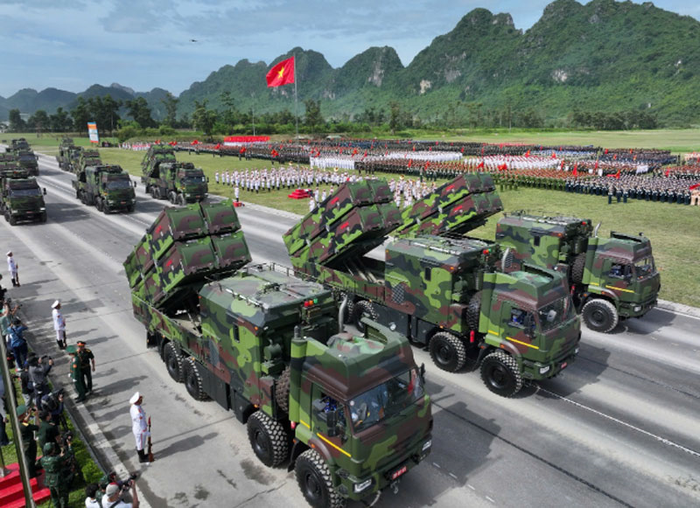 Photo caption: The Truong Son missile complex produced by the Viettel Military Industry and Telecoms Group. Photo: TUAN HUY
The source of our Army's victorious strength and growth originates from the talented and wise leadership of the Party and President Ho Chi Minh. The Party's views and guidelines on building the Army have always been supplemented and perfected to suit each revolutionary period, meeting the requirements of the struggle for national liberation and the firm defense of the socialist Fatherland of Vietnam.
Immediately after the victory of the resistance against the French colonialists, before the US imperialist scheme to wage an aggressive war against Vietnam under a new colonial policy, in September 1954, the Politburo issued a resolution stating: "We must build the People's Army into a revolutionary, regular, and relatively modernized army." This is considered an important milestone laying the foundation for the formation and development of the Party's thinking on building a revolutionary, regular, elite, and modern army. President Ho Chi Minh also affirmed: "We must strive to build our Army into a mighty People's Army, a revolutionary army progressing toward regularity and modernity, to preserve peace and defend the Fatherland."
Concretizing the guidelines of the Party and President Ho Chi Minh, during the years of resistance against the Americans to save the nation, the Army was continuously built in all aspects. In terms of troop strength, "from 170,000 (1958) to 300,000 (1963), then 700,000 (1966) and up to 1 million (1973)." In terms of organization, there were three major development steps, also three leaps in combat power: building regularity and renovating equipment (1954-1964); rapidly developing the various services and branches such as air force, anti-aircraft artillery, missiles, radar, armor, special forces, artillery, engineers, communications, etc. (1964-1967); and building large strategic corps, the 1st, 2nd, 3rd, and 4th Corps (1973-1975). The "regularization and modernization" of the Army contributed to the victory of the resistance against the Americans to save the nation.
 Photo caption: Senior Lieutenant General Nguyen Van Gau visits the soldiers and people of Song Tu Tay Island, April 2026. Photo: DUY KHANH
After the liberation of the South and national reunification, entering the period of building and defending the Fatherland, through the Party's congresses, the views and guidelines on building the Army continued to be inherited, supplemented, developed, and increasingly perfected. The 7th National Party Congress (1991) advocated: "Build the People's Army to be revolutionary, regular, gradually modern, and elite, with a rational organizational structure and troop strength; enhance comprehensive quality and combat power." In the Platform for National Construction in the Period of Transition to Socialism (1991), the Party stated: "Build the people's armed forces with an appropriate standing force in the direction of revolutionary, regular, gradually modern, and elite, with a large reserve force and militia/self-defense force with high combat capability." Based on the country's conditions and the requirements of defending the Fatherland, the 12th National Party Congress clearly defined the guideline: "Build the people's armed forces to be revolutionary, regular, elite, and gradually modern, with priority given to modernizing certain services, branches, and forces." The 13th National Party Congress continued to assert: Build the People's Army to be "revolutionary, regular, elite, and gradually modern, with some services, branches, and forces advancing directly to modernity." The 14th National Party Congress resolution stated: "Build the People's Army and the People's Public Security to be revolutionary, regular, elite, and modern; firmly defend the socialist Fatherland of Vietnam." This is a new development with a turning point, reflecting the Party's strategic thinking and vision in building the Army, strengthening national defense, and defending the Fatherland; it is also a strategic goal toward the milestone of the 100th anniversary of the Party's founding and the 100th anniversary of the nation.
Photo caption: A break during training of officers and soldiers of Battalion 152, Regiment 250 (Division 361, Air Defense - Air Force Service). Photo: TOAN LUU
Photo caption: Senior Lieutenant General Nguyen Van Gau presents the flag of "Excellent Training Unit" to Regiment 1 (Division 2, Military Region 5). Photo: LE PHUC
In the coming years, forecasts of the world and regional situation continue to be rapid and unpredictable. Peace and cooperation remain major trends, but will face many obstacles and challenges. Major powers increase strategic competition, high-tech arms races, and linkages to create influence; the landscape of "multipolarity, multi-centers, and multi-layers" intertwined with cooperation and strategic competition becomes more defined. Global issues and non-traditional security continue to evolve complexly, affecting the development of nations in many ways. The Asia-Pacific and Indian Ocean regions continue to develop dynamically, but also contain elements of instability. Domestically, after 40 years of renovation, Vietnam's position and prestige on the international stage have been elevated. However, the country still faces many intertwined difficulties and challenges; the four risks identified by the Party persist and are more severe in some aspects; hostile forces inside and outside the country intensify their activities against the Party and State, and the "depoliticization" of the Army becomes more sophisticated and cunning...
In the new context, the methods of warfare have changed significantly; electronic warfare, cyber warfare, information warfare, and the use of high-tech weapons are increasingly common. This requires the Army to be organized in a streamlined, compact, and strong manner, with high mobility, scientific-technological competence, and the ability to master modern weapons and equipment. If not built modernly, the Army will find it difficult to meet the requirements of warfare in high-tech conditions. Additionally, the country's deep and comprehensive international integration also raises the need to enhance defense capabilities and the Army's position...
To build a revolutionary, regular, elite, and modern People's Army that meets the requirements of defending the Fatherland today, it is necessary to focus on effectively implementing several contents and measures as follows:
First, maintain and strengthen the Party's leadership over the Army, build the Army to be politically strong
This is a fundamental principle and a consistent and overarching content in the Party's political and military line, playing a particularly important role in the process of building a revolutionary, regular, elite, and modern army; it is a decisive factor ensuring that our Army always maintains its revolutionary nature, absolute loyalty to the Party, the Fatherland, and the people. Accordingly, the entire military must continue to thoroughly grasp and seriously and effectively implement the resolutions, directives, and regulations of the Central Committee, the Politburo, the Secretariat, and the Central Military Commission on Party building and rectification and the political system, focusing on the 4th Central Committee Resolution (12th and 13th Congresses) of the Party; linking the building of a clean and strong typical Party Organization in the Army with building comprehensive and strong "exemplary and typical" agencies and units, as a foundation for enhancing comprehensive quality and all-around combat power, truly serving as the core of leadership and unity within the Party. At the same time, agencies and units need to thoroughly grasp and strictly implement the guidance of the General Secretary and President To Lam, Secretary of the Central Military Commission, on "two steadfastnesses, two accelerations, two preventions" and the motto "five stabilities" into daily actions, training criteria, and measures for building agencies and units in the new situation.
Second, continue to build a streamlined, compact, strong, and modern army with high comprehensive quality and combat power, meeting requirements in all situations
Building a streamlined, compact, strong, and modern army is a major and consistent guideline, reflecting the Party and State's strategic vision and thinking for the cause of building and defending the Fatherland. This is an objective demand to ensure that the Army is capable of successfully fulfilling all assigned tasks. Accordingly, agencies and units throughout the military need to strengthen leadership, direction, and synchronized and effective implementation of the Party's, the Central Military Commission's, and the Ministry of National Defense's directives and resolutions on building a revolutionary, regular, elite, and modern army. First of all, officers and soldiers must be politically sharp; proficient in military art and tactics in various forms of warfare; elite in technical and tactical skills; and build a streamlined and compact organizational structure with high mobility. In particular, the core issue in building an elite army is building human resources; each officer and soldier must always have a steadfast and firm political stance, ideology, and mettle, high fighting will and determination, good command and combat skills, and always master all weapons, equipment, and techniques; they must be skilled in armed struggle and also adept in political-ideological struggle, in fighting and preventing "peaceful evolution"; they must be resolute and sharp in struggle, exposing erroneous perceptions, hostile and reactionary views, opportunists, and political malcontents opposing the Party and State.
Continue to review and build a streamlined, compact, and strong force, ensuring a synchronous and rational organizational structure; perfect regulations and rules on functions, tasks, and mechanisms for leadership, management, command, and operation of agencies, units, and commune-level military commands after organizational restructuring... Improve the quality of training, exercises, education, and training. Effectively implement projects and plans on education and training; invest in human resources to build smart and modern schools; define training objectives, models, and programs in accordance with the motto "The training quality of the school is the combat readiness capability of the unit." Effectively implement Resolution No. 57-NQ/TW of the Politburo and Resolution No. 3488-NQ/QUTW of the Central Military Commission on breakthroughs in science and technology development, innovation, and digital transformation.
Third, accelerate breakthroughs in building regularity, compliance with laws and discipline, creating strong and comprehensive changes in building agencies and units
Building regularity, managing and complying with laws and military discipline essentially concretize the Party's line, guidelines, and regulations; the Constitution and laws of the State suitable to the characteristics, situation, functions, and tasks of the military. The 12th Military Party Congress resolution identified: "Breakthrough in improving the quality of building regularity, managing and complying with discipline; resolving administrative procedures and processing work in the electronic environment." This is an important and consistent content, creating a foundation and strength to build a revolutionary, regular, elite, and modern army, meeting the requirements of building and defending the Fatherland.
Agencies and units throughout the military need to continue to thoroughly grasp and strictly implement directives, regulations, and circulars on building regular order and discipline management, especially Directive No. 79/CT-BQP dated July 22, 2022, of the Minister of National Defense on building comprehensive and strong "exemplary and typical" units; Circular No. 143/2023/TT-BQP dated December 27, 2023, of the Minister of National Defense on disciplinary handling in the Vietnam People's Army. At the same time, do a good job of research, consulting for amendments, supplements, and perfecting the legal system on military and national defense, and issuing directives, documents, systems of documents, regulations, and rules on building regularity, compliance with discipline and law, and guiding and implementing uniformly throughout the military. Strengthen measures for inspection, supervision, preliminary and final reviews, and lessons learned; closely combine the breakthrough in building regularity and discipline compliance with the breakthrough in organizational and personnel adjustments, improving comprehensive quality and combat power; link discipline management with ideological management, human management with building a healthy military cultural environment; create strong, comprehensive, and solid changes in building agencies and units. Actively coordinate closely with local party committees, authorities, and families in managing and grasping the thoughts and social relationships of military personnel to timely take preventive and preventive measures, avoiding passivity and surprise.
Fourth, build and develop a proactive, self-reliant, self-sufficient, dual-use, modern defense industry to meet the requirements of Army modernization
The defense industry is a part of the national industry, holding a particularly important position and role, contributing to enhancing military and defense potential and strength, and building and defending the Fatherland. Developing the defense industry into a spearhead of the national industry, achieving advanced and modern scientific and technological levels, is an inevitable requirement of building a modern army. The 14th National Party Congress resolution stated: "Build a strong national industry; build a proactive, self-reliant, self-sufficient, dual-use, modern defense and security industry." The 12th Military Party Congress resolution identified: "Breakthrough in developing the defense industry; invest in research, design, manufacturing, production, improvement, and modernization of various types of weapons and technical equipment with strategic and modern significance; prioritize in order strategic, operational, and tactical weapons to meet the requirements of modernization and enhance the combat power of the Army." This is both a goal and a new requirement in the process of building a revolutionary, regular, elite, and modern army, meeting the requirements of defending the Fatherland today.
Accordingly, all officers and soldiers must thoroughly grasp the military and defense viewpoints, lines, and policies for defending the Fatherland, and the guidelines, goals, task requirements, and solutions for building and developing the defense industry; link defense industry development with national industry, prioritize modern, efficient, and highly dual-use technologies. Master design, core technology, and key technology, increase the localization rate of defense industrial products. Restructure defense industrial facilities, build enterprises with sufficient capacity to lead the national industry; build a streamlined, compact, and strong Defense Industry Corporation. Perfect the mechanism for mobilizing resources and comprehensive strength of enterprises outside the military in researching and producing modern defense equipment. Enhance the effectiveness of international integration and defense diplomacy to leverage and transfer technology, mobilize external resources for the cause of Army modernization, promote cooperation in various fields, and boost cooperation in defense industry and military technology development, combined with the procurement of new and modern weapons and equipment.
Building a revolutionary, regular, elite, and modern People's Army is a strategic requirement in the cause of defending the Fatherland today. Effectively implementing this guideline will ensure that our Army has sufficient strength to successfully fulfill its role as the core force in consolidating national defense and defending the socialist Fatherland of Vietnam in the era of the nation's rise.
Senior Lieutenant General NGUYEN VAN GAU, Member of the Party Central Committee, Deputy Minister of National Defense


