
Key Points
- In 1999, Buffett warned that stock prices could begin declining.
- Now, the metric he used to predict the downturn is flashing another warning signal.
- The right investing strategy is more important than ever.
After months of volatility and stagnating performance, the S&P 500 (^GSPC +0.62%) and Dow Jones Industrial Average (^DJI +0.28%) both reached new record highs this week. While the tech-heavy Nasdaq Composite (^IXIC +1.30%) is still working through its recent pullback, it's surged by nearly 4% in the last five days alone, as of this writing.
However, all of this growth over the past few years has raised fresh concerns around valuations. Tech companies are spending massive amounts to build out data centers, with AI spending expected to top $5 trillion by 2030, according to analysis from McKinsey & Company.
Some investors are drawing parallels to the dot-com bear market of the early 2000s, when hundreds of internet companies ballooned in value only to crash hard when the bubble popped.
Back then, Warren Buffett warned that stock prices were on the verge of a decline. Now, the stock market is flashing a warning sign yet again. Here's what investors need to know.

Former Berkshire Hathaway CEO Warren Buffett. Image source: The Motley Fool.
Warren Buffett warned that stocks would decline
In the late 1990s, the stock market was experiencing unprecedented growth. The S&P 500 had earned total returns of nearly 200% between 1995 and 1999 alone, largely thanks to the dot-com boom. In 1999, however, Warren Buffett warned in a speech that he believed stock prices were due for a pullback.
In a 2001 follow-up essay for Fortune magazine, he discussed how he used the relationship between the total value of U.S. stocks and GDP to assess valuations. He explained that when this figure is between 70% and 80%, "buying stocks is likely to work very well for you." He added, however, that "if the ratio approaches 200% -- as it did in 1999 and a part of 2000 -- you are playing with fire."
To be clear, no stock market metric is 100% accurate, nor can it predict the market's short-term movements. That said, the metric now nicknamed the "Buffett indicator" currently sits at a record high of just over 232%.
Investors may want to brace themselves for volatility
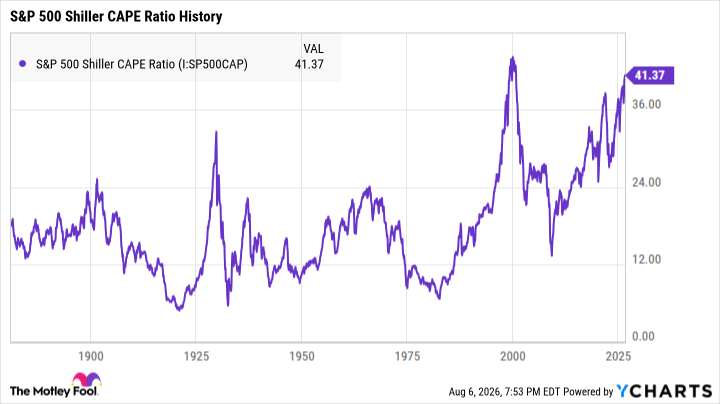
The Buffett indicator isn't the only metric suggesting the market may be overvalued. The S&P 500 Shiller CAPE Ratio tracks the S&P 500's 10-year inflation-adjusted earnings, and historically, higher values have been followed by declines in stock prices.
This metric reached an all-time high of around 44 in late 1999, just before the market descended into the dot-com bear market. Currently, it's just over 41 -- its second-highest point in history.
S&P 500 Shiller CAPE Ratio data by YCharts
In a recent interview with CNBC, Buffett discussed how investors should navigate this historically expensive market. He warned that many investors are getting too comfortable with short-term risky investments, emphasizing, "that's not investing, it's not speculating, it's gambling."
What should investors do right now?
In the CNBC interview, Buffett added that investors don't need to shy away from investing entirely. However, he noted that "prices for an awful lot of things will look very silly."
Many stocks are now overvalued, meaning their prices have strayed from their underlying business fundamentals. During the dot-com bubble burst, plenty of overhyped companies saw their stock prices surge. But because they lacked solid fundamentals, they couldn't survive the ensuing bear market.
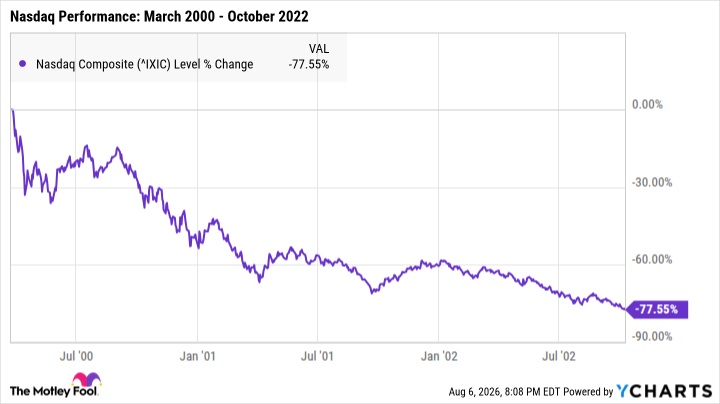
Whether or not we're in an AI bubble right now, the same lessons still apply. Companies with solid fundamentals may experience short-term volatility, but they'll likely recover. Those that are fueled primarily by hype, however, may struggle to bounce back.
In Buffett's 1999 warning, he offered this timeless advice about choosing stocks: "The key to investing is not assessing how much an industry is going to affect society, or how much it will grow, but rather determining the competitive advantage of any given company and, above all, the durability of that advantage."
Healthy companies with strong competitive advantages are the most likely to thrive over time. The more of these stocks you own, the better prepared you'll be for anything the market may have in store.
Read Next

Aug 8, 2026•By Sean Williams

Aug 8, 2026•By Jennifer Saibil
Aug 8, 2026•By Neil Patel
Are Your Investments Prepared for a Bear Market? Here's How to Tell.

Aug 8, 2026•By Katie Brockman

Aug 8, 2026•By James Brumley

Aug 8, 2026•By Sean Williams
An Inflation Quadruple Whammy, Headlined by Trumpflation, Threatens to Crush the Stock Market
About the Author

Katie Brockman is a contributing writer at The Motley Fool covering retirement, Social Security, and investing fundamentals. Prior to The Motley Fool, Katie held various writing and editing roles at companies ranging from small start-ups to multimillion-dollar brands. Her work has appeared in USA Today, Inc magazine, and other authoritative media outlets. She holds a bachelor’s degree in business administration and management from Illinois Wesleyan University.
Stocks Mentioned
[ \
\
S&P 500 Index
SNPINDEX: ^GSPC
$7,757.64
(+0.62%)+$47.68](https://www.fool.com/quote/snpindex/%5Egspc/) [
Motley Fool Stock Advisor’s Latest Pick
---% Avg Return
[ \
\
Dow Jones Industrial Average
DJINDICES: ^DJI
$54,036.93
(+0.28%)+$151.83](https://www.fool.com/quote/djindices/%5Edji/) [ \
\
NASDAQ Composite Index
NASDAQINDEX: ^IXIC
$26,690.62
(+1.30%)+$342.26](https://www.fool.com/quote/nasdaqindex/%5Eixic/)
*Average returns of all recommendations since inception. Cost basis and return based on previous market day close.
Premium Investing Services
Invest better with The Motley Fool. Get stock recommendations, portfolio guidance, and more from The Motley Fool's premium services.


