
The rate at which water companies discharged the “most toxic” sewage more than doubled at the start of 2026, new data obtained by LBC suggests.
In the first five months of 2026, there were 7,280 incidents of water firms in England and Wales dumping sewage, chemicals, and other pollutants on days of little or no rainfall.
This means the rate of potentially illegal spills rose to 48 incidents per day between January 1 and May 31 this year, compared with 23.5 instances per day across the whole of 2025.
A dry day spill is recorded when water companies use storm overflows to release sewage or other pollutants into waterways on days with less than 0.25mm of rainfall.
Companies are allocated outfall permits which allow them to use storm overflows to discharge effluent in periods of heavy rainfall to prevent sewage building up and backing into people’s homes and businesses.
Read more: Higher water bills must mean fewer leaks and cleaner rivers - otherwise, what's the point?
Dry-day spills are illegal except in exceptional circumstances, such as the companies experiencing power failures or severe blockages.
Severn Trent, which serves nearly seven million customers across the Midlands, had the worst record of dry-day spills according to the new data, recording 1,403 incidents in the first five months.
Three other companies registered over 1,000 such spills in the period: South West Water (1,299), Yorkshire Water (1,228) and Thames Water (1,052). Across the whole of 2025, only South West Water (2,451) and Yorkshire Water (1,030) recorded over 1,000 dry-day spills.
Overall, there were 8,576 dry day spills throughout the course of 2025, meaning companies hit 85% of the total for the whole of last year in just five months.
Though the government has announced an expansion in the number of inspections being carried out by the Environment Agency (EA), with 11,500 scheduled to take place in 2026/27, many campaigners remain unconvinced this will yield meaningful change.

The rate of potentially illegal spills rose to 48 incidents per day between January 1 and May 31 this year.
Picture: Alamy

Severn Trent, which serves nearly seven million customers across the Midlands, had the worst record of dry-day spills.
Picture: Alamy
“From the regulatory point of view, it shows that there is zero deterrent for the water companies,” Robert Forrester, a former EA employee, told LBC.
“They're not concerned one bit about dumping the sewage in the most sensitive situations. They're confident they're going to be able to dump it, make the money, and get away with it.”
Forrester, who uncovered the new figures through environmental transparency laws, argued that sewage spilled on dry days is often the “most toxic” because it is undiluted by rainfall, posing a greater potential risk to waterways.
He believes that a combination of enforcement action against company executives and a change of the industry’s ownership model is necessary to bring firms into line.
“We need to target the CEOs that are currently sitting in water companies because they've shown they will carry on carrying out these actions and nothing will stop them at the minute.
“The water companies won't stop showing utter contempt to public health [and] the environment, and the regulators won't take the necessary steps to stop them.
“I think it's fitting that the lowest number of dry day spills comes from the one water company that isn't privatised, Welsh Water.”
Water companies that flout environmental rules and do not meet the criteria for dumping sewage on dry days face stricter financial penalties under reforms introduced in July.

Polluted murky stream in a rural ditch, a telltale sign of a sewer pipe bursting.
Picture: Alamy
Previously, the EA was required to hit a criminal standard of proof to prosecute water firms, but the regulator is now able to issue penalties of up to £500,000 for offences where the civil standard of proof is met.
Under legislation passed last year, moreover, water company executives, directors, and employees can also face up to two years in prison for obstructing EA investigations or covering up illegal spills.
However, the new figures are likely to renew pressure on Andy Burnham to lay out a plan for reforming the industry.
The prime minister has indicated that he’s aiming to place water companies under “greater public control” to combat issues ranging from infrastructure investment to environmental concerns and rising bills for consumers.
Yet, Mr Burnham has stopped short of calling for the whole sector to be brought into public ownership.
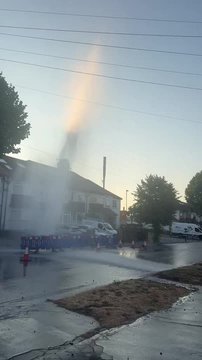
Burst pipe in London spews 'geyser' of water
Reports also suggest Number 10 has cooled on plans to bring the country’s biggest supplier, Thames Water, into a special administration regime (SAR) amid concerns about the cost to the taxpayer and challenges in the courts.
Polling suggests bringing the industry into public ownership would prove popular, while a petition calling for referendum on nationalising England’s water companies is approaching 200,000 signatures.
There are fears, though, the overall costs could prove prohibitive.
Modelling by the Department for Environment, Food and Rural Affairs (DEFRA) suggests the cost of nationalising the entire industry could reach £100bn.
Responding to the data on dry day spills, a spokesperson for the industry body Water UK said: "No spill is ever acceptable. Water companies are working to end them as fast as possible by tripling investment.
"Companies are investing £12 billion to halve spills from storm overflows by 2030 including relining and sealing sewers to prevent groundwater infiltration – one of the main causes of dry day spills.”
Meanwhile, a spokesperson for DEFRA added: “It is totally unacceptable that some water companies are failing to deliver value for money for customers and polluting our rivers, lakes and seas.
"After years of failure, we have taken immediate action to make water companies more accountable and for the first time ever they are now required to report dry day spills as pollution incidents, providing the government with the evidence to go after water companies where performance falls short.”


