
10-watt antenna helps underwater robots communicate across 700 meters
A research group at the University of Florida has just announced the BlueME antenna system, a compact magnetoelectric device that consumes a maximum of 10 watts but allows autonomous underwater robots to exchange data with each other at distances exceeding 700 meters (2,296 feet). This technology opens up the possibility of deploying a coordinated fleet of marine robots in real time without having to surface to connect.
Why underwater communication is so difficult
Seawater is a hostile environment for almost all wireless signals. Salt water absorbs radio waves extremely quickly, forcing conventional electronic devices to consume very high power or use bulky antennas to transmit information through thick water layers. As a result, today's autonomous underwater robots can only exchange simple, intermittent status signals with each other. Whenever they need to share complex mission data or receive new commands, they must stop operation and move back to the surface, a process that is both slow and energy-intensive.
The idea behind BlueME came from an unexpected connection between two seemingly completely different worlds. Dr. Adam Khalifa, a member of the research team, specializes in designing tiny wireless medical implants to transmit signals through human muscle and bone tissue. In the process, he realized that the human body is essentially a dilute saline mass, and the physical challenges of transmitting signals through biological tissue almost exactly match what autonomous robots face on the seafloor. From that insight, the team opened a completely new approach to the ocean communication problem that had been stalled for decades.
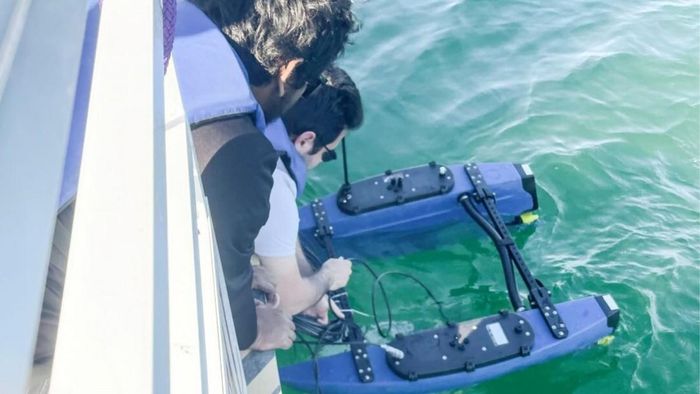
How BlueME works
Instead of forcing a strong signal through water, BlueME uses an array of magnetoelectric antennas that vibrate at the natural mechanical resonant frequency of the material. This mechanism allows the system to emit electromagnetic signals in the very low and low frequency bands, two wavebands capable of penetrating turbid water, sediment, and chaotic environments near the surface with almost no attenuation.
The difference from existing technology is clear. Acoustic sonar is affected by underwater echoes and seafloor terrain reflections. Laser optics lose effectiveness as soon as water becomes cloudy or visibility is low. BlueME's low-frequency electromagnetic signals are not affected by either factor.
In terms of energy consumption, the system operates at a maximum of 10 watts, lower than a standard stereo camera. Dr. Md Jahidul Islam, the project leader, emphasized that energy efficiency is a core design criterion because autonomous underwater robots are severely limited in battery and payload. With 10 watts, BlueME maintains high-fidelity communication links between robots at distances exceeding 700 meters.
Applications from military to environmental
The application range of BlueME spans many fields. In the military and maritime security sectors, naval fleets can deploy coordinated drone teams to sweep for mines or detect hazards without putting people in harm's way. In the offshore energy industry, companies can automate the safety inspection process of deep-sea pipeline structures. In environmental research, scientists can continuously monitor fluctuations in marine ecosystems in real time.
Dr. Islam described a specific scenario: robots report to the operations center every 10 minutes, and operators can make immediate decisions, even adjust the mission while the robots are still operating underwater. This is a capability that current systems completely lack.
The path from prototype to commercial
The research team has filed a provisional patent application for BlueME technology. They are currently seeking funding and industrial partners to upgrade the prototype and mount the system on commercial autonomous submarines. This is a familiar transition phase in the lifecycle of a new technology, from lab to market, and is often where many promising developments are delayed or halted due to lack of capital.
However, the interdisciplinary foundation of the project, combining Dr. Islam's expertise in marine robotics with Dr. Khalifa's knowledge of medical implants, creates a difficult-to-replicate advantage. The idea of applying signal transmission principles from the human body to the ocean environment did not come from a purely oceanographic research lab, and that is precisely why BlueME solves a problem that traditional approaches left open for decades.
Phạm Anh


