
How a small Austrian town found itself at the heart of the AI hardware race

Employees walk at the AT&S production facilities in Leoben, Styria, Austria, on August 11, 2026. — AFP pic
Summary
- Nestled in the picturesque town of Leoben, Austria, electronics company AT&S is thriving due to the global AI boom, with its shares increasing by over 450% this year.
- Specializing in integrated circuit substrates, critical for AI systems and high-speed data processing, AT&S highlights Europe's ability to excel in niche tech markets.
- The company has expanded its operations globally with facilities in China and Malaysia, positioning itself as a major player despite not matching the scale of U.S. and Asian counterparts.
- AT&S's success has brought economic growth and international recognition to Leoben, creating new demands and opportunities within the community.
First Published: Sunday, 23 Aug 2026 9:00 PM MYT
LEOBEN, Aug 23 — Nestled in the wooded hills of Austria’s Styria region, the town of Leoben oozes tradition with its pastel-coloured buildings and quaint central square boasting a 13th-century church.
But on the edge of town, engineers peer through giant magnifying glasses while robotic arms manipulate sheets of copper to develop components used in some of the world’s most advanced AI systems.
AT&S, an electronics company based in Leoben, makes integrated circuit (IC) substrates, the boards that connect chips to computer memory and power supplies — a crucial component in the race to develop AI and high-speed data processing.
The company’s shares have surged more than 450 per cent this year, making it one of the most striking beneficiaries in Europe of the AI boom.
For chief executive Michael Mertin, this success shows that Europe can still “occupy important niches” in the AI race, even if it cannot compete with US rivals on chip innovation, or with Asian firms in terms of production scale.
“We will not be the leading nation or the leading region... (but) there are some outstanding technologies where we are world leaders in Europe,” Mertin said.
Founded in 1987, AT&S initially made printed circuit boards before entering the IC substrate business in 2016, when it began serial production at a new plant in Chongqing, China.
The company opened a second factory to produce IC substrates in Malaysia in 2024.
The Leoben site, known as the Hinterberg plant, serves as the global headquarters and houses its research and development operations.
After investing more than €500 million (RM2.4 billion) in a research and production centre opened last year, it has also become Europe’s only major commercial manufacturer of advanced IC substrates.
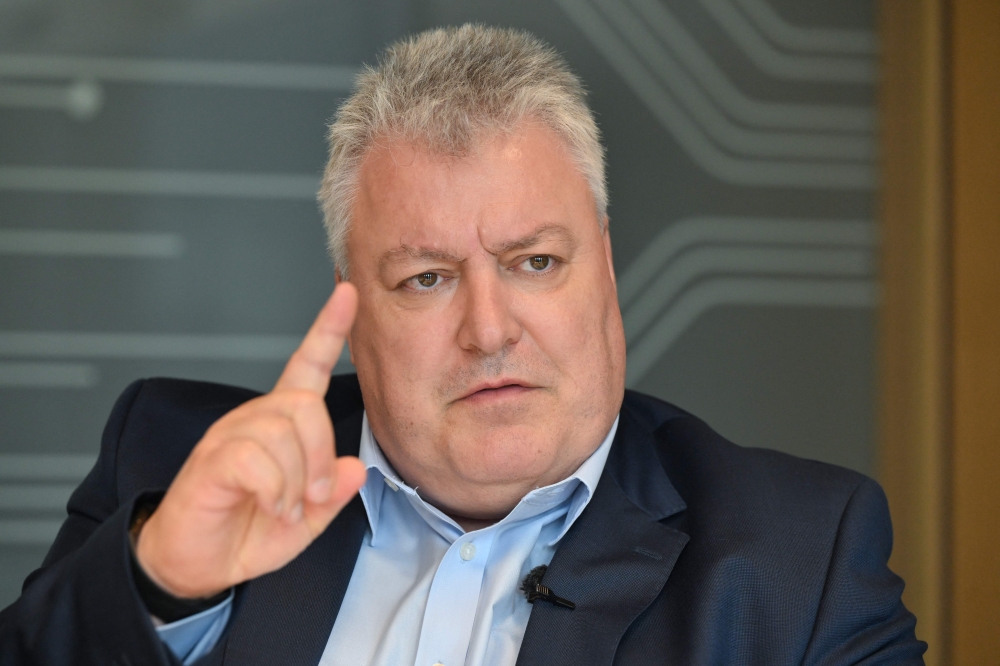
CEO Michael Mertin from manufacturer of IC substrates and circuit boards AT&S is pictured during an interview in Leoben, Styria, Austria, on August 11, 2026. — AFP pic
‘Industrial revolution’
Malcolm Penn, chairman of the semiconductor consultancy Future Horizons, said AT&S was one of few European companies directly benefiting from booming demand for AI hardware.
“They’re riding the AI boom... They’re not driving the wave, they’re riding the wave,” he said.
IC substrates are “critical” in the AI ecosystem “because they’re one of the key aspects of reducing power consumption, reducing noise, increasing speed,” he added.
Europe’s strengths in AI-related hardware tend to lie in specialised parts of the semiconductor supply chain, with companies such as Dutch lithography giant ASML and British chip designer Arm occupying leading positions.
AT&S cannot claim to be in the same league as them, but the growth of AI has led to a big increase in demand over the past few months, said Barbara Decker-Schloegl, its senior director of operations.
“You can see it across all areas — customer inquiries keep rising and rising,” she said.
“The issue of artificial intelligence, including the high demand for the corresponding computing modules, will not foreseeably slump,” Mertin added.
“From my point of view, this is an industrial revolution, almost like the introduction of engines or, back then, the steam engine,” he said.
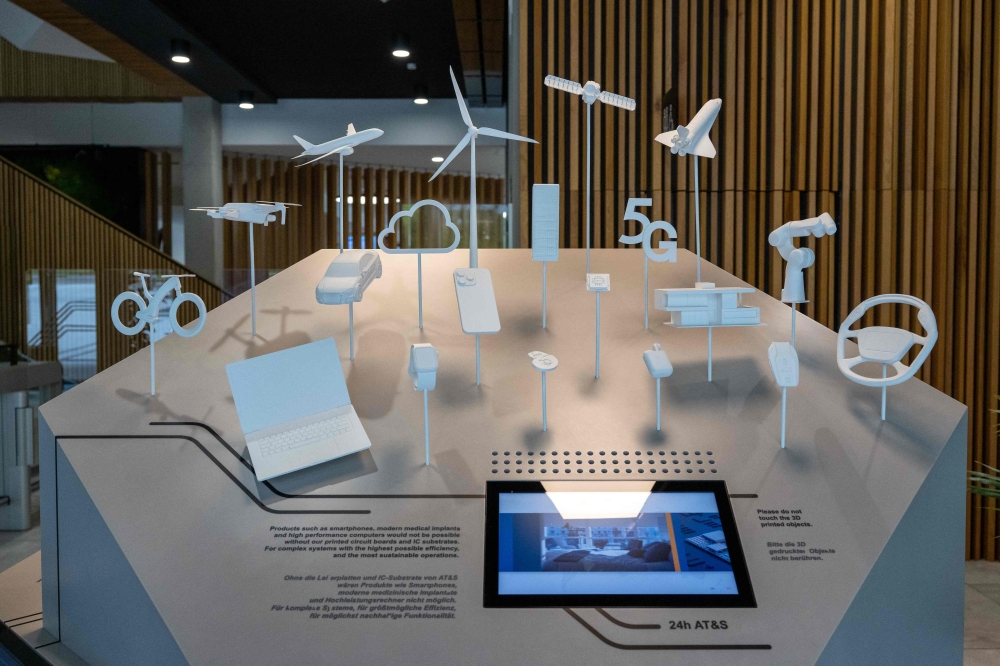
An installation shows examples of applications using AT&S products at the company’s headquarters in Leoben, Styria, Austria, on August 11, 2026. — AFP pic
Local heft, global workforce
Around 2,200 people from more than 70 countries work at the site in Leoben, a former iron mining centre of 28,000 people in the mountainous southern state of Styria.
Mario Alroy, 36, from India, has been an account manager at AT&S for four years and travels to work daily from Graz, the nearest big city.
“Styria is really a wonderful place to be. You have mountains, you have lakes, if you’re interested in wine you can go wine tasting... The quality of life is very good,” he said.
But around 60 per cent of the staff are Austrian, and “AT&S is one of the largest employers in this region”, Decker-Schloegl said.
The Technical University of Leoben, long known for mining, metallurgy and materials science, has supplied AT&S with generations of engineers and technical specialists.
Kerstin Neukamp, a spokeswoman for the mayor’s office, said the growth of AT&S had brought “highly qualified jobs and additional international visibility” for the town and the region.
However, “with additional employees and their families, new demands also arise in terms of housing, education, childcare, and other services offered by the city”, she added.
In Leoben’s central square, Sigrid Halm, a 52-year-old social worker, said AT&S was “very important for the town, because there are a lot of jobs over there”.
“My father used to work there, he was an engineer in Hinterberg and a senior executive. Both of my children have worked there, and I know many people who still work there,” she said. — AFP


