BlueScope Steel has identified more than 300 risks at the ageing Whyalla steelworks plant as part of work undertaken for administrators preparing to sell the business once owned by Sanjeev Gupta, with almost half of the 1100 workers facing the axe as the blast furnace enters terminal decline.
The country’s largest steelmaker had been working with KordaMentha, the administrators, and identified 316 risks, 30 of which are still to be rectified as the auction process reaches the final stretch after a fraught 19 months.
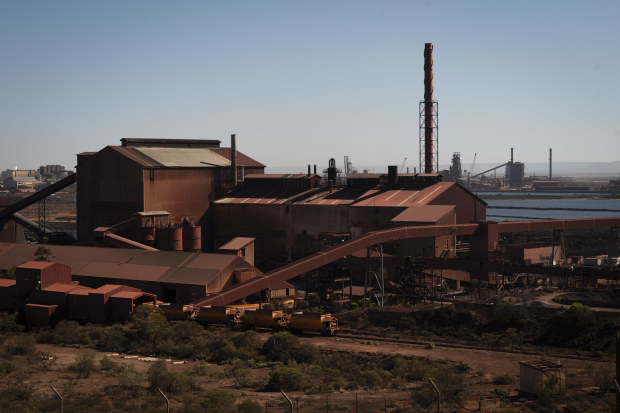
The Whyalla steelworks has been under the control of administrators KordaMentha since February 2025. Ben Searcy
BlueScope had expressed interest in acquiring the plant in a consortium that also included Korean, Indian and Japanese steel makers. It has since backed off its pursuit of a deal, but retains the right to make a last bid once the auction process has been finalised.
The risks identified in BlueScope’s assessment last year show the issues the two final bidders – coal magnate Matt Latimore’s M Resources and India’s Jindal Steel – will confront if they successfully purchase the plant, nearby iron ore mines and the Whyalla port.
Two people briefed on the matter who spoke on condition of anonymity because they were not authorised to comment said both bidders were working on the assumption that they would have to spend about $600 million on a new electric arc furnace. The existing blast furnace has been operating since the steelworks was built by BHP in the 1960s.
This means many workers could lose their jobs because it will take 2½ years for a new modern furnace to be built.
A funding and indemnity agreement between KordaMentha and the South Australian government providing the administrators with financing to run the operations and protection from future legal claims was on Friday updated for a fourth time, with a further $232 million agreed, taking the limit to $1 billion.
The previous indemnity deed was due to run out on September 30. KordaMentha said the funds were “in line with the state budget” handed down on June 4.
KordaMentha, which has been operating the Whyalla plant since the South Australian government removed Gupta’s GFG Alliance in February last year, has previously warned that the plant has been starved of capital.
The blast furnace has been unable to operate since April because of a technical problem. About 1100 people work at the plant, with 500 at the blast furnace and connected operations. A mill that bends steel into shape will keep operating using imported materials if the furnace cannot be revived.
The full extent of the issues at the furnace was detailed in documents filed in the Federal Court by KordaMentha partner Lara Wiggins in December. The documents said BlueScope delivered a “risk register” about the plant in May last year.
In one instance, “due to severe degradation and leakage in the aged crude gas main connected to the blast furnace”, workers had to weld sheets to cover holes in the pipes.
A KordaMentha spokeswoman said on Friday that 30 of the 316 risks identified by BlueScope in their assessment last year were unresolved.
South Australian Premier Peter Malinauskas has already conceded that redundancies at the Whyalla plant are likely, even under a new owner.
“A lot of people work in and around the blast furnace. So when the blast furnace turns off, whether it be in the not too distant future or in a few months’ time, as the transition starts to manifest, yes, there will be redundancies,” he told parliament on September 1.
“The current blast furnace’s days have always been numbered. It’s a question of when, not if, the blast furnace is turned off.”
The federal and state governments have pledged $2.8 billion for an overall rescue package for the plant under new ownership.
KordaMentha partner Sebastian Hams estimated at a confidential briefing in August last year that the successful buyer would need to spend between $5 billion and $8 billion to build a modern steelworks at Whyalla and fully develop nearby iron ore mines in the Middleback Ranges.
If successful, Jindal, which operates steel-making plants in Oman and in the Czech Republic, intends to import large amounts of semi-finished steel from the Middle East to Whyalla while it builds a new plant. M Resources would import the material, known as steel blooms, from partners in Asia.


