
Countries react to new US tariffs
Many countries immediately reacted after the US announced new tariffs ranging from 10% to 12.5% on imports from trading partners accused of not preventing forced labor in supply chains.
On July 24, The Business Times cited Singapore Foreign Minister Vivian Balakrishnan's statement that the US has "no technical or economic basis" to impose a 12.5% tariff on Singapore. Speaking at the ASEAN Foreign Ministers' Meeting in the Philippines, Balakrishnan emphasized that the US has a trade surplus with Singapore. He said Singapore is not a target of the US but does not want to become an unintended casualty.
Australian officials also expressed opposition to the tariffs imposed on their country. In a statement, Australian Deputy Prime Minister and Minister of Defense Richard Marles said the new anti-forced labor tariffs announced by Washington are "absurd" and said he would continue discussions with the US on trade and forced labor. Meanwhile, Australian Minister for Trade and Tourism Don Farrell said the tariffs are unjustified, inconsistent with the bilateral free trade agreement, and should be removed. He also stressed that Australia's anti-modern slavery measures are among the strongest in the world.
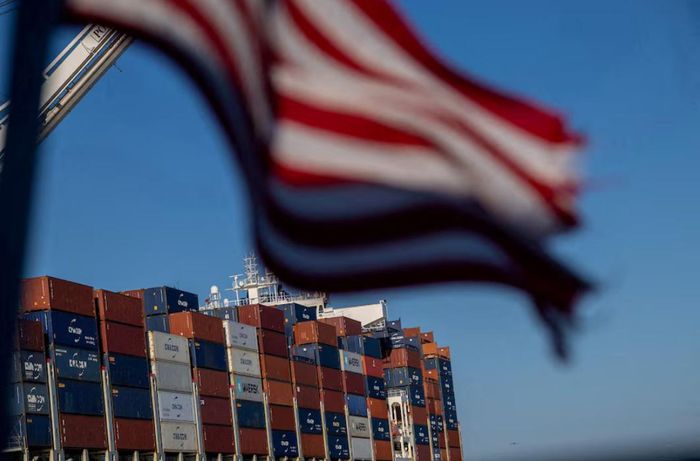
A cargo ship loaded with containers at the Port of Oakland (California, USA), August 4, 2025. Photo: Reuters
On the same day, China opposed the new tariffs imposed by the US on itself and 59 other trading partners, with China facing the highest tariff of 12.5%. Speaking at a press conference on July 24, Chinese Foreign Ministry Spokesperson Lin Jian affirmed that Beijing opposes all forms of unilateral tariffs, emphasizing that tariff wars and trade wars are detrimental to all parties.
For most of 2025, China and the US experienced an escalating trade war but reached an agreement when US President Donald Trump and Chinese President Xi Jinping met in October of that year. After Trump's visit to Beijing in 2026, China said it would cooperate with the US to reduce tariffs, but the latest tariffs threaten to increase trade tensions between the two countries.
Earlier, the US Trade Representative (USTR) announced that from July 24, the US would impose tariffs of 10% to 12.5% on imports from 60 trading partners under Section 301 of the Trade Act of 1974, citing forced labor concerns. This measure replaces the temporary 10% global tariff imposed by Trump, which expired on July 24. The US's largest trading partners, including Canada, Mexico, and China, are among the 60 trading partners facing new tariffs. The UK, Australia, India, and the 27 member states of the European Union (EU) are also affected.
The additional tariffs result from an investigation launched by USTR Jamieson Greer in mid-March to determine whether US trading partners have completely removed products using forced labor from their supply chains. The new tariffs include a range of exemptions, such as fertilizers and certain fuels, two commodities that are currently experiencing sharp price increases due to the Middle East conflict. Some food items, automobiles, metals, and pharmaceuticals are also exempt.
In response to the impact of the new tariffs, many affected countries are seeking ways to respond through negotiations, maintain exempted items, and protect the interests of export businesses. In Southeast Asia, Malaysian Prime Minister Anwar Ibrahim said on July 24 that his country will continue to discuss with the US the new tariffs related to forced labor if the current negotiation results are unsatisfactory. At a press conference in Kuala Lumpur, Ibrahim said the Malaysian government has taken note of the latest US tariff announcement and will continue to negotiate to ensure national interests.
Meanwhile, some countries said the US's new tariff move does not cause significant disruption compared to the previous expired tariffs. Despite opposing forced labor allegations, the Swiss government noted that the US is complying with its previous commitment to Switzerland regarding a maximum tariff cap of 12.5%. The UK also noted that the new tariff move would not have a negative impact. "The agreement between the UK and the US remains in place," a UK government spokesperson said.
The US president has long viewed tariffs as a tool to both increase budget revenue and create leverage in trade negotiations, despite criticism that this policy raises import costs and prices for US consumers. According to analysts, the latest developments signal that Washington's tariff war will continue, and the next steps of the Trump administration could change the global trade landscape.
Vietnam strictly prohibits all forms of forced labor
On July 25, responding to a reporter's request for Vietnam's reaction to the USTR's new 12.5% tariff on goods from all economies "investigated" under Section 301, Vietnamese Foreign Ministry Spokesperson Pham Thu Hang stated:
The USTR's decision does not fully reflect the reality and Vietnam's efforts in preventing, reducing, and eliminating forced labor, including the ban on importing products made with forced labor.
Vietnam strictly prohibits all forms of forced labor and seriously complies with the regulations of the International Labor Organization (ILO), international treaties, and free trade agreements to which Vietnam is a party. On July 22, 2026, the Government issued Decree No. 292/2026/ND-CP, which prohibits the import of goods extracted, produced, or manufactured wholly or partly through forced labor.
Vietnam will continue to exchange and work with the US in a constructive and cooperative spirit, requesting the US to fully assess the measures Vietnam has implemented to adjust the tariff rate on Vietnamese goods in line with reality and Vietnam's law-building and enforcement efforts.
DOAN CA
BAO CHAU


