
Electricity, Drones, Sensors – The Future of Cherry Cultivation
05.07.2026, 04:03 Uhr
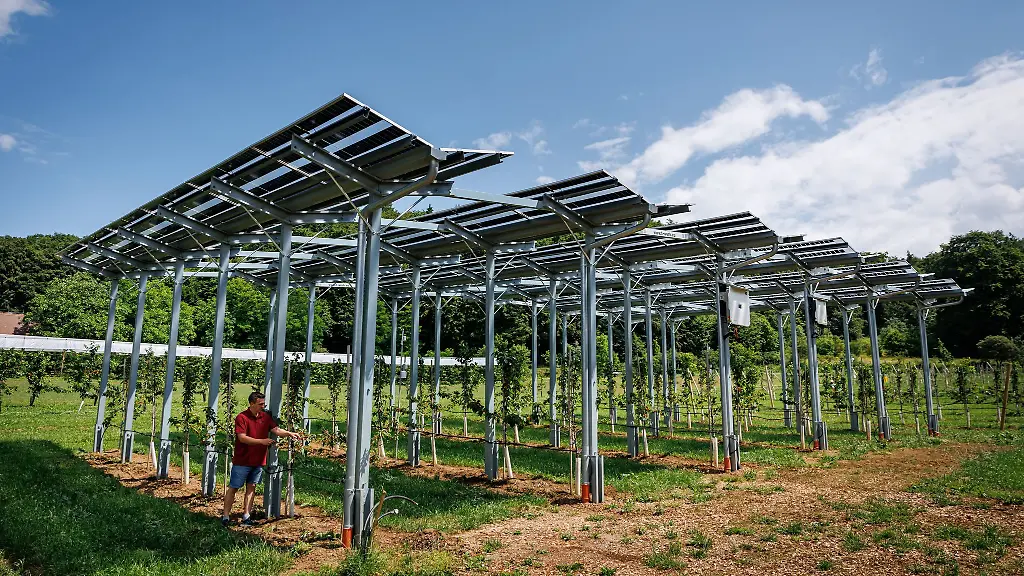
Cherry cultivation shapes the Franconian Switzerland region. And it is a complex business for growers with many uncertainties. Could electricity production help the industry in the future?
Hiltpoltstein (dpa/lby) - The cherry harvest in Franconian Switzerland is underway – but at the same time, the focus is also on the future. Because growing the red fruits is a delicate undertaking: one frosty night in spring or a hailstorm in June can ruin the entire harvest. Added to this are succession concerns among farms, rising cost pressure, and competition from abroad. How the future of cherry cultivation could look is what the Fruit Information Center of the Forchheim district wants to find out. And recently built an agri-photovoltaic system over the cherry trees.
Currently, the electricity from the system is sufficient to cover the energy needs of the facility with its training rooms and offices, as Jonas Maußner, head of the Fruit Information Center, said. The Y-shape of the system is striking: rainwater flows into a channel and from there into the water reservoir. The water collected there is then used to irrigate the trees.
These Are the Advantages of the Solar Modules
The photovoltaic panels are installed at a height of four meters, and the trees beneath them are expected to grow up to 3.50 meters tall. Additionally, heat build-up under the system is avoided, Maußner further explained.
The experimental system is currently testing what percentage of light permeability is optimal for the growth of trees and fruit. Measurements are being taken directly at the plant. Advantages of the system: heavy rain or even hail does not hit leaves and fruit. Too much solar radiation and thus sunburn on the cherries is also prevented. And at the same time, electricity is generated without sealing cultivation areas.
This Is How Irrigation Works Without Drinking Water
Due to increasingly longer dry periods, artificial irrigation of fruit tree stands is also an ever more pressing issue, Maußner said.
The modern irrigation of the experimental system brings collected rainwater directly to the trees – so even in the current dry phase, it is not necessary to resort to drinking water.
Of course, a normal farm, possibly run as a sideline, flinches at the cost of such a system. "We want to show what is technically possible here," said Maußner. "Of course, we show the maximum."
Each farm can get information at the experimental system. Then one must see which solution fits individually. Basically, as the expert emphasized, water storage and irrigation are "huge topics" and thus important for the future of cherry cultivation in Franconia.
Despite all adversities and problems, he firmly believes that the cherry has a future, Maußner assured: "It is part of our cultural landscape." Cultivation is simultaneously modernizing; there are varieties with a later flowering time so that the blossoms are not destroyed by late frosts.
How Drones Could Help
Another future scenario is the increased use of drones: By flying over the trees, pests could be detected earlier – and possible control agents could be used only precisely where they are needed. Fruit sizes, leaf condition, and many other details could also be quickly captured by drones.
Franconian Switzerland is known for cherry cultivation: The region in the triangle of cities Bayreuth-Nuremberg-Forchheim is considered one of the largest contiguous cherry-growing areas in Europe with around 250,000 cherry trees on 25 square kilometers. Another cultivation focus in Bavaria is in Lower Franconia.
Source: dpa


