
Homes near pylons to get £250 a year off energy bills – first sites revealed
10 minutes ago
Share
Save
Calum Watson
BBC Scotland
 PA Media
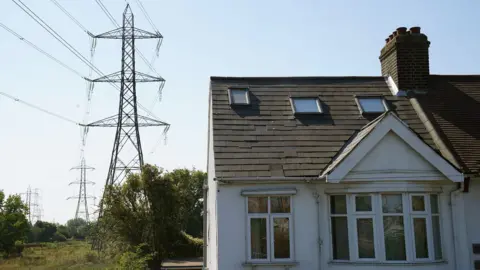
Households living within 1600ft of upgraded pylons will be eligible for the discount
The first locations where households living close to new upgraded electricity pylons and substations will receive a £250 annual discount on their bills have been revealed.
Customers living within 1,600ft (500m) of 43 transmission projects across Britain will be eligible for the payments for up to 10 years under the bill discount scheme, sometimes dubbed "pounds for pylons".
UK ministers say replacing and upgrading decades-old infrastructure is vital for distributing renewable power and improving energy security.
Critics, however, argue the discounts are meagre compensation for the impact on their homes, neighbourhoods, and the environment.
About two-thirds of the projects are in Scotland, to support the fast-growing wind energy sector.
But major upgrades are also planned across Britain, including areas north of London, as well as East Anglia, the Midlands, and North Wales.
| Country | Project | Description |
|---|---|---|
| England | North London Reinforcement | Upgrading overhead lines between Waltham Cross and Tottenham |
| England | Bramford to Twinstead Tee | New lines and cables between Suffolk and Essex |
| England | Norwich to Tilbury | A new network of pylons and cables between Suffolk and Essex |
| England | Grimsby to Walpole | An overhead line between Lincolnshire and Norfolk |
| England | North Humber to High Marnham | New lines between East Yorkshire and Nottinghamshire |
| England | Chesterfield to Willington | Overhead lines and substations across Derbyshire |
| England | Brinsworth to High Marnham | Upgrades to existing overhead lines across Derbyshire |
| Wales | Pentir to Trawsfynydd | New cables and upgrades to the network in north‑west Wales |
| England | Eastern Green Link 3 | A converter station in the Walpole area of Norfolk |
| England | Eastern Green Link 4 | A converter station in the Walpole area of Norfolk |
UK Energy Minister Michael Shanks told BBC Radio Scotland Breakfast the UK's power infrastructure had undergone decades of "woeful underinvestment".
He said he understood the objections of those living nearby, but added the pylons were "crucial" to ensure the National Grid maintained future resilience.
"I totally accept that people might not like that, but it is critical national infrastructure and it has to be built somewhere," he said.
"Building any kind of infrastructure in these communities does cause disruption. But that doesn't mean we shouldn't build any kind of infrastructure and I'm afraid in this country, for too long, we have taken that view, and the result is that we have been held back by not having the infrastructure the country needs."
Shanks added: "Either we go through decades of not upgrading the grid and take the risk that the grid will actually fail, but we also lose the opportunity of cheaper bills, homegrown power connecting.
"We're not prepared to take that risk."
The Department for Energy Security and Net Zero says Britain's electricity grid was largely designed for an era when power came from coal and gas-fired power stations, and now needs major upgrades to cope with growing amounts of renewable energy.
Ministers say the lack of capacity means some wind farms are sometimes paid to switch off because there is not enough network infrastructure available to carry the electricity to homes and businesses that need it.
Greg Jackson, chief executive of the UK's biggest domestic energy supplier, Octopus Energy, said the electricity system is inefficient, brittle and expensive.
He told BBC Radio 4's Today programme the discount scheme was a "positive first step", adding that last year the UK spent more than £1bn paying wind farms to turn off on windy days.
"We should just be giving that electricity more cheaply to the people and businesses who live in the areas where we're generating it," he said.
"By doing that, you'd be able to stop wasting that money and instead put the electricity to use cutting bills for those people. But crucially cutting bills for everybody else as well because it's less wasteful."
 SSEN Transmission
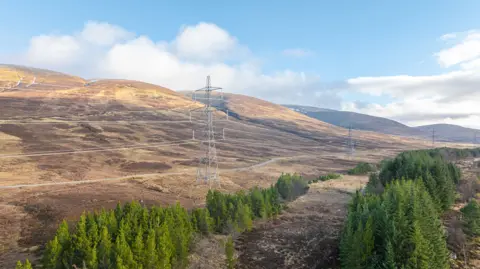
The Beauly to Denny power line from the Highlands to central Scotland has already been upgraded and became operational in 2015
Approximately 80p a year will be added to all energy bills to fund the discount scheme.
Most households that qualify will receive the discount automatically on their electricity bill every six months although some, such as those on commercial meters, may need to apply.
The first payments will start early next year, when eligible customers will receive more information from their supplier or the energy regulator Ofgem.
An assessment earlier this year estimated that between 120,000 and 160,000 households could eventually receive the discounts as more projects are rolled out.
Rural campaign groups argue it is impossible to put a price on the loss of landscapes, and some residents living close to proposed projects say the money being offered is an insult.
Kate Matthews of the Save Our Mearns campaign group, fighting plans for upgraded pylons in north-east Scotland including the Kintore to Tealing project, said the discount scheme was an insult.
She said: "£2,500 off electricity bills over 10 years is a slap in the face for residents facing ruined businesses and unsellable homes.
"This government is either massively out of touch or is showing their contempt for affected residents and energy consumers."
Matthews said the plans had already caused "mental anguish" for residents who now faced a decade of development that would lead to noise, road closures, and heavy traffic.
"Then a lifetime of pylons impacting on their environment, agriculture, tourism, property values, physical and visual amenity to name a few," she added.
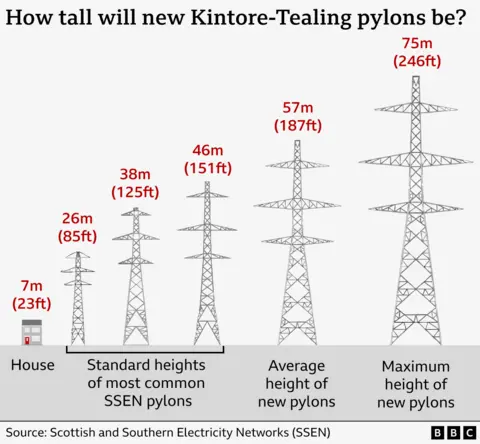
The size of the pylons will vary depending on location and purpose, but in north east Scotland some the proposed latticed structures are about 187ft (57m) tall.
They would be similar in appearance to the already upgraded line running from Beauly to Denny where the pylons range from 138ft (42m) to 213ft (65m).
Many of projects involve a mix of underground and pylon supported cables, as well as sub-stations, converter stations, and equipment used in electricity transmission.
Campaigners have called for greater sections of the network to be "undergrounded".
But National Grid and transmission companies argue this would be significantly more expensive and make it harder to carry out repairs.
Why more pylons could be heading your way
Battle lines drawn over 'monstrous' pylons and solar farm 'wastelands'
Bills to rise by 80p to fund discounts for homes near pylons


