Key races to watch for the Aug. 11 primaries: Live results maps for elections in 6 states
Voters in six states will cast their ballots Tuesday, Aug. 11 for their preferred candidates in primaries and special elections ahead of Election Day in November.
Credit: AP
"I Voted" stickers rest on a ballot box at a polling place
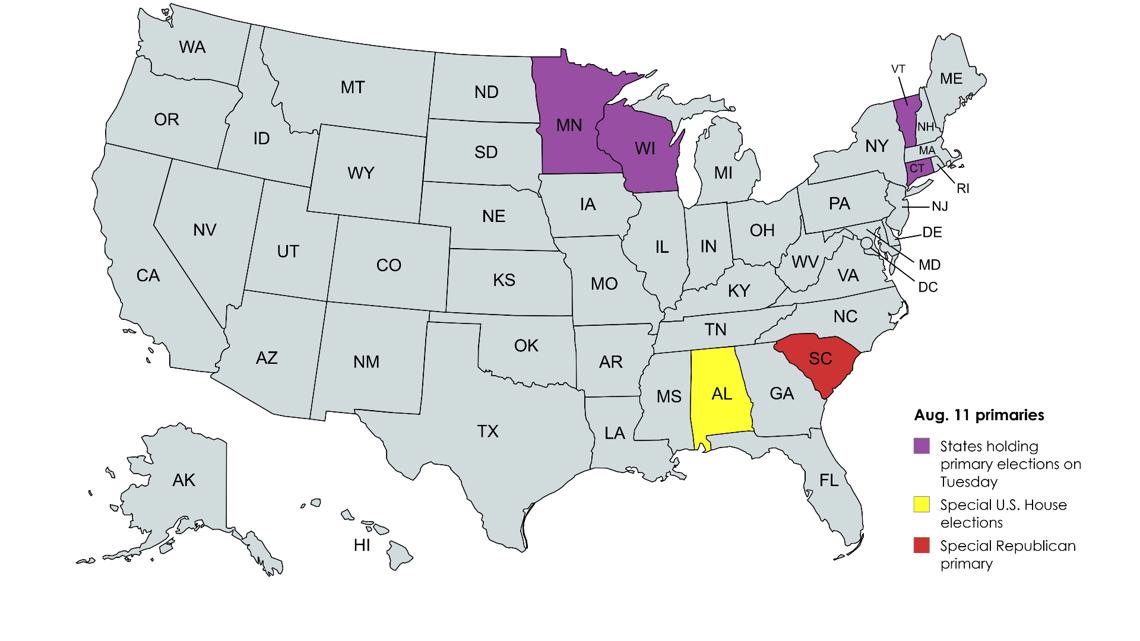
WASHINGTON — Polls opened in six states Tuesday, Aug. 11, with voters in Alabama, Connecticut, Minnesota, South Carolina, Vermont and Wisconsin selecting their preferred candidates ahead of the general election in November.
Voters in South Carolina will decide which Republican candidate they want for U.S. Senate following the death of incumbent Sen. Lindsey Graham in July.
In Alabama, polls opened for a special primary after a U.S. House redistricting delay.
If you can't see any of the maps below, click here. Refresh often for the latest numbers. The Associated Press compiles these results.
Credit: Created using MapChart.
Tuesday's elections.
Alabama
Voters in Alabama will go to the polls Tuesday to vote in a special primary election for four of the state's seven U.S. House districts.
Primaries for all seven congressional districts were originally scheduled for May 19, but Republican Gov. Kay Ivey postponed the contests for the 1st, 2nd, 6th and 7th Congressional Districts.
Republicans are aiming to flip Alabama’s 2nd Congressional District, which was redrawn after a U.S. Supreme Court decision this year weakened the Voting Rights Act. It's one of several Democratic-leaning districts across the South that were reshaped to favor Republicans.
In April, the Supreme Court struck down a majority-Black district in Louisiana as an unconstitutional gerrymander that relied too heavily on race. Alabama Republicans, like those in other Southern states, seized on the decision.
Seeking to implement a map previously drawn by the Legislature, lawmakers approved legislation to nullify the results of ongoing primaries and instead authorize Tuesday's special primary elections. The Supreme Court in June granted Alabama permission to switch maps.
The results of the race could help determine the balance of power in the House as Republicans try to hold on to a slim majority in November's midterms. Both parties have put the district on their priority list.
U.S. Rep. Shomari Figures, the Democratic incumbent for the 2nd District, is seeking a second term. Six Republicans are competing to challenge Figures, who is unopposed.
Alabama has open primaries, meaning voters will be allowed to select either a Republican or Democratic ballot at their polling location.
There will be no runoff in the election, meaning the candidate who gets the most votes Tuesday will be the nominee.
Polls close at 7 p.m. Central Time.
Connecticut
Voters in Connecticut will have the opportunity to select their preferred candidates for U.S. House, governor, lieutenant governor, attorney general and secretary of state, among other roles.
Connecticut operates closed primaries, meaning only voters affiliated with the party may vote in a party's primary.
Voting ends at 8 p.m. Eastern Time in Connecticut.
U.S. House:
Connecticut has five U.S. House seats. All five seats are currently filled by Democrats, and all are running for reelection.
Among the state delegation, only Rep. John Larson of the 1st Congressional District is facing a competitive primary.
Governor:
Incumbent Gov. Ned Lamont has led the Nutmeg State since 2019 and is running for reelection for a third term and seeking the Democratic nomination. He is running against Democratic state Rep. Josh Elliott from Hamden, who has rallied support from a handful of other state lawmakers who have accused Lamont of being too moderate.
Ryan Fazio, a Republican state senator from Greenwich, has secured the GOP nomination for governor and is the presumptive nominee.
Minnesota
There are several competitive races in Minnesota, where voters on Tuesday will decide on their preferred candidates for U.S. Senate, U.S. House, governor, lieutenant governor, attorney general and secretary of state, among other roles.
Any registered voter may participate in any party's primary.
Polls close at 8 p.m. Central Time.
U.S. Senate:
The race for an open U.S. Senate seat has led to a highly competitive primary, with multiple candidates from both parties vying for a chance to get on the November ballot.
Sen. Tina Smith, a Democrat, opted not to seek reelection. Candidates seeking the Democratic nomination follow a trend this primary season, where moderates and progressives face off at the polls. U.S. Rep. Angie Craig and Lt. Gov. Peggy Flanagan have emerged as party frontrunners. Smith has endorsed Flanagan as her successor, but the race could be close.
U.S. House:
Because Rep. Craig threw her hat into the race for U.S. Senate, it leaves her 2nd Congressional District seat open in the November election. The vacancy has spawned a six-way Democratic primary race. The winner will face Republican state Sen. Eric Pratt in November. Pratt is unopposed in the nomination.
Craig is the only U.S. House member in Minnesota who is not seeking reelection in the state's eight districts.
Governor:
Gov. Tim Walz, a Democrat, is not seeking reelection. His decision to retire comes amid a tumultuous political season in the state.
In the race for governor, U.S. Sen. Amy Klobuchar faces minimal opposition for the Democratic nomination.
The nine-candidate Republican field includes state House Speaker Lisa Demuth, MyPillow founder and prominent 2020 election denier Mike Lindell and healthcare executive Kendall Qualls. President Donald Trump has endorsed Lindell.
South Carolina
A special election is being held in South Carolina to replace the late Sen. Lindsey Graham on the November ballot. Graham won the Republican primary in June and was seeking reelection for a fifth term when he died at age 71 on July 11. Graham had served in the U.S. Senate since 2003.
The winner of the race will become the party’s nominee in November and will face off against Democrat Annie Andrews, a pediatrician from Charleston.
Among the crowded field of about a dozen Republican candidates is Sen. Darline Graham, the 62-year-old younger sister of Lindsey Graham, who was sworn in as the late senator’s replacement days after his death. Regardless of the outcome of Tuesday’s election, Darline will serve out the remainder of Lindsey's fourth term until January.
Darline has rallied mainstream Republican support around her candidacy, including an endorsement from President Donald Trump.
Other candidates include two current U.S. House members, Ralph Norman and Russell Fry, and former Gov. Mark Sanford, who served two terms from 2003 to 2011. Mark Lynch, whom Graham defeated in the initial primary back in June, is also on the ballot.
Norman, who finished third in the June primary for governor, was among several candidates using the special primary as another opportunity to seek statewide office.
Only voters who participated in the June Republican Primary or who did not vote in the Democratic Primary can participate in Tuesday’s special election.
Polls close for the special primary election at 7 p.m. Eastern Time.
Vermont
Voters in Vermont will decide on their preferred candidates for U.S. House, governor, lieutenant governor, attorney general and secretary of state, among other races.
Democrats in the gubernatorial race will try once again to defeat Republican Gov. Phil Scott in November after five failed attempts. Vermont does not have term limits for the office of governor, and each term length is two years.
In 2024, Scott received 74% of the vote in his reelection bid. That's up from the 69% of the vote he won in 2022.
Scott is one of only two Republican governors to serve a state that then-Vice President Kamala Harris carried in the 2024 election. He’s also been a rare Republican critic of President Donald Trump.
Two Democratic challengers are at the forefront of that battle to unseat him: economist Amanda Janoo and former child advocacy organization CEO Aly Richards.
Voters will also select a Republican nominee to challenge Democratic U.S. Rep. Becca Balint in November.
Vermont does not register voters by party, and any registered voter can participate in any party's primary on Tuesday.
Polls close at 7 p.m. Eastern Time.
Wisconsin
Primary election voters in Wisconsin will have the opportunity to select their preferred candidates for U.S. House, governor, lieutenant governor, attorney general and secretary of state, among other positions.
Wisconsin has an open primary system, meaning that unaffiliated voters are able to vote for their preferred candidate by requesting either a Republican or Democratic ballot.
Polls close in Wisconsin at 8 p.m. Central Time.
Governor:
With Democratic Gov. Tony Evers declining to seek reelection, four Democrats will appear on the ballot on Tuesday.
Among the candidates are former state government official Joel Brennan, Milwaukee County Executive David Crowley, State Assemblymember Francesca Hong from Madison and state Sen. Kelda Roys also from Madison.
The competition between Crowley and Hong could set up a staging ground for another battle between the Democratic establishment and the progressive wing of the party, with Crowley securing Evers' endorsement in the race.
Meanwhile, Hong, who has been endorsed by some national progressive figures like Rep. Ilhan Omar of Minnesota and Rep. Ro Khanna of California, has been leading in polls conducted by Marquette University.
Rep. Tom Tiffany, whose 7th Congressional District includes most of the state’s northern borders with Michigan, Minnesota and Lake Superior, has secured Trump’s endorsement in the Republican primary. Andy Manske, a medical service technician from Milwaukee, is Tiffany’s only opponent.
Considered a swing state in national elections, Wisconsin has also seen its share of party switching for governor. Before Tony Evers swore into office in 2019, the state had been governed by Republican Scott Walker.
Wisconsin has eight congressional districts. Six of those seats are held by Republicans, and two are held by Democrats. All eight seats will be decided in November, and seven incumbents are running. Tiffany is the only incumbent not running for reelection.
Among these campaigns, only the two Democratic incumbents have yet to secure their party’s nomination ahead of Tuesday’s primary elections.
The Associated Press contributed to this report.