
For many years, Vietnam's shipbuilding industry was primarily viewed as a traditional heavy industry, linked to mechanics, metallurgy, and maritime transport. However, entering the 2020s, the world is witnessing a fundamental change in the industry's status. Shipbuilding is no longer just the production of ships, but has become a strategic component in industrial competition, logistics supply chain security, green transition, and national maritime economic power.
New growth cycle of the global shipbuilding industry
About 80-90% of global trade volume is transported by sea. This means the world fleet is the "circulatory system" of the global economy. A country that controls maritime transport capacity and shipbuilding industry will have a special advantage in international trade, logistics, energy, and economic security.
In this context, the global shipbuilding industry is entering its largest new growth cycle in many years, driven by three historical forces: Green transition and carbon emission reduction; global supply chain restructuring; and modernization and digitalization of the world fleet.
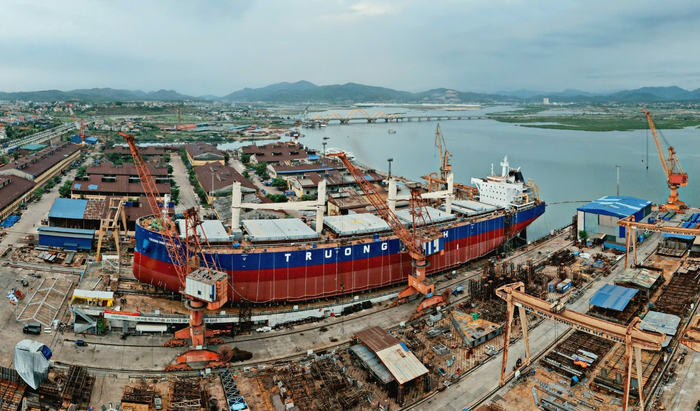
Building new ships at Ha Long Shipbuilding Company under the Vietnam Shipbuilding Industry Corporation (SBIC).
After a prolonged decline due to the global financial crisis, the Covid-19 pandemic, and international trade downturn, the shipbuilding industry is entering a new recovery cycle.
According to research by Clarksons Research (the world's largest maritime research organization), global newbuilding orders have increased sharply in recent years, especially in segments and ship types such as container ships, LNG carriers, car carriers, clean fuel ships, and offshore energy support vessels. The main drivers of this new ordering wave are the need to replace aging fleets, strong maritime trade growth, and emission reduction requirements by the International Maritime Organization (IMO). The current world fleet has a large proportion of ships aged 15-20 years. With increasingly stringent environmental standards, many old ships will no longer be economically viable to operate. This creates huge demand for newbuildings over the next 10-20 years, presenting opportunities for the global shipbuilding industry, including Vietnam.
"Greenification" of maritime transport will transform the entire shipbuilding industry
This is the most important trend in global maritime. The IMO has set targets: drastically reduce greenhouse gas emissions by 2030; aim for net-zero emissions around 2050. This creates a technological revolution in the global shipbuilding industry, with prominent technology trends for vessels using energy sources: LNG, methanol, ammonia, hydrogen, electric hybrid, fuel cell technology, energy-saving systems, and carbon capture technology. The country that masters green ship technology will control the future shipbuilding market, gain advantages in technical standards, and dominate the new global maritime energy supply chain.
Additionally, digital transformation and artificial intelligence (AI) are restructuring the shipbuilding industry. According to data from reputable maritime research organizations, the modern shipbuilding industry is rapidly changing under the influence of AI, big data, autonomous robots, the Industrial Internet of Things (IIoT), digital twins, and digital design. This changes the nature of competition in the industry: from cheap labor to high-tech capability, with the technology gap widening, making it very difficult for "latecomer" countries to catch up without a breakthrough strategy.
Vietnam faces the biggest strategic opportunity in decades
Vietnam has many advantages due to its location on one of the world's most important sea routes. World Bank statistics show that about 90% of Vietnam's international trade is transported by sea. Additionally, its favorable geographical location with a long coastline, large exclusive economic zone, rapidly developing port system, proximity to the East Asian supply chain, and a young, competitive labor force.
Vietnam has many advantages for developing the shipbuilding industry.
The shipbuilding industry holds special significance for Vietnam's economy. It is an industry with a very high spillover effect. Promoting the shipbuilding industry will drive other auxiliary industries and key heavy industries such as metallurgy, mechanics, electrical-electronics, materials, logistics, digital technology, technical training, ports, and defense industry.
According to many international studies, each direct job in shipbuilding can create about 20 indirect jobs in the supply chain. Particularly, as Vietnam aims for double-digit GDP growth and strives to reduce logistics costs, developing the maritime economy under Resolution No. 36-NQ/TW on Vietnam's Sustainable Maritime Economy Development Strategy to 2030, with a vision to 2045, and industrialization and modernization, shipbuilding could become a "leading industry."
Difficulties and challenges Vietnam will face
First, the technology gap is very large compared to developed countries. This is the biggest challenge, as Vietnam currently mainly builds medium-sized ships, depends on foreign technology and imported equipment. Without strong investment in R&D and technology development, Vietnam will be stuck in the "trap" of low-value segments.
Second, the supporting industry is weak. Due to weak capacity in mastering technology and supporting industries, which have not been prioritized for investment over many years, many core equipment items must still be imported, such as engines, electrical equipment, automation, specialized materials, and control systems, leading to high costs, supply chain dependence, and reduced competitiveness.
Third, lack of financial resources. Shipbuilding requires large capital, long cycles, and high risks. Enterprises find it difficult to access long-term capital, face high interest rates, and lack international guarantee tools. This is a "strategic bottleneck" for development. Shipbuilding enterprises urgently need support in preferential credit, state guarantees, specialized banks, and export support funds.
Shipbuilding workers at Bach Dang Shipbuilding Company.
Fourth, challenges in human resources. Vietnam needs a high-quality workforce including AI engineers, new energy engineers, materials experts, automation engineers, and digital industrial managers. However, this workforce is currently in short supply.
Fifth, international competitive pressure will intensify. Forecasts indicate that competition in the shipbuilding industry will not decrease but increase over the next 10-20 years. All countries view this as a strategic industry. If Vietnam does not have a clear strategy, the risk of falling behind is very high.
Shipbuilding industry as a national strategic foundational industry
Conclusion No. 18-KL/TW of 2026 from the 2nd Conference of the 14th Central Party Executive Committee further strongly affirms the role of the shipbuilding industry by identifying it as a "national foundational industry."
This is not just an industry that produces ships, but an entire shipbuilding industrial ecosystem with a high spillover effect on the economy of a maritime nation like Vietnam. Shipbuilding is the "mother" of many other industries. A strong shipbuilding industry will drive metallurgy, precision mechanics, industrial electronics, digital technology, logistics, defense industry, and high-tech training, while promoting maritime economic development, contributing to maritime sovereignty protection, energy security, and national industrial capacity. Therefore, the Government needs to build a long-term national strategy to 2045-2050 for developing the shipbuilding industry, concretizing Conclusion No. 18-KL/TW.
An appropriate strategy for Vietnam is to select market segments that are specific, suitable for the country's technological level, production capacity, and geo-economic advantages. In the coming period, Vietnam should focus on developing medium-sized vessels, specialized ships, service ships for offshore wind power, engineering vessels, coastal transport ships, and regional green ships, while also strongly developing ship repair, conversion, and upgrading according to IMO's new emission reduction standards. These are segments with rapidly growing demand in the Asia-Pacific region, with technical requirements more aligned with Vietnam's current capabilities, and capable of creating high added value and promoting the formation of a domestic maritime industrial ecosystem.
Developing supporting industry is a survival condition
A supporting industry development policy is needed and considered a survival condition, meaning the shipbuilding industry cannot develop sustainably, increase added value, and compete internationally without building a domestic supply ecosystem for materials, equipment, and technical services serving shipbuilding. Specifically, this includes: high-quality shipbuilding steel; marine engines; electrical and automation systems; maritime equipment; specialized paints; anti-corrosion materials; navigation equipment; life-saving equipment; HVAC systems; marine cables; valves; pumps; pipes; ship interiors; design software; technical services; logistics; and inspection. Without increasing localization rates, Vietnam will remain in an assembly position.
Launching a 45,000-ton bulk carrier at Ha Long Shipbuilding Company.
As the global shipbuilding industry rapidly shifts toward an "intelligent maritime industry" model, investment in technology and innovation will become a decisive factor in the competitiveness of Vietnam's shipbuilding industry in the coming period. Vietnam needs to focus on building modern ship design centers, R&D centers for green ships, new fuels, and smart maritime technology; and promote the formation of smart shipyards applying robots, digital twins, big data, and real-time production management.
Development experience from leading shipbuilding countries shows that no major shipbuilding nation has developed solely based on pure market mechanisms. Instead, the state's enabling role through industrial policies, financial support, long-term credit, export guarantees, and promotion of technological innovation has always been decisive in forming national competitiveness in shipbuilding. This industry has characteristics of very large capital investment, long production cycles, high market risks, and strong impact from global trade fluctuations. Without strategic support mechanisms, enterprises find it very difficult to maintain international competitiveness.
In this context, Vietnam needs to study and issue strong reform policies on industrial institutions and finance to create a long-term development foundation for the shipbuilding industry. The focus is on building an industrial credit mechanism suitable for the industry's characteristics, including providing medium- and long-term credit at competitive interest rates; establishing credit guarantee and export guarantee funds for shipbuilding contracts; studying and applying preferential tax policies for supporting industry products, green ships, and technological innovation activities. At the same time, it is necessary to promote the formation of maritime industrial clusters and shipbuilding clusters under a modern model, linking shipyards, supporting industry enterprises, logistics, ports, research institutes, and training institutions.
The global shipbuilding industry is entering its most profound transformation period in decades under the impact of green transition, digital transformation, and global supply chain restructuring. This is a particularly important historical opportunity for Vietnam to make a breakthrough in maritime industrial development and enhance national industrial capacity. If it seizes the opportunity well, Vietnam can not only become an important shipbuilding center in Southeast Asia but also contribute to reducing logistics costs, promoting the maritime economy, creating high-quality technical jobs, and forming a modern industrial ecosystem to serve rapid and sustainable growth goals.
DR. PHAM HOAI CHUNG, Vice Chairman of the Vietnam Shipbuilding Science and Technology Association (VISIA), former Deputy Director of the Institute for Transport Development Strategy


