
MIT Uses AI to Challenge a Century-Old Process for Mass Ammonia Production
By Alex Kimani - Aug 26, 2026, 6:00 PM CDT
- Ammonia production consumes up to 2% of global energy and generates around 1.5% of emissions, largely because conventional Haber-Bosch production relies heavily on fossil fuels.
- MIT researchers are using AI and quantum-mechanical modeling to identify metal-nitride catalysts that could dramatically reduce the energy required for electrochemical ammonia production.
- The technology remains theoretical and Haber-Bosch still dominates, but AI could dramatically accelerate the search for catalysts capable of making low-carbon ammonia commercially competitive.
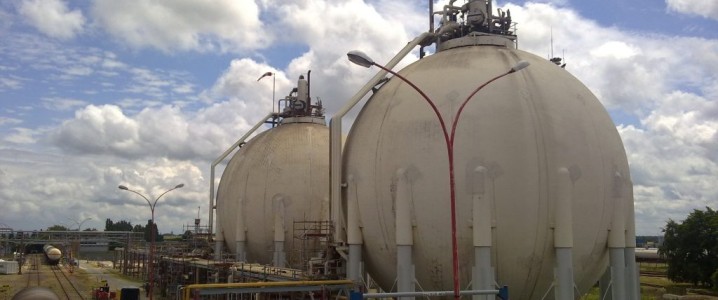
Ammonia production consumes as much as 2% of the world's energy and generates roughly 1.5% of global greenhouse gas emissions, largely because the industry still relies on a century-old process powered by fossil fuels. Roughly 80% of the 200 million metric tons of ammonia produced globally every year goes into nitrogen fertilizers, with the rest used in plastics, textiles, explosives and other industrial chemicals.Researchers at the Massachusetts Institute of Technology (MIT) have now developed a new method that uses AI and quantum-mechanical calculations to identify the catalyst combinations most likely to cut the energy required to produce ammonia electrochemically.
Instead of synthesizing and testing thousands of alloys one by one, the researchers can use AI to predict which combinations are most likely to lower the energy needed to make ammonia.
Electrochemical ammonia synthesis has been studied for decades as an alternative to the traditional Haber-Bosch process. Electrochemical synthesis replaces the fossil-fuel-derived hydrogen and extreme temperatures and pressures used by Haber-Bosch with electricity, water and nitrogen. If that electricity comes from low-carbon sources, ammonia can be produced without natural gas or coal as a feedstock.
But efficiency is still an issue.
Electrochemical ammonia production remains too slow and inefficient to compete with Haber-Bosch at industrial scale, with much of the difficulty caused by nitrogen. The two atoms in a nitrogen molecule are held together by an extremely strong triple bond that requires high levels of energy to break before the nitrogen can react to form ammonia, according to the researchers.
Related: Natural Gas, Not Oil, Is Key Inflation Concern in Europe
MIT is focusing on metal nitride catalysts because their own nitrogen can participate in ammonia production, reducing some of the energy needed to break apart nitrogen molecules from the air.
Finding the right material is yet another complication.
There are potentially millions of alloy combinations, making it impractical to manufacture and test each one. Led by researcher Constantine Athanitis, the MIT team used quantum-mechanical calculations to determine which microscopic properties control different stages of the reaction, then trained machine-learning models to predict which alloys could overcome bottlenecks including nitrogen dissociation and hydrogen transfer.
“ If we can somehow find a catalyst that reduces the energy needed and is more selective for ammonia production,” Athanitis said, “ then we could essentially hit the jackpot.”
But no single catalyst solves every problem. Some materials are better at breaking nitrogen apart, while others handle the hydrogen reactions more efficiently. MIT is using AI to find alloys that can do both well enough to make the overall process more efficient.
“ Metal nitride compounds make an ideal material system for this reaction and for identifying the electronic, chemical, and structural properties that determine reactivity in nitrogen reduction and ammonia electrosynthesis,” said Bilge Yildiz, professor of Nuclear Science and Engineering and Materials Science and Engineering at MIT.
For now, this is all theoretical. The catalysts identified by the models still have to be manufactured and tested in an operating electrochemical cell, and MIT researchers are now preparing experiments to determine whether the predicted performance survives outside the computer models.
Haber-Bosch, as such, maintains the advantage–for now.
But conventional ammonia production generates hundreds of millions of metric tons of CO2 every year and ranks among the world’s most energy-intensive chemical processes. Electrochemical production could eliminate much of that fossil-fuel use, but production rates and efficiency still have a long way to go before they can challenge Haber-Bosch.
MIT has not solved those problems. What it has done is use AI to narrow the hunt for catalysts that could, replacing the slow process of synthesizing and testing thousands of alloys one by one.
By Alex Kimani for Oilprice.com
More Top Reads From Oilprice.com
- Treasury Expands Iran Sanctions Without Targeting Major Chinese Banks
- Europe Dodges a Rhine Crisis for the Worst Possible Reason
- CNOOC Posts Record Profit as China Pumps More Oil at Home
Download The Free Oilprice App Today


ADVERTISEMENT
Set us as your preferred Google source
FACEBOOK Twitter LINKEDIN REDDIT PRINT
Previous Post\ \ Equinor Targets 27% International Production Growth by 2030

Alex Kimani
Alex Kimani is a veteran finance writer, investor, engineer and researcher for Safehaven.com.
Related posts
Octopus Boss Warns UK Is Too Exposed to Global Gas Prices Aramco Finds a New Way to Keep Saudi Crude Flowing to China Equinor Targets 27% International Production Growth by 2030
Leave a comment
First Name
Last Name
That email address is already in the database. Please login to your account to post your comment, or enter a different email address to continue with your comment & account creation.
Captcha
Comment
Please understand that, by submitting this form, you will be creating a free OilPrice.com account, and therefore agree to abide by our Terms of Use. Your details will be stored in our database and shared with our third party mailing list provider. You will be sent an email containing a link that will ask you to generate a new password - please follow the link to complete your OilPrice account activation.
We will save the information entered above in our website. Your comment will then await moderation from one of our team. If approved, your data will then be publically viewable on this article. Please confirm you understand and are happy with this and our privacy policy by ticking this box. You can withdraw your consent, or ask us to give you a copy of the information we have stored, at any time by contacting us.
ADVERTISEMENT
ADVERTISEMENT
Most Popular
 \ \ U.S. Refiners Face New Crude Squeeze as Canada Cuts Oil Sands Output
 \ \ Oil Prices Fall as Iran Negotiation Hopes Return
  \ \ Hope Fades, Traders Brace for Extended Oil, LNG Squeeze
  \ \ The Biggest Victims Of Trump’s Economic D-Day On Iran
  \ \ Oil Nears $100 as Trump’s ‘Economic D-Day’ Raises the Stakes



By signing up to our newsletter, you agree for your email address to be shared with our third party mail providers.
ADVERTISEMENT
ADVERTISEMENT
EXXON Mobil-0.35
Open57.81Trading Vol.6.96MPrevious Vol.241.7B
BUY 57.15
Sell 57.00


