
Norway's Oil Output Beats Forecasts Again Despite Pullback from April Highs
By Jan-Thore Bergsagel - Jun 24, 2026, 2:00 PM CDT
Crude oil production averaged 1.72 million bpd in May, down from April's high but still 7.2% above official forecasts.
Total petroleum production declined month-on-month, while natural gas output fell to 303 million cubic meters per day, broadly in line with forecasts and reflecting operational and seasonal factors.
Year-to-date petroleum production is 4% higher than in 2025.
Norwegian petroleum production eased in May after April's exceptionally strong performance, but the country's offshore sector continued to outperform expectations. Crude oil production came in 7.2% above official forecasts even as both oil and gas output declined from the previous month, reinforcing Norway's position as one of Europe's most reliable energy suppliers.
Norway produced an average of 1.722 million barrels of crude oil per day in May, according to preliminary figures from the Norwegian Offshore Directorate. While that was down from 1.952 million barrels per day in April, production remained well above official expectations, extending a trend that has characterized much of 2026.
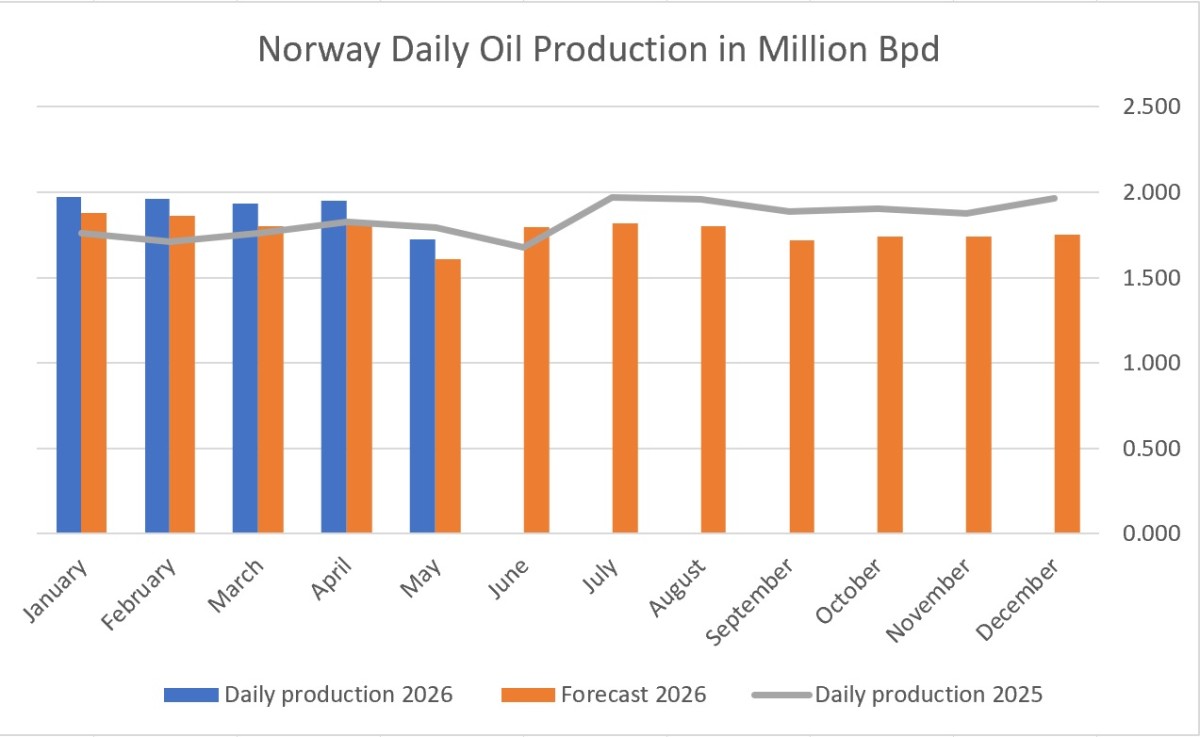
Data source: Norway Petroleum Directorate
Total liquids production, including natural gas liquids and condensate, averaged 1.909 million barrels per day in May, compared with 2.170 million barrels per day the month before. Despite the month-on-month decline, oil production exceeded official forecasts by 7.2%, while total petroleum production came in 2.9% above expectations.
Natural gas production followed a different trajectory. Gas output averaged 303 million cubic meters per day in May, down from 340 million cubic meters per day in April. Unlike crude oil production, however, gas volumes were broadly in line with official forecasts, suggesting the decline primarily reflected operational and seasonal factors rather than weaker field performance.
The latest figures highlight an important distinction in Norway's production profile. While both oil and gas output retreated from April's exceptionally strong levels, oil production continues to consistently outperform expectations, demonstrating the resilience of the Norwegian Continental Shelf even as many mature producing regions around the world struggle with accelerating decline rates. Related: Saudi Arabia’s Decided Who Its Future Superpower Partner Is, And It’s Not the US
Year-to-date production remains firmly ahead of last year. Total petroleum production during the first five months of 2026 reached 102.6 million standard cubic meters of oil equivalent, approximately four percent higher than during the same period in 2025.
The figures arrive at a time when European oil and gas markets are increasingly dependent on stable Norwegian supply. With OPEC+ gradually restoring production and geopolitical tensions continuing to influence global energy markets, Norway remains one of the few major producers consistently delivering volumes above expectations.
Much of that resilience is anchored by world-class assets on the Norwegian Continental Shelf. Johan Sverdrup, Europe's largest producing oil field, remains a cornerstone of Norwegian crude output and continues to help offset natural declines elsewhere on the shelf. On the gas side, the giant Troll field supplies roughly one out of every ten cubic meters of gas consumed in Europe, making it one of the continent's most strategically important sources of energy.
Although May represented a normalization from April's exceptionally strong output, the continued outperformance of oil production against forecasts suggests Norway's offshore sector remains one of the most dependable sources of incremental supply in the global energy market. For Europe, that reliability has become increasingly valuable as policymakers and consumers seek secure long-term energy supplies in an increasingly uncertain geopolitical environment.
By Jan-Thore Bergsagel for Oilprice.com


